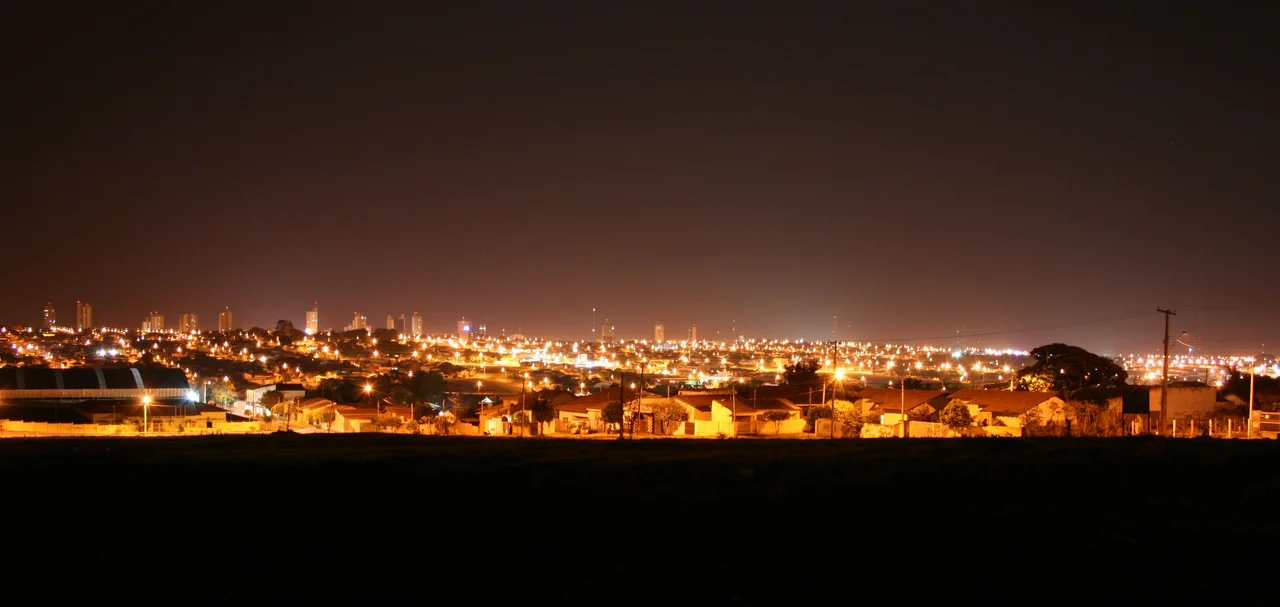

Votuporanga
The most expensive cow ever sold in Brazil came from here. Her name was Ópera. She was a Nelore, a zebu breed developed for Brazilian conditions, and her genetics made her worth more than most people earn in a lifetime. When she died, the Votuporanga region honored her the way a small Brazilian city honors its most famous exports: with streets named in her memory, a shopping center that took her name, and, according to the city's own sources, a brothel that did the same. All of this fits a place whose name in Tupi means 'good winds' or 'soft breezes,' a city that markets itself as the Magnet of Entertainment and does not apologize for it.
The Farm That Became a City
Votuporanga began as collateral. In the early 20th century, the land where the city now stands was part of the Marinheiro de Cima Farm, owned by a coffee baron named Francisco Schmidt. Schmidt ran into debts - common enough among São Paulo plantation owners during the coffee price crashes of the era - and was forced to sell the farm to Theodor Wille, owner of the German-Brazilian trading house Wille, Schmillinski e Cia. Wille subdivided the land into plots and sold them cheap. People came - mostly small farmers, some refugees of earlier failed coffee ventures, a few families from central and northern Europe. The population grew slowly. The settlement, at first part of a district called Vila Monteiro (now Álvares Florence), acquired a name of its own in 1937 when the notary public of nearby Tanabi, Sebastião Almeida de Oliveira, suggested Votuporanga - from the Tupi words votu (air, breeze) and poranga (nice, good). On August 8, 1937, Father Isidoro Cordeiro Paranhos celebrated the founding Mass. In 1945 Votuporanga became a municipality. That same year the Araraquarense Railroad reached the town, linking it to the Port of Santos.
From Coffee to Furniture
Coffee built northwestern São Paulo, but it did not stay. Frost waves, soil exhaustion, and commodity price crashes pushed coffee cultivation south and out of the region over the 20th century. Votuporanga adjusted. In the 1980s, as the regional economy sought new industries, furniture manufacturing took root in the town - small and medium-sized factories producing home furnishings for the Brazilian domestic market. By the present day, the furniture sector employs around 15,000 workers in Votuporanga alone, making the city one of Brazil's significant furniture-production hubs. Agricultural machinery factories, metalworking shops, and haulage-related industries round out the industrial base. The service sector accounts for nearly three quarters of the city's GDP. Population stands at about 140,000, with another 50,000 in the surrounding microregion. The Rodovia Euclides da Cunha, state highway SP-320, paved in the 1970s, connects Votuporanga to São Paulo city 520 kilometers southeast. In 2016, Pope Francis created the Roman Catholic Diocese of Votuporanga, elevating the city's status in church administration.
The Cow Named Ópera
Brazilian cattle breeding takes a seriousness that sometimes surprises outsiders. Champion bulls and cows are evaluated like racehorses - pedigrees scrutinized, conformation measured, offspring tracked across generations. Prize animals can sell for millions of reais. The Votuporanga microregion, situated in the heart of the Brazilian beef belt, has produced some of the country's most valued zebu stock. Ópera, a Nelore cow from this area, became the most expensive cow ever sold in Brazil - the exact price has been reported variously in millions of reais. When she died, her legacy did not. The streets of Votuporanga that carry her name are ordinary residential streets, marked on blue signs. The Shopping Ópera is a mid-size mall that anchors one of the commercial districts. These tributes reflect a cultural pride particular to rural Brazilian towns - the idea that a great cow is a genuine civic achievement, worthy of honor the way a great athlete or author might be elsewhere. It is easy to joke about. It is also earnest.
City of Soft Breezes
Votuporanga's self-promotion leans into the name. The city brands itself the City of Soft Breezes, and its tourism motto translates as Magnet of Entertainment. Nightlife is a genuine economic factor. Bars, restaurants, and music venues cluster in the central districts, drawing visitors from smaller towns in the surrounding microregion. Clube Atlético Votuporanguense represents the city in professional football; the club's home games pull reliable crowds even when the team is struggling. Four universities operate in town - UNIFEV, IFSP Câmpus Votuporanga, REGES, and a branch of FATEC - giving Votuporanga a student population that supports the restaurants and clubs. Public health infrastructure includes the historic Santa Casa de Misericórdia and the Casa de Saúde e Maternidade Nossa Senhora Aparecida, both founded by the Italian-descended Catholic elite that shaped much of the city's institutional life in the mid-20th century. Domingos Pignatari State Airport provides general aviation access. The climate is tropical, warm most of the year, and the breeze the Tupi founders named it for still blows.
From the Air
Located at 20.42°S, 49.97°W in northwestern São Paulo state, 520 km from São Paulo city. Votuporanga sits on the Rodovia Euclides da Cunha (SP-320) in a region of cattle ranching and furniture industry. The landscape from altitude shows characteristic large rectangular pastures interspersed with smaller crop fields. Domingos Pignatari State Airport (SDVG) serves general aviation. Nearest major airports: São José do Rio Preto (SBSR) to the east and Campo Grande (SBCG) across the state border to the west.
Nearby Stories
- São José do Rio Preto 22 km away
- Paraná River 42 km away
- Birigui 66 km away
- Frutal 69 km away
- Olímpia 74 km away
- Tietê River 99 km away
- São Simão, Goiás 144 km away
- Cisalpina Private Natural Heritage Reserve 145 km away