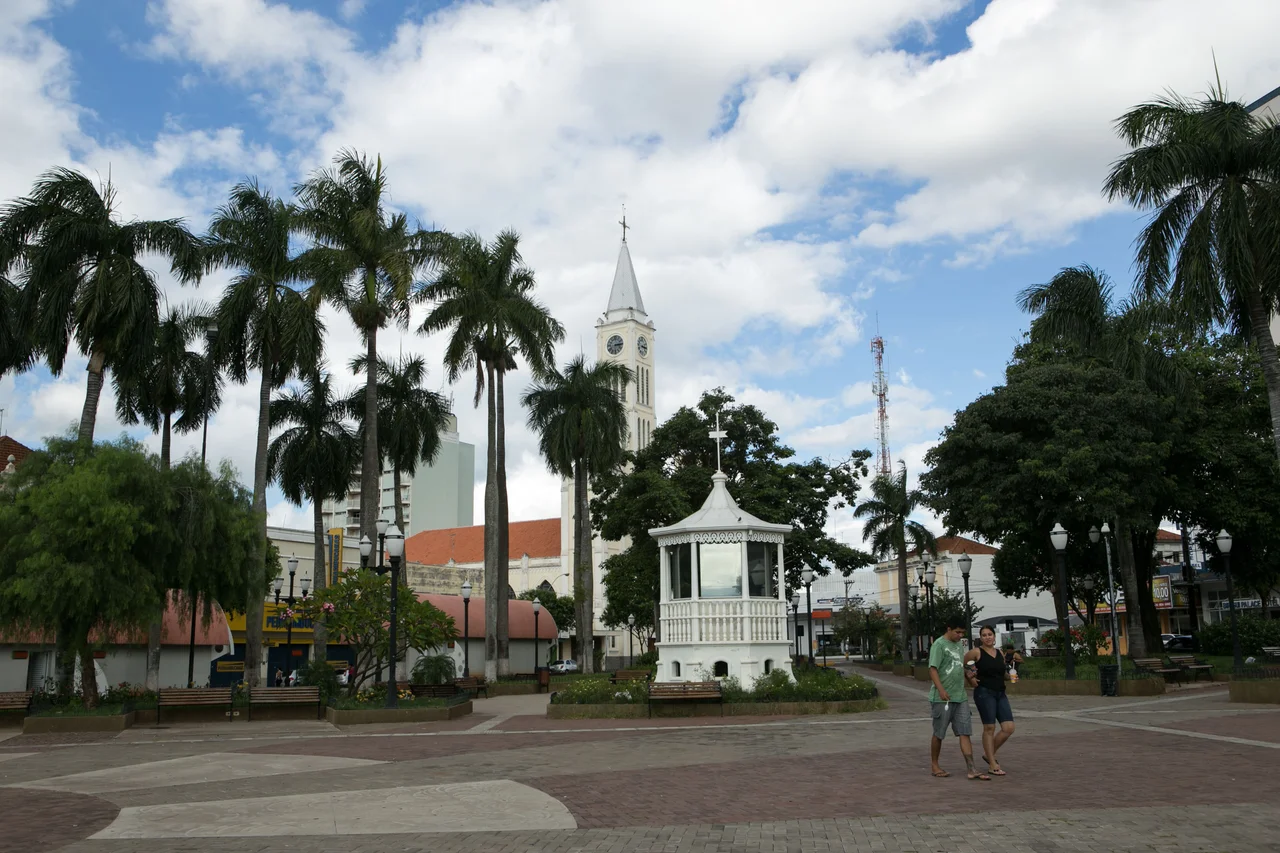

Birigui
The name means "little fly" in Tupi-Guarani - specifically, a biting sandfly of the Lutzomyia genus, abundant enough in this corner of the Sao Paulo interior that Indigenous people called it the fly that always comes. Railroad workers adopted the word for the clearing between kilometers 259 and 261 of the Northwest Railway, where locomotives stopped for water and fuel starting in 1908. When a Portuguese entrepreneur named Nicolau da Silva Nunes founded the town on December 7, 1911, he kept the railroader's name. Today Birigui is known for something other than its insects: it is the children's shoe capital of Brazil. Fifty-seven million pairs a year come off its factory floors, and the industry employs 18,000 people - sixty percent of every job in town. A century after the railroad put Birigui on the map, the city still owes its shape to the line that brought it into being.
The Portuguese Dreamer
Nicolau da Silva Nunes was born in the Parish of Moutamorta in Tras-os-Montes, the mountainous northeastern corner of Portugal, and emigrated to Brazil in search of opportunity. He was living in Sales de Oliveira when he read a newspaper article describing fertile land in northwestern Sao Paulo state. He traveled out to see it and was struck by the exuberance of the forests and the clarity of the streams. He bought 400 bushels of land in 1911 - enough for himself and two partners, Antonio Goncalves Torres and Afonso Garcia Franco - and began selling lots to settlers. The only obstacle, as he saw it, was his neighbors: the Coroado people, the Crowned Indians, whose ancestral territory this was. Contemporary accounts report that Silva Nunes used trickery to hide the evidence of Indigenous presence from his customers - erasing trails, staging demonstrations of security - in order to keep his land sales moving. The dispossession was part of the founding. The forests he admired belonged to people he concealed from view.
The First Families
The first house in Birigui was built of mud, at the confluence of what are now Silvares and Founders' Streets. Dona Antonia Real Dias was the first woman to live there, arriving with her husband Francisco Galindo de Castro. Lucas Scarpin, Antonio Simoes, Faustino Segura, Ricardo Del Nery, Joao Galo, France Contel, Giuzeppe Fonzar - the surnames read like a small immigrant atlas, Portuguese and Italian and Spanish families drawn by the same promise that had drawn Silva Nunes. In 1912, a bandeirante captain named Jose Cordeiro arrived with his expedition from Lencois Paulista and joined the settlement. Manuel Bento da Cruz founded the Sao Paulo Company of Lands, Timber and Colonization, with Roberto Clark and James Mellor as his pioneers. The town grew quickly. Coffee plantations pressed against the cerrado in every direction, and by 1921, only ten years after its founding, Birigui won administrative emancipation from its parent municipality. Archibald Thomas Clark took office as the first mayor in March 1922.
The Shoe City
For most of the twentieth century, Birigui was a small agricultural town - cattle, coffee, later cotton and sugarcane. What changed its trajectory was an industry concentration that grew organically in the mid-century: children's footwear. Small shops opened, specialized, connected with suppliers, and by the 1980s Birigui had become the leading center of children's shoe production in Brazil. The 2006 figures are telling: 159 factories producing 57 million pairs of children's shoes in a single year, generating over 800 million reais in revenue. Eighteen thousand workers were employed in the sector - sixty percent of all jobs in the municipality. The industry has faced the same pressures that have hollowed out manufacturing elsewhere - cheap imports from Asia, rising labor costs, the pull of agribusiness - but Birigui has held onto its niche. The city's annual Brazilian Children's Footwear Fair still draws buyers from across the country.
Biribol and Bandeirantes
If Birigui has a sporting innovation, it is biribol - a game invented in the city by a teacher named Dario Miguel Pedro. Biribol is volleyball played in a swimming pool, two teams of two facing off across a net, volleying a ball back and forth without letting it hit the water. It has spread across Brazil and found a modest international following, but its heart is here, where it was invented. The city's football club, Bandeirante Esporte Clube, was founded on March 11, 1923, with Jose Troncoso as its first president. In 1987 the team played in the top division of the Campeonato Paulista, the premier league of Sao Paulo state. More recently, the city produced Tabatha Ricci, a fighter who made it to the UFC, and volleyball player Victor Cardoso. Birigui now has 124,883 inhabitants spread across 530 square kilometers - a solid mid-sized paulista city, running its factories, playing its aquatic volleyball, descended from a railway clearing named for a biting fly.
From the Air
Located at 21.29 S, 50.34 W in northwestern Sao Paulo state, Brazil. The city sits on highway SP-300 (Rodovia Marechal Candido Rondon) and SP-461 (Rodovia Gabriel Melhado), with the nearest commercial airport at Aracatuba Airport (SBAU-Aracatuba, about 25 km east). Terrain is the flat-to-rolling cerrado of the Northwest Paulista at approximately 410 meters elevation. The old Noroeste rail corridor still runs through the city. Best aerial viewing in the May-October dry season. The Tiete River valley lies to the south.
Nearby Stories
- Pompeia, São Paulo 61 km away
- São José do Rio Preto 64 km away
- Presidente Prudente 70 km away
- Tietê River 80 km away
- Votuporanga 90 km away
- Caetetus Ecological Station 90 km away
- Cisalpina Private Natural Heritage Reserve 99 km away
- Olímpia 125 km away