.jpg)
São José do Rio Preto
In 2024, São José do Rio Preto inaugurated 239 new homes for 743 people and, with the ribbon-cutting, became a Brazilian city without a single favela. The last substandard settlement - Favela Marte - had been restructured and urbanized through what became a pioneering project nationwide: every family relocated into a home with complete infrastructure, nobody displaced, the community name preserved. It is the kind of municipal achievement that rarely makes international news, but it sits inside a larger pattern here. This city of 504,166 people treats 100% of its collected sewage. Its streets are tree-lined on 97.78% of residential blocks - the third-highest urban afforestation rate in Brazil.
Saint Joseph of the Black River
The name compounds two things: São José, for the patron saint, and Rio Preto, the Black River that runs through the center. The region was Kaingang land before the nineteenth century, its indigenous population decimated over decades by bandeira expeditions, migration, and forced miscegenation. The city itself was founded on March 19, 1852 - Saint Joseph's Day, still the anniversary celebrated every year - by João Bernardino de Seixas Ribeiro, a migrant from Minas Gerais. A local farmer named Luiz Antônio da Silveira donated land for the first chapel, built where the cathedral now stands. The municipality was formally founded in 1894, with original boundaries enclosing roughly 26,000 square kilometers between the Paraná, Grande, Tietê, and Turvo rivers.
The Rails That Built Rio Preto
The Araraquarense Railway reached the city in 1912, and Rio Preto became a terminus. Everything changed. The railway turned the town into a choke point for agricultural exports moving out of the northwest São Paulo countryside. By 1929 the city had grown to around 27,800 people; municipal infrastructure scaled to match. The Municipal Market opened in 1944 and still operates. The Dr. Fernando Costa Public Library opened in 1943 and now houses 46,000 volumes. The old railway station, deactivated in 2001, reopened in 2024 as the Railway Museum - another one of Rio Preto's preservation moves, converting obsolete infrastructure into cultural memory rather than demolishing it.
A Cerrado-Atlantic Hybrid
The ecological signature of Rio Preto is unusual: the Cerrado, Brazil's interior savanna, meets remnants of the Atlantic Forest here in the transitional zone. The Municipal Zoo (Zoobotânico Municipal), founded in 1973, sits on 14 hectares of this mixed vegetation, caring for around 300 animals across 70 species - many of them rescues from wildlife trafficking, vehicle strikes, and fires. The city also runs two educational ecological parks, Danilo Santos de Miranda and Dr. Joaquim de Paula Ribeiro, with walking tracks threaded through native woodlands. Rolling hills average 489 meters in elevation. The climate is classic tropical savanna - hot wet summers, mild dry winters, annual average around 23°C.
A Hospital the Size of a Small City
The Hospital de Base is the second-largest hospital in São Paulo state and among the largest in Brazil. Its complex employs 8,800 people - 1,082 physicians, 641 medical residents across 48 specialties, 3,689 nursing professionals, and 3,388 administrative and support staff. The institution maintains 1,318 beds (1,048 ward, 268 ICU) and the largest surgical center in the interior of São Paulo, with 46 rooms equipped for highly complex procedures including robotic surgery. Beside it stands the Hospital da Criança e Maternidade, established 2013, which is Brazil's largest pediatric hospital with 255 beds. The scale of care here draws patients from across the northwest quadrant of the state and beyond.
Development Without a Capital's Size
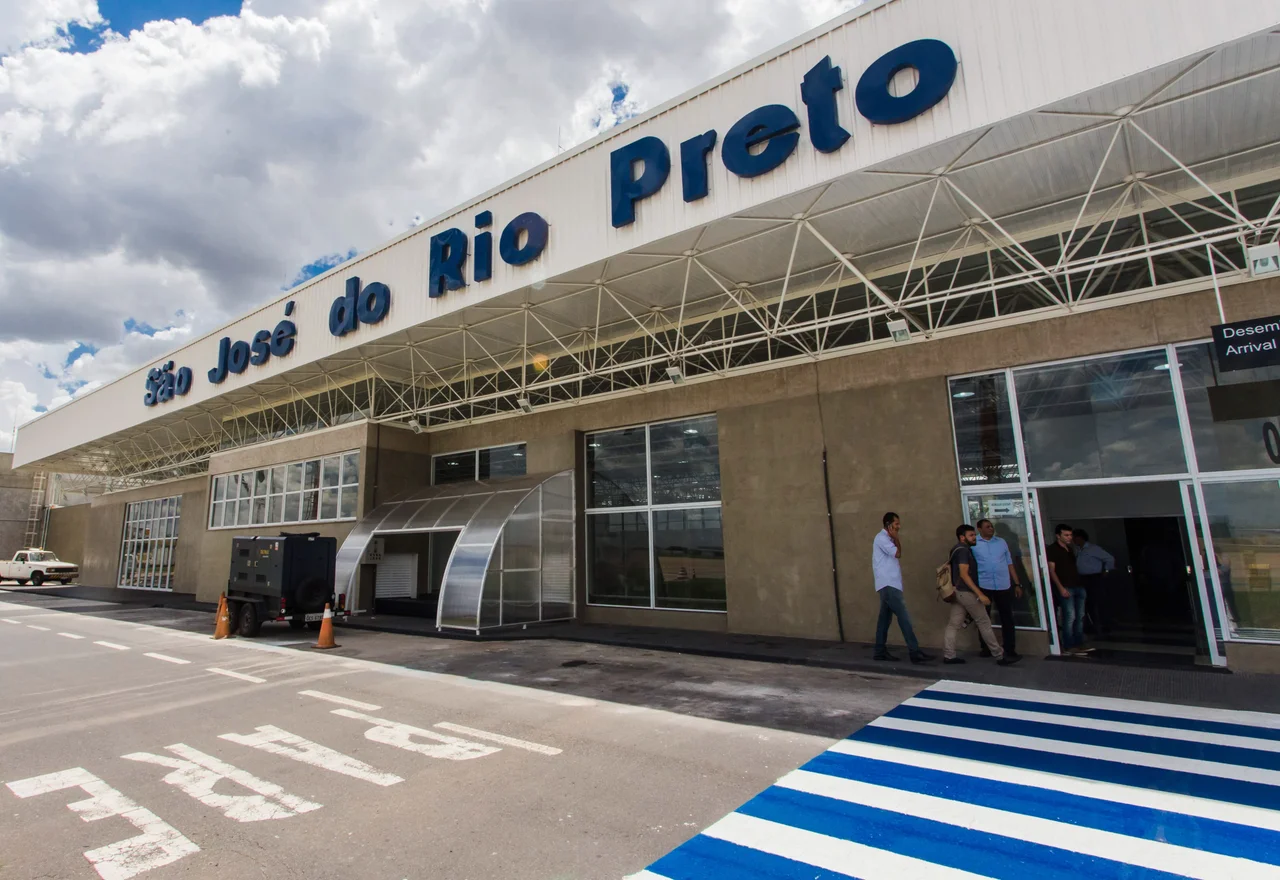
In 2025 the Firjan Municipal Development Index ranked São José do Rio Preto the eighth-most-developed city in Brazil and the fourth-most-developed in São Paulo state. The airport named for Professor Eribelto Manoel Reino, founded in 1959, moved over 768,000 passengers in 2024 - the highest traffic of any of São Paulo's 27 regional airports. Azul, GOL, and LATAM run scheduled service. The economy tilts heavily tertiary - 84.53% of GDP is services and commerce - with agriculture contributing under 1%. Sugarcane, rubber, oranges, and maize still grow in the surrounding countryside, but the city's identity is urban, white-collar, and increasingly networked.
Comedy, Cathedrals, and Country Bulls
Every January, the Brazilian January of Comedy packs the Humberto Sinibaldi Neto Municipal Theater for eight days of stand-up and sketch. Every July, 100,000 people attended the five-day Rio Preto Country Bulls rodeo in 2025 - sertanejo stars, bull riding, the full cowboy-country Brazil. In May 2025, Pope Leo XIV elevated the local archdiocese to metropolitan status. A new Federal University of São Carlos campus opens here in 2026, adding nine degree programs. The International Theater Festival completed its 56th year in 2025. From the air, the city reads as a dense green crosshatch - tree-lined avenues running between low residential blocks, the Preto River cutting black through the center, infrastructure that mostly works and keeps getting better.
From the Air
Located at 20.82°S, 49.38°W, São José do Rio Preto sits at 489 meters average elevation on gently rolling hills in northwest São Paulo state, 445 km from the state capital and 700 km from Brasília. Nearest airport: São José do Rio Preto Airport (SBSR, Professor Eribelto Manoel Reino State Airport), the busiest regional airport in São Paulo state. Surface highway references: SP-310 (Rodovia Washington Luís) east-west and BR-153 (Rodovia Transbrasiliana) north-south; the junction is clearly visible. Recommended viewing altitude: 8,000-12,000 feet AGL for urban footprint with Preto River.
Nearby Stories
- Votuporanga 17 km away
- Titanochampsa 40 km away
- Birigui 49 km away
- Frutal 77 km away
- Adamantina Formation 88 km away
- Ribeirão Preto 116 km away
- Uberaba 134 km away
- Industrias Reunidas Fabricas Matarazzo 137 km away