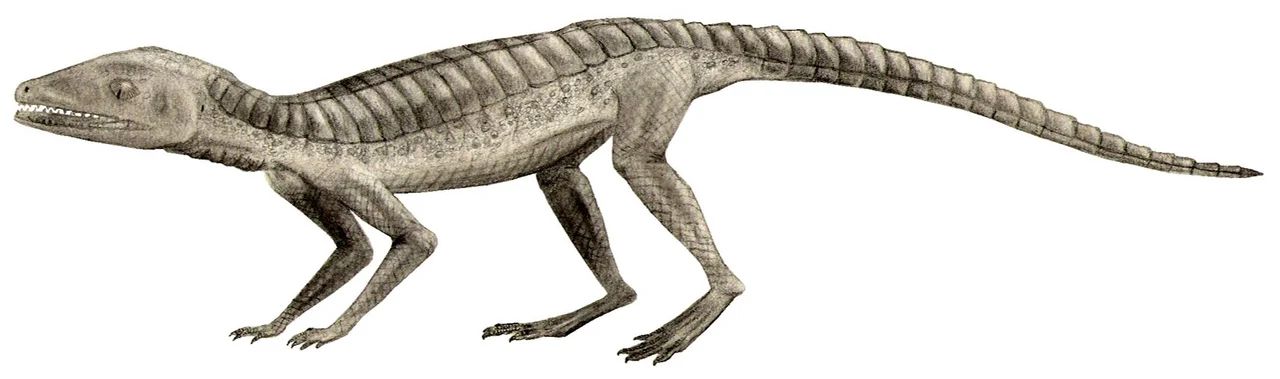

Titanochampsa
When the skull came out of the ground in Monte Alto in 1987, the paleontologists who found it made a reasonable mistake. The bone was enormous, clearly reptilian, clearly Cretaceous. They assumed it belonged to a titanosaur - one of the giant long-necked sauropods whose remains are scattered across the red sandstones of Brazil's Bauru Group. The specimen sat in storage, labeled wrong, for nearly thirty years. Then in 2016 a re-examination revealed the truth. This was not a sauropod. It was a crocodyliform. And when a fuller analysis came out in 2022, it got a name that preserved the original embarrassment: Titanochampsa - "titanic crocodile" - a monster so large its skull could pass for a sauropod's bone at first glance.
One Skull, Many Questions
The type specimen - MPMA 02-0005/87 - is a partial skull roof, and it is all scientists have. Most of the right side survives: parietal bone, frontal bone, squamosal, postorbital, with the quadratojugal and supraoccipital less well-preserved. The surface shows faint grooves and pits arranged at regular intervals, ornamentation subtle enough to distinguish Titanochampsa from its contemporaries. Baurusuchids have more pronounced sculpting that varies across the skull; peirosaurids and modern crocodilians wear deeper pits. This animal's ornament was quieter. But its supratemporal fenestrae - the openings in the skull roof where jaw muscles anchored - were anything but subtle. They were triangular and huge, occupying 50% of the skull roof, a clear sign of powerful adductor muscles on the lower jaw. This creature could bite.
Dating the Bones
The fossil came from the Marília Formation in the Monte Alto municipality of southeastern São Paulo state. The Marília is Maastrichtian in age - the final stage of the Cretaceous, spanning from roughly 72 to 66 million years ago, ending with the mass extinction that ended the age of non-avian dinosaurs. The formation contrasts with the older, more fossil-rich Adamantina Formation that dominates elsewhere in the Bauru Group. Research suggests the Marília sediments accumulated under arid to semiarid conditions, in the distal end of a fluvial system - closer to the origins of individual rivers rather than their mouths, which explains the relative scarcity of fossils here. Titanochampsa lived in the ephemeral water bodies of this harsh drying landscape, one of the last big predators before the extinction came.
How Big Was It?
The honest answer is that paleontologists cannot say with precision. The incomplete skull makes body-size estimation genuinely difficult. Researchers measured the width of the skull table and compared it to other crocodyliforms - living species like the American alligator and American crocodile, and extinct genera including Stratiotosuchus, Uberabasuchus, and Eosuchus. The different body plans of these reference animals produced very different length estimates, spanning an uncomfortably wide range. Rather than split the difference with an average that would be misleading, the paper in which Fachini and colleagues described the animal published both the low and high ends. What is certain is that Titanochampsa was substantially larger than most Bauru Group crocodyliforms, and that its bite force was comparable to that of the largest notosuchians in the older Adamantina Formation - which topped out around 4 meters.
Where It Fits
The phylogeny is contested. Two separate analyses - one based on Martínez and colleagues' 2018 dataset, another based on Ruiz and colleagues' 2021 matrix - both placed Titanochampsa deep within Neosuchia, the broad group of crocodyliforms that includes modern crocodiles. One analysis put it in a polytomy near the base of Longirostres alongside the extant Crocodylus genus. The other grouped it with more basal Eusuchian taxa like Allodaposuchus, Hylaeochampsa, and Iharkutosuchus. But support for either placement is thin, and most of the diagnostic characters cannot be assessed on the incomplete fossil. Fachini and colleagues ultimately stopped short of confirming Neosuchian affinities, labeling the animal simply a mesoeucrocodylian - meaning it is clearly advanced but its exact relationship to living crocodilians remains open.
Not a Notosuchian
What the team did confirm firmly: Titanochampsa was not a notosuchian, and this matters enormously. Until its discovery, the Bauru Group was believed to have been a realm of notosuchians almost exclusively - a group of mostly terrestrial, relatively small-jawed predators. Finding a large Neosuchian-adjacent crocodyliform in these strata rewrites the fauna of Cretaceous Brazil. Titanochampsa differs from baurusuchids across twelve anatomical characters, two of which are baurusuchid synapomorphies. The skull table is fundamentally different. The animal also differs substantively from peirosaurids, another major Bauru Group crocodylomorph clade. Its anatomy suggests a semi-aquatic ambush predator - lurking in ephemeral water bodies, exploding out to seize prey with that massive bite - a lifestyle closer to modern crocodiles than to any other Brazilian Cretaceous crocodyliform known.
What the Climate Might Have Allowed
The appearance of a semi-aquatic ambush hunter in the Marília Formation might not be random. The authors speculate that Titanochampsa's ecology could tie into the climatic shifts the region experienced during the late phases of the Maastrichtian - changes that might have created enough standing water to support such a lifestyle in an otherwise arid landscape. More fossils would confirm or refute this hypothesis. For now, a single skull roof in a Brazilian museum drawer tells a story that is both complete and incomplete: a giant predator that lived at the end of the dinosaur era, in a drying world, whose existence flips decades of assumptions about what the Brazilian Cretaceous contained. The fossil that looked like a titanosaur turned out to be a different kind of titan entirely.
From the Air
The Titanochampsa fossil was recovered from the Marília Formation in Monte Alto municipality, São Paulo state, Brazil, at approximately 21.27°S, 48.54°W. Monte Alto sits in northern São Paulo state amid the red sandstone and claystone outcrops of the Bauru Group - a geological unit dating to the Late Cretaceous. Elevation is approximately 700 meters. The municipality hosts a paleontology museum (Museu Paleontológico de Monte Alto) where the holotype is housed. Nearest airports: Ribeirão Preto (SBRP) ~140 km northeast, São José do Rio Preto (SBSR) ~75 km northwest. Recommended viewing altitude: 3,000-5,000 feet AGL for regional geology context.
Nearby Stories
- São José do Rio Preto 35 km away
- Ribeirão Preto 42 km away
- Olímpia 46 km away
- São Carlos 52 km away
- São Paulo (state) 57 km away
- Adamantina Formation 95 km away
- Marília 100 km away
- Franca 101 km away