
Ribeirão Preto
By 1902, more than half the population of Ribeirao Preto had been born in Italy. The coffee had drawn them - green gold, Brazilians called it - and for a few decades at the turn of the twentieth century this inland city in Sao Paulo state was the largest coffee producer in the world. Mansions went up on the avenues, two opera houses opened, cafes modeled on those in Milan served espressos to barons whose wealth would have astonished a Medici. Then the 1929 crash arrived, coffee values collapsed, and the city had to reinvent itself. It did. Ribeirao Preto went on to become the core of what Brazilians would call, without much irony, their California.
Black Creek
The name is literal. A stream called Ribeirao Preto - black creek, sometimes translated as black stream - runs through town. The first settlers arrived around 1856 from elsewhere in Sao Paulo state and from Minas Gerais, looking for pasture. They brought with them enslaved Africans whose labor built the coffee economy that would define the city for the next three-quarters of a century. Coffee reached the region in the 1870s, and it was as if someone had opened a tap. The Mogiana Railway ran south to Santos, connecting the farms to the world. When Brazil abolished slavery in 1888, the coffee barons needed new workers urgently. They recruited Italians, Portuguese, Spanish, Germans, Japanese - anyone who would come. The government created the Antonio Prado Colonial Nucleus in 1887 to settle Italian families, and those Italians built what are now the northern and eastern districts of the city.
The Pedro II Theatre
The Pedro II Theatre survived, and it shouldn't have. It was built in the 1920s during the coffee boom, named for the emperor who had ruled Brazil until three decades earlier. A second opera house, the Carlos Gomes Theatre, was demolished in 1949 when the city decided it did not need two. In 1980 a fire destroyed the Pedro II's ceiling. The restoration in the 1990s asked the Japanese-Brazilian artist Tomie Ohtake to design a new one, and her work - abstract, luminous - now crowns a space that holds 1,580 people. Inaugurated on October 8, 1930, the theatre is now the third-largest opera house in Brazil and home to the Ribeirao Preto Symphony Orchestra, one of the oldest in the country. Walk in and you understand what the coffee money was trying to buy: a claim that the interior of Sao Paulo state could do culture as seriously as Paris.
Pele's Revenge
On September 6, 1964, Ribeirao Preto's Botafogo FC - often confused with the Rio club of the same name - beat Pele's Santos 2-0 on home turf. A small victory over a big team, and a humiliation for the King of Football. On November 21 the same year, in the coastal city of Santos, Botafogo-SP walked into the return match and Pele walked off having scored eight goals. Santos won 11-0. Locals still tell the story. Franklin Foer's book How Soccer Explains the World got the Botafogo wrong - he wrote as if it were the Rio club - and in Ribeirao Preto this is a point of weary amusement. The real Ribeirao contribution to Brazilian football is more durable: brothers Socrates and Rai, both national team captains, began their careers at Botafogo-SP.
Sugarcane and Ethanol
When the oil crises of 1973 and 1979 forced Brazil to look for alternative fuels, the government launched Pro-Alcool - a program to develop ethanol from sugarcane. Subsidies flowed to farmers in the Ribeirao Preto region, whose soils were unreasonably fertile. Within a decade, the area was producing roughly 30 percent of Brazil's sugarcane ethanol fuel. The sugarcane boom rebuilt the wealth the coffee bust had drained, and by the 1980s and early 1990s the city had picked up the nickname Brazilian California - a modern sophisticated service center, humming with money, attracting migrants from poorer regions. Those migrants kept coming, and not all of them found work. Favelas appeared for the first time on the edges of a city that had always been too prosperous for slums. Economic miracles have always come with footnotes.
A Beer Town by Evening
Ribeirao Preto is hot - 23 degrees average, with a record of 43.6°C recorded on October 29, 2012. Hot weather produces a particular local genius: the evening beer economy. The city is saturated with bars, from corner botecos where pensioners argue about football to pub-style establishments rivaling those in Rio or Sao Paulo. Microbreweries have multiplied. On weekend nights the center fills with students from the University of Sao Paulo's Ribeirao Preto campus - a school built, in a pleasing historical irony, on the grounds of the old Monte Alegre coffee farm that German immigrants had planted in another era. The campus preserved the original farm buildings and trees, so students walk to medical school past houses that once belonged to a coffee baron. The city rebuilds itself on top of itself, but it keeps the good parts.
An Agricultural Capital
Every year the Agrishow agricultural fair brings international buyers to Ribeirao Preto. It is one of the largest agricultural trade shows in Brazil - a reminder that despite the biotech labs, the information-technology firms, and the 52 hotels catering to business travelers, this city's center of gravity remains the land. Sugarcane is still the dominant crop, followed by maize, peanut, and soybean. Medical equipment, dental supplies, pharmaceuticals, and beer come off the production lines of the industrial zones. The Kaiser Film Studios, housed in the old Brewery Paulista and covering 13,000 square meters, make Ribeirao one of Brazil's cinema centers too. The city is also the birthplace of Bambas, one of the oldest samba schools in Brazil, founded in 1927. In February the carnival schools parade. The rest of the year, the farms do their quieter work, and the evenings belong to cold beer in shaded bars.
From the Air
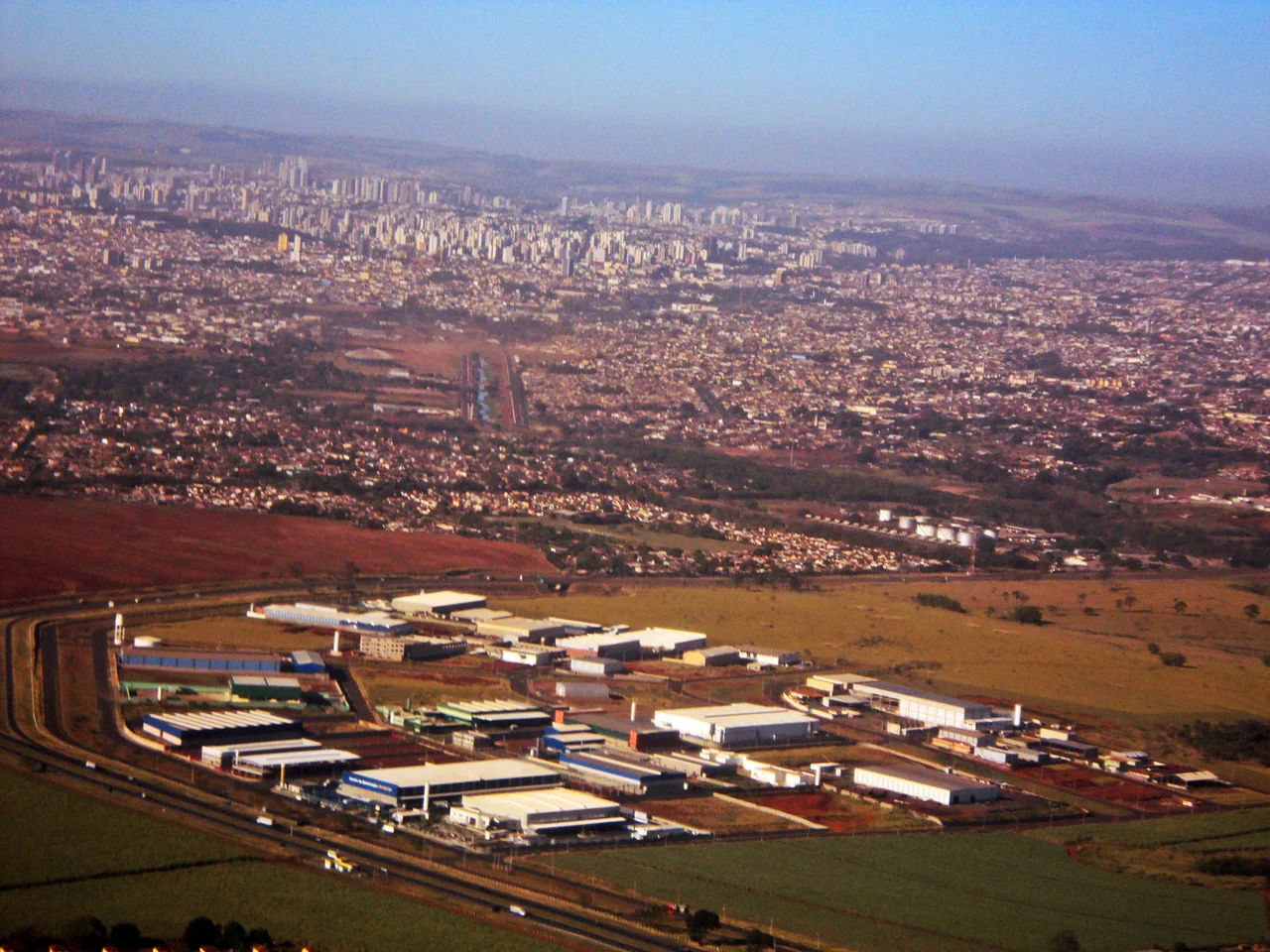
Ribeirao Preto lies at 21.17°S, 47.81°W in the northeastern reaches of Sao Paulo state, elevation 531 m. Leite Lopes State Airport (SBRP) is the main regional field, 3 km south of downtown, with frequent connections to Sao Paulo and Brasilia. The terrain is the gently rolling Planalto Central - undulating former cerrado and Atlantic Forest, now mostly converted to sugarcane, maize, and orchard. Cruise at 3,500-5,500 feet to see the characteristic checkerboard of cane fields interspersed with the green patches of remaining forest. Tropical wet/dry climate (Koppen Aw): hot humid summers Dec-Feb with frequent thunderstorms, dry cool winters Jun-Aug. Sao Paulo Guarulhos (SBGR) is 313 km south.
Nearby Stories
- Vassununga State Park 31 km away
- Titanochampsa 40 km away
- Guaxupe 43 km away
- Vargem Grande do Sul 48 km away
- Franca 49 km away
- São Paulo (state) 75 km away
- Olímpia 81 km away
- Southeast Brazil 109 km away