
Bayrakli Mosque, Chios
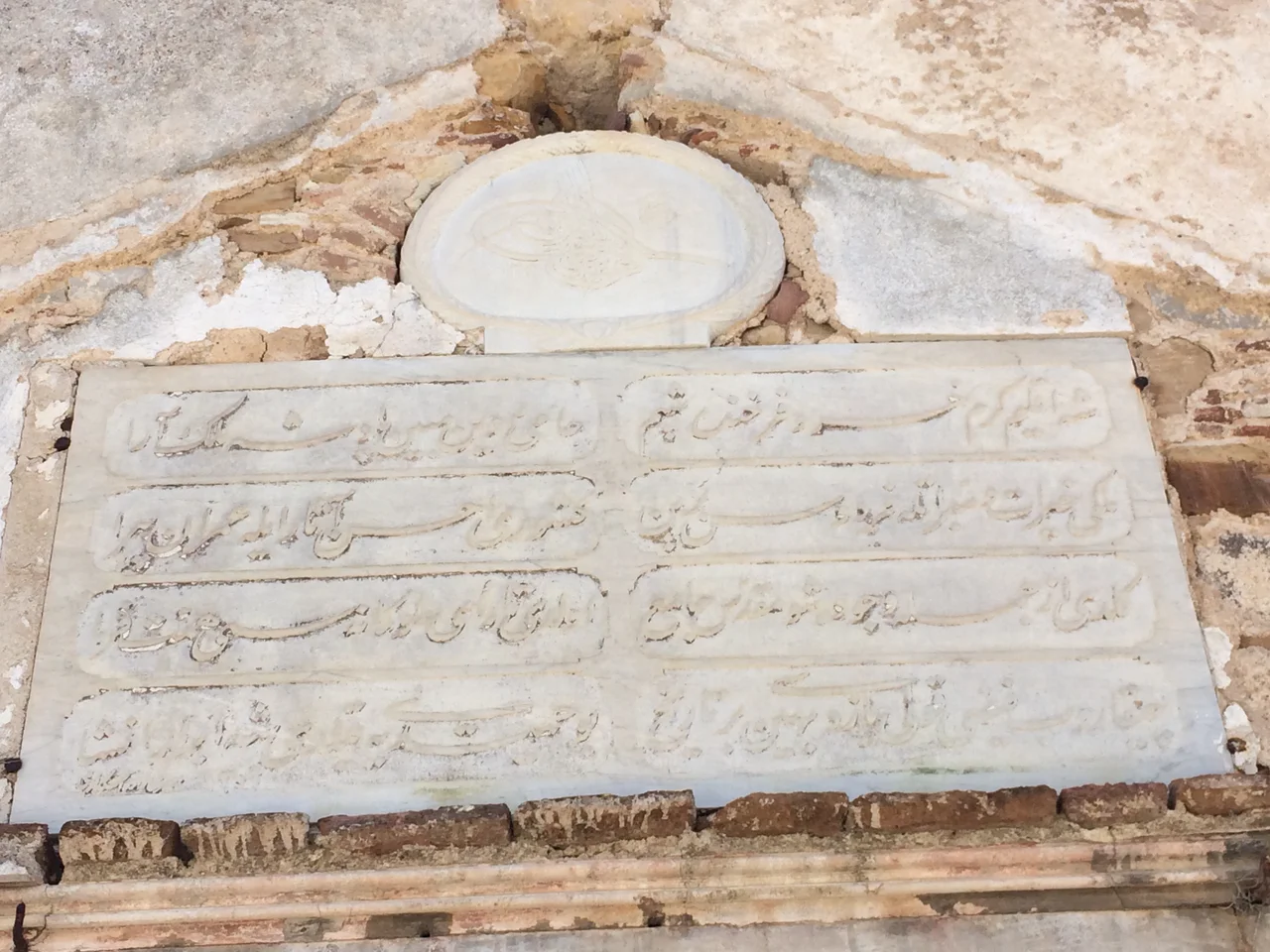
Carved into the stone of a small building in Chios town are the initials of an Armenian family who once lived inside it. Above the doorway, an Ottoman marble inscription dates the structure to 1891–1892. And above the prayer niche, a panel in Arabic invokes Zacharias, the Virgin Mary, and Solomon's Temple. The Bayrakli Mosque — also called the Hamidiye Mosque — was built as a Muslim house of worship and is now, by every measure of use, none of these things and somehow all of them. It is a building that has changed hands, faiths, and meanings, and kept the marks of each.
Built by a Sultan's Order
The marble inscription above the doorframe records the essentials plainly: construction began in 1891–1892 by order of Sultan Abdülhamit II, when Chios still belonged to the Ottoman Empire and was administered as part of the Vilayet of the Archipelago. This was an island with a long Muslim presence, its community concentrated in the town itself, and the new mosque was one expression of that life. It is one of only three former mosques still standing on Chios — the others are the Osmaniye Mosque and the Mecidiye Mosque — survivors of a religious landscape that the twentieth century would almost entirely erase. None of the three is used for Islamic worship today.
When the Worshippers Left
The mosque fell silent because of one of the great upheavals of the modern Aegean. In the aftermath of the First World War, the Treaty of Lausanne of 1923 mandated a compulsory exchange of populations between Greece and Turkey, uprooting hundreds of thousands of people from homes their families had held for generations. Muslims left Chios; Orthodox Christians arrived. The mosque, no longer needed for prayer, became shelter instead — it housed a displaced Armenian family, refugees of the Armenian Genocide who had landed on Chios with nothing. The initials they cut into the stone are still there. A building raised to gather one community became a roof over the heads of another that had lost everything.
Three Faiths in the Stone
The most haunting detail is the inscription above the mihrab, the niche that once pointed worshippers toward Mecca. Its Arabic text reads, in translation, "each time Zacharias goes in the altar where Mary takes place" — a reference to the Virgin Mary and to the high priest Zacharias visiting Solomon's Temple. Mary and Zacharias are revered in Islam and in Christianity alike, and the line gestures back to the Jewish temple of Jerusalem. In a single panel, on a single wall, three of the world's faiths brush against one another. The main prayer hall was later torn down, leaving the rectangular shell under its roof, but that inscription endures — a quiet argument that the traditions which fought so bitterly across these waters share more than they admit.
A Layered Heritage
The Bayrakli Mosque sits in the heart of Chios town, a short walk from the harbor and the archaeological museum, and it asks more of a visitor than most monuments do. It is Ottoman architecture on a Greek island, an Islamic building inscribed with Christian and Jewish memory, a place of worship that became a refuge and then a relic. Recently restored and opened to the public, it stands as a reminder that Chios was never a single story. The island has been Genoese and Ottoman and Greek; its people Muslim, Christian, and Jewish; its buildings repurposed again and again. To read the stones of the Bayrakli Mosque is to read all of that at once.
From the Air
The Bayrakli (Hamidiye) Mosque stands in Chios town at 38.3729°N, 26.1361°E, within the dense old urban fabric near the harbor and the medieval castle on the island's east coast. It is a short distance from the Archaeological Museum of Chios. Chios International Airport (LGHI) lies just south of the town along the coastal plain, making the whole quarter easy to overfly on approach. A low pass at 2,000–3,000 ft over Chios town reveals the tight grid of streets and the surviving Ottoman structures among them. The Turkish coast sits about 7–10 km east across the strait; İzmir (LTBJ) is roughly 70 km away. The eastern, town-facing side of Chios is typically clear and calm in summer.
Nearby Stories
- Psara 18 km away
- Battle of the Oinousses Islands 28 km away
- St. Helena Church 35 km away
- Battle of Corycus 35 km away
- Greek Islands 60 km away
- Temple of Artemis at Ephesus 61 km away
- Adramyttium 94 km away
- Skyros 101 km away