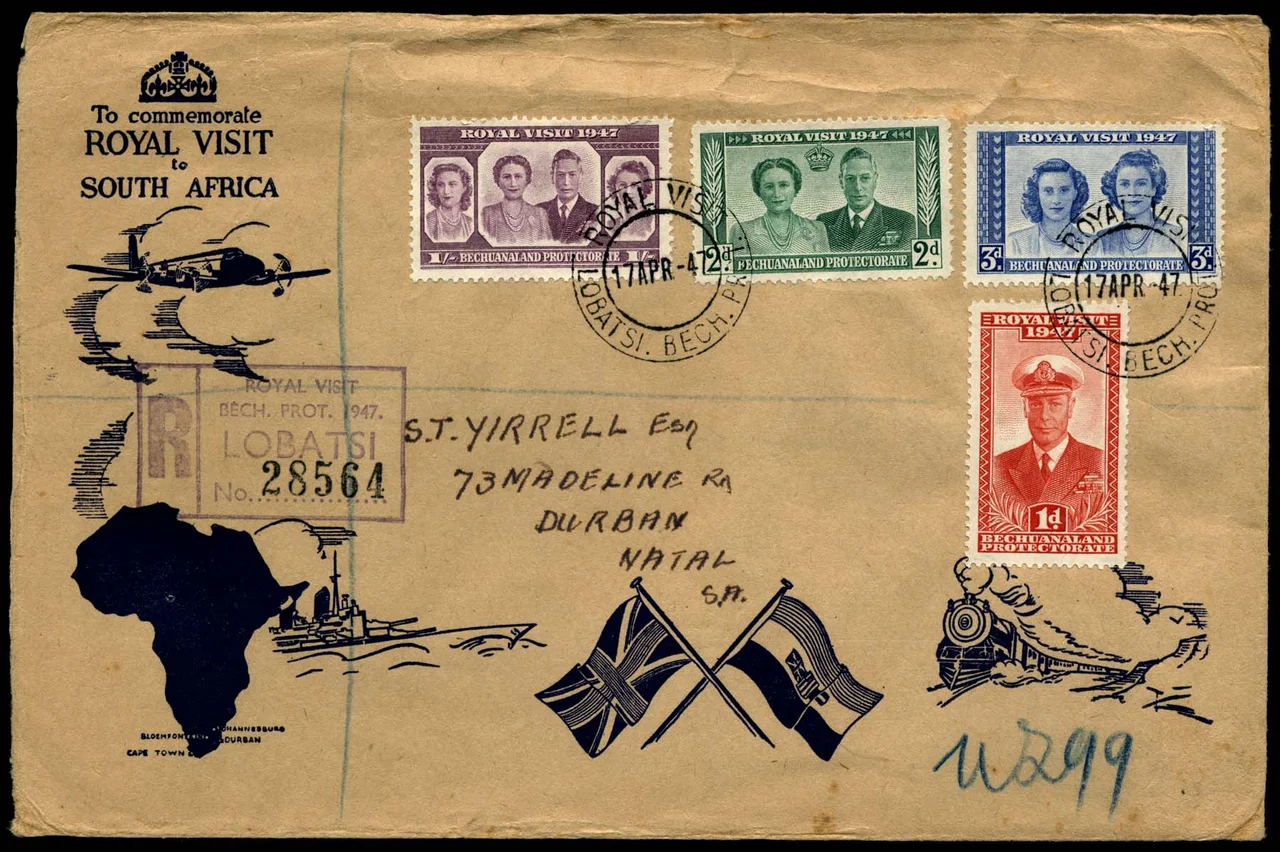

Bechuanaland Protectorate
The country was governed from a town that lay outside it. For most of its life, the Bechuanaland Protectorate was administered from Mafeking, a railway settlement in the Cape Colony, beyond the protectorate's own southern border. Officials commuted to the edge of the territory they ran. It was an absurd arrangement, and it lasted decades, and it tells you almost everything about how Britain regarded this stretch of the Kalahari: as a strategic corridor to be held cheaply rather than a place to be built. That neglect, paradoxically, helped save the land that would become Botswana.
A Line on the Map
On 31 March 1885, Lieutenant Colonel Sir Charles Warren marched roughly 4,000 imperial troops north from Cape Town and declared a protectorate over the Tswana country. The Scottish missionary John Mackenzie had spent years warning London that Boer farmers were pressing in from the south and that the African peoples here needed imperial protection. Britain agreed, but with little enthusiasm and less money. The territory south of the Molopo River became the Crown colony of British Bechuanaland, later folded into the Cape and now part of South Africa. The northern stretch became the protectorate. The very name was borrowed: Bechuanaland meant simply the country of the Tswana, the homeland of the Bangwato, the Bakwena, the Bangwaketse, and smaller communities, alongside the San and other peoples who had lived there long before.
The Chiefs Who Crossed an Ocean
Britain expected to hand the protectorate over to Cecil Rhodes's British South Africa Company, then carving out Rhodesia to the north. The Tswana rulers had other plans. In 1895, three dikgosi - Khama III of the Bangwato, Sebele I of the Bakwena, and Bathoen I of the Bangwaketse - sailed to England to appeal directly to Queen Victoria and Colonial Secretary Joseph Chamberlain. They toured town halls and chapels, allied themselves with temperance and anti-slavery campaigners, and argued, in person, that their people should not be sold to a chartered company. They won. The land stayed under the Crown. Within months, the disastrous Jameson Raid - launched from Bechuanaland soil at the end of 1895 - shattered Rhodes's reputation and confirmed the wisdom of the chiefs' resistance.
An Infant Heir and a Marriage That Shook a Nation
When Khama III died in 1923, his son Sekgoma II briefly succeeded him, but Sekgoma II died in 1925, leaving his young son Seretse, then only four years old, as heir. Seretse's uncle Tshekedi Khama ruled as regent, building schools and grain silos and feuding constantly with colonial officials. The plan was simple: Seretse would study law in Britain, then come home to lead. Instead, in 1948, Seretse married a white Englishwoman, Ruth Williams. The marriage detonated a crisis. Tshekedi opposed it on the grounds that a chief belonged to his people and could not marry as he pleased. British authorities, anxious not to offend apartheid South Africa, exiled both men. Riots followed, and people died. The story would later be told in the 2016 film A United Kingdom.
From Exile to State House
Seretse and Ruth were eventually allowed home, but by then Seretse's ambition had shifted. He no longer wanted to be a tribal chief; he wanted to lead a nation. He founded the Bechuanaland Democratic Party and, on 30 September 1966, became the first president of the independent Republic of Botswana - the very land the three chiefs had crossed an ocean to protect seventy-one years earlier. The protectorate had spanned roughly 225,000 square miles and, at its founding, a recorded population of about 120,000. It left behind few grand colonial monuments. What it left instead was a continuity of Tswana self-government that few African states could claim, and a leader who governed until his death in 1980.
The Quiet Inheritance
Botswana's modern stability did not arrive by accident. It grew from those decades when London ruled with such a light, indifferent hand that local institutions were never dismantled. The dikgosi who said no to Rhodes, the regent who built schools, the exiled heir who chose democracy over chieftaincy - each refusal and each choice compounded. When diamonds were discovered shortly after independence, the country had functioning leadership ready to manage the windfall rather than be consumed by it. The protectorate's strangest feature, a capital outside its own borders, is now a historical footnote. Its deepest legacy is a nation that was protected, in part, because its own people insisted on protecting it.
From the Air
The historical heart of the former protectorate centers on present-day southeastern Botswana, around 24.65 degrees south, 25.90 degrees east, near the modern capital Gaborone. The land reads as semi-arid bushveld and Kalahari sandveld from altitude - flat, tawny, threaded with seasonal rivers and dotted with cattle posts. Sir Seretse Khama International Airport (ICAO: FBSK, IATA: GBE), 15 km north of Gaborone, is the primary gateway; the historic administrative town of Mafeking (now Mahikeng, South Africa) lies south across the border. Best viewed from 8,000 to 12,000 feet in the clear, dry winter air between May and September, when dust haze is minimal.
Nearby Stories
- Limpopo River 58 km away
- Jwaneng diamond mine 65 km away
- Oppikoppi 80 km away
- Pilanesberg National Park 81 km away
- Siege of Mafeking 101 km away
- Marakele National Park 180 km away
- Battle of Rooiwal 208 km away
- Botswana 298 km away