
Bedourie Pisé House
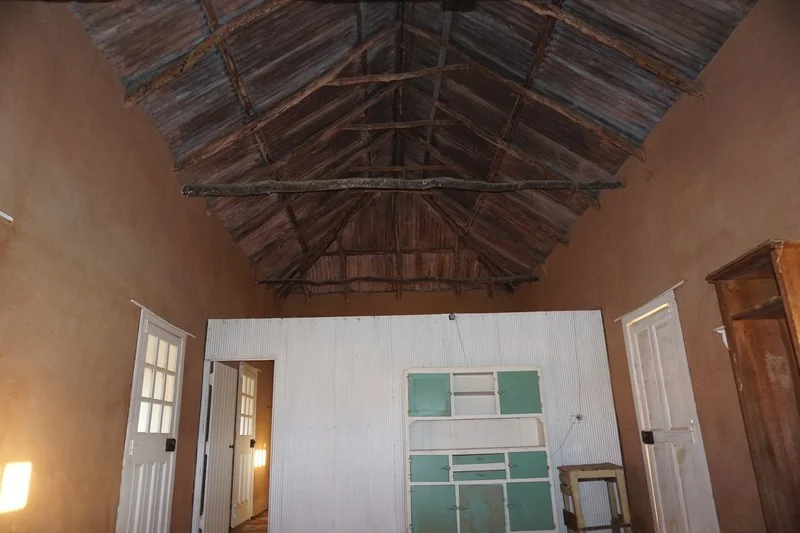
Almost nothing built of earth survives out here. Across the Channel Country, the old pisé buildings, walls of dirt rammed hard between timber forms, mostly burned, melted, or slumped back into the ground they came from. The grand hotel at Windorah burned in 1954. The one at Canterbury simply melted once its roof was stripped away and the rain got in. So the squat, thick-walled house at the south end of Bedourie's Herbert Street is something close to a miracle of endurance: raised in 1897, it is the oldest building in town and one of only five known nineteenth-century pisé structures left standing in all of Queensland. It has no windows, an earth floor, and walls cool to the touch in the worst of the summer heat.
Walls of Rammed Earth
Pisé de terre is an old idea: damp earth packed in layers between wooden boxing until it sets nearly as hard as stone. In a place where timber was scarce and bricks had to come hundreds of kilometres by camel and dray, dirt was the one building material in endless supply. The result suited the climate perfectly. Thick earthen walls shrugged off the deterioration that rotted timber, and they held their temperature, cool in the brutal summers, warm on cold desert nights. Bedourie's house is a modest single storey, its rammed walls forming a rectangular core lightly bagged on both faces, wrapped on all sides by an earth-floored verandah whose posts are rough bush timber, branches stripped of bark and left in the round. The roof is corrugated iron. The whole thing reads as the work of people making do, and making it last.
The Woman Who Built a Town
The house was the home of Mary Brodie, and her story is the town's. Born around 1858 and known across a long life as Mary Dolan, then Brodie, then Craigie, she was an early businesswoman in central western Queensland who, by most accounts, essentially founded Bedourie. She ran the Royal Hotel and funded this pisé house, but she was also the town's postmistress, storekeeper, butcher, and wine and spirit merchant, a one-woman main street keeping a remote settlement supplied along the trading route between Queensland and South Australia. Following a frontier tradition of widowed and unmarried women running outback pubs, she lived and worked here for more than twenty years. Local memory came to call her Mother Bedourie, a publican who watched over the race-day crowds and, it was said, even issued the hotel's own currency. She died in 1941, having outlasted nearly everything but the walls.
A Hut Behind the House
Behind the pisé house stands a smaller, sadder building, and it carries the heavier history. The Aboriginal Tracker's Hut was raised in 1947 at the Bedourie police station as lodgings for a tracker known as Doctor Jack and his wife, Norah, and moved here in 2011. It is a single bare room of corrugated iron on low stumps, unlined inside, a window on each wall, one timber door. The plainness is the point. This was the standard the Queensland government provided for the Aboriginal men whose extraordinary skill it depended on. A succession of trackers read country that white police could not. In the decades before Doctor Jack arrived, earlier trackers found a murder victim in 1908 and a missing man in 1913; Doctor Jack himself located a lost theatre troupe in 1940. They were essential, and they were housed in a tin shed. The hut survives as one of only three such structures known in Queensland, a quiet, uncomfortable record of how much was asked of these men and how little was offered in return.
What the Earth Remembers
Take in the whole site and the contrast is hard to miss: a businesswoman's house that has become a town's proudest landmark, and a worker's hut that documents a harder truth, set a few paces apart on the same patch of red ground. Between them sits a rough bathhouse and generator shed, doorless, its openings just gaps in the iron. The Royal Hotel had hot and cold running water by 1917, yet for years afterward townsfolk still trudged to the bore for their daily showers. Every structure here speaks of improvisation, of a community building what it could from what it had. Listed on the Queensland Heritage Register in 2019, the place is now part of how Bedourie tells its own story, earth walls and tin sheds together, neither one allowed to stand for the past alone.
From the Air
The Bedourie Pisé House stands at 24.36°S, 139.47°E at the south end of Herbert Street in Bedourie, far western Queensland, on the edge of the Simpson Desert and the braided channels of Eyre Creek. Bedourie Airport (ICAO YBIE) is at the edge of town; nearest major airport is Mount Isa (ICAO YBMA) roughly 350 km north, with Birdsville (ICAO YBDV) about 200 km south. The single-storey iron-roofed house is too small to identify from cruising height; navigate to the township grid and the airstrip, then locate Herbert Street running through the town centre. Recommended low-level viewing altitude 1,500 to 3,000 ft AGL in the clear, dry air typical of the region. Surface dust can collapse visibility quickly when winds rise off the gibber plains.
Nearby Stories
- Glengyle Station 28 km away
- Lakes Muncoonie, Mumbleberry and Torquinie Important Bird Area 33 km away
- Coorabulka 55 km away
- Astrebla Downs National Park 67 km away
- Ethabuka Reserve 68 km away
- Georgina River 76 km away
- Simpson Desert Important Bird Area 100 km away
- Durrie Station 128 km away