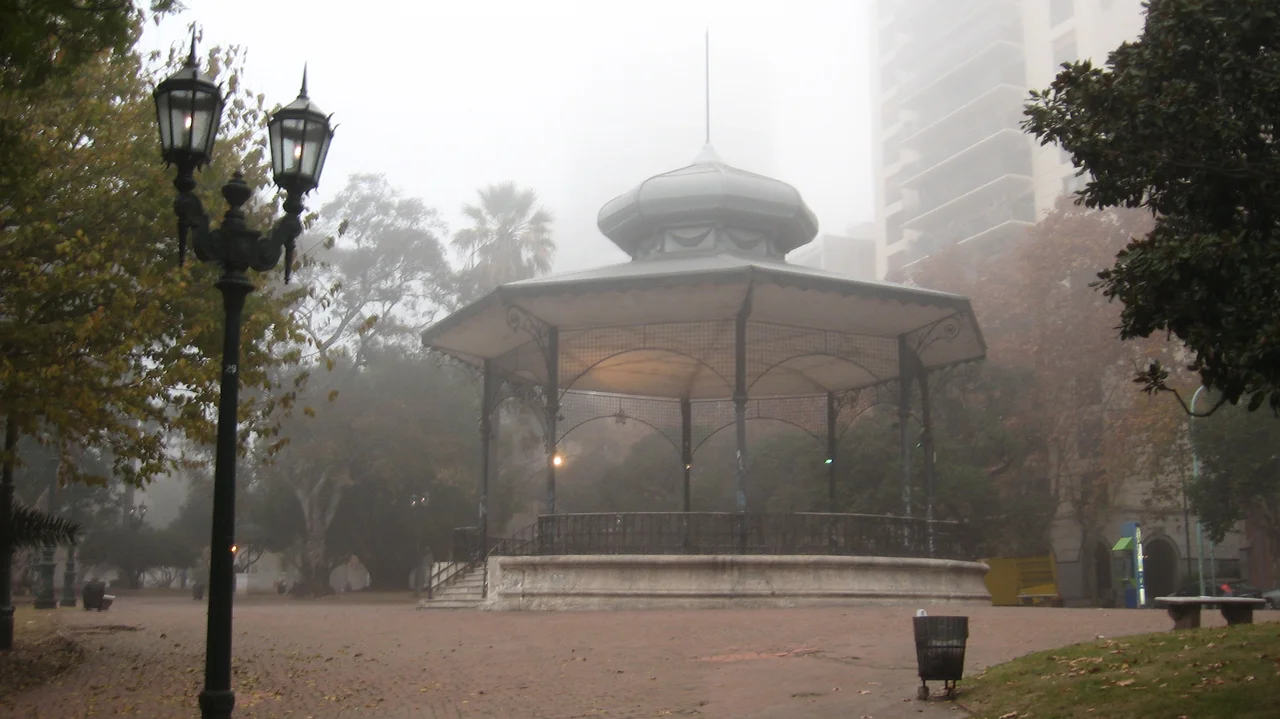

Belgrano, Buenos Aires
For a few extraordinary weeks in 1880, the capital of Argentina was not the great port city of Buenos Aires but this quiet northern town. Amid a bitter standoff between the national government and the province, President Avellaneda moved the country's authorities here, and it was in Belgrano's town hall that Congress passed the law declaring Buenos Aires the federal capital of the Republic. The building still stands, now a museum. Today Belgrano wears its history lightly — a prosperous, tree-shaded barrio of apartment towers, embassy mansions, and a small Chinatown — but the streets that once briefly governed a nation are still here, hiding in plain sight.
Named for the Man Who Made the Flag
The barrio honors Manuel Belgrano, the politician and military leader who designed the Argentine flag. When he died in 1820, the Buenos Aires legislature resolved that the next town founded would carry his name. That moment came in 1855, under circumstances tangled in old grievances: fearful that relatives of the deposed strongman Juan Manuel de Rosas might contest the seizure of his lands, the provincial government laid out a new town on part of that property and named it Belgrano. The settlement grew so quickly it was soon declared a city — and then, in 1880, found itself improbably at the center of the nation, the place where the law federalizing Buenos Aires was issued before the district swallowed Belgrano itself in 1887.
Three Belgranos in One
Locals divide the barrio into distinct worlds. Along Avenida Cabildo, the busy spine that Subte Line D follows underground, the neighborhood pulses with cafés, bookstores, cinemas, and boutiques, its wide sidewalks crowded with Porteños on weekend afternoons. West of Crámer Avenue lies Belgrano R, a calmer, lower-density enclave of detached homes in North American and English styles, some with backyard pools — favored by wealthy Argentines, expatriate executives, and the embassies of Egypt, Japan, South Korea, Tunisia, and the United Arab Emirates, among others. And then there is Belgrano C, home to the city's compact Chinatown, where restaurants and specialty grocers draw Asian-Argentine families and curious visitors alike.
Parks, Museums, and a Round Church
Belgrano keeps its grandest green space at Barrancas de Belgrano, a park spread across former natural river terraces and shaped by Carlos Thays, the French-Argentine landscape architect who designed open spaces all across Buenos Aires. On Manuel Belgrano square, a weekend artisan fair gathers around a bust of the flag's creator, and at the plaza's edge stands the Inmaculada Concepción church — known to everyone simply as La Redonda, the round one, for its circular plan, a favorite for afternoon weddings. Two house-museums sit nearby: the Larreta, set in writer Enrique Larreta's former residence with a carefully tended Andalusian garden, and the Sarmiento, housed in the old town hall where Congress once met when Belgrano was capital.
The Monument by the River
Belgrano runs down toward the Río de la Plata, its avenues threading between the riverbank and the city limits at Avenida General Paz, the freeway beyond which the suburbs of Vicente López and Olivos begin. The barrio holds one of Argentine football's great landmarks, though it is often misattributed to a neighbor: while nearby Núñez is famous as the home of River Plate, the club's vast stadium — the Estadio Monumental, which also hosts the national team — actually stands within Belgrano's boundaries. Down in Lower Belgrano, the smaller Estadio de Excursionistas keeps the local side close to home, a reminder that even an elegant barrio keeps its neighborhood loyalties.
From the Air
Belgrano occupies northern Buenos Aires at roughly 34.56°S, 58.46°W, set back from the Río de la Plata. From the air, the standout landmark is the Estadio Monumental near the river within the barrio's bounds, with the green of Barrancas de Belgrano and the dense apartment corridor of Avenida Cabildo cutting northwest to southeast. Avenida General Paz marks the city limit about 1.5 km west. Aeroparque Jorge Newbery (ICAO: SABE) is the nearest field, roughly 4 km southeast along the shoreline — Belgrano lies close to its approach and departure paths. Ministro Pistarini International (Ezeiza, ICAO: SAEZ) is about 28 km southwest. Clear, calm mornings give the cleanest view of the river edge and the stadium; afternoon river haze can soften the skyline.
Nearby Stories
- Ezeiza Massacre 1.9 km away
- Luján, Buenos Aires 5.1 km away
- Curutchet House 13 km away
- Colonia del Sacramento 17 km away
- Martín García Island 28 km away
- Atucha Nuclear Power Plant 37 km away
- Lobos 43 km away
- Cry of Asencio 87 km away