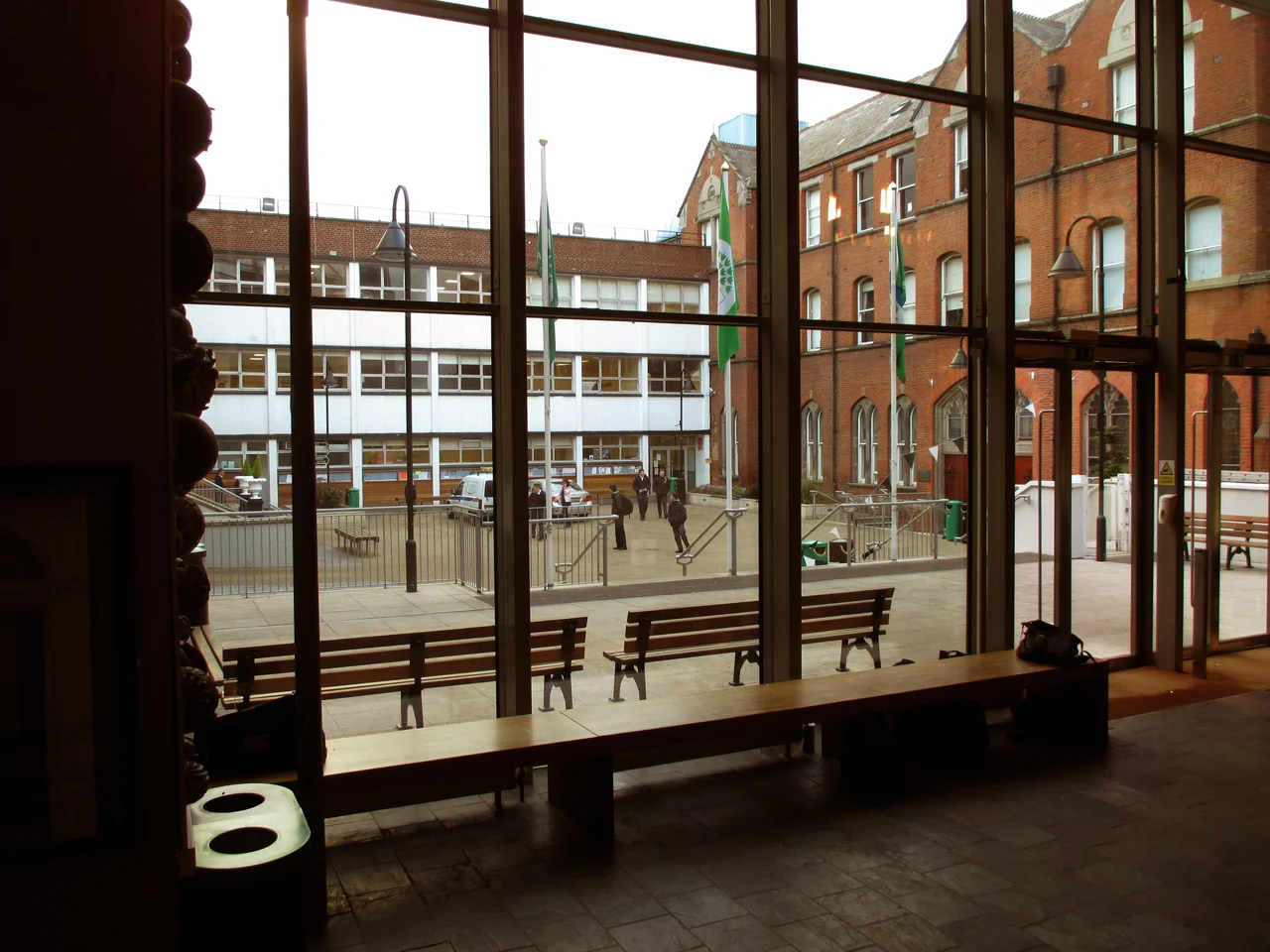

Belvedere College
In 1832, three years after Catholic emancipation, a small group of Irish Jesuits opened a school for nine boys in a disused Poor Clares convent on Hardwicke Street in north Dublin. Nine years later they bought Belvedere House on Great Denmark Street, a Georgian mansion built in the 1770s for George Augustus Rochfort, the second Earl of Belvedere, with interiors by the great stuccodore Michael Stapleton. The school took the building's name and has been there ever since. Belvedere College has educated boys at this address for one hundred and eighty-five years now. James Joyce attended from 1893 to 1898 and made the school a setting for A Portrait of the Artist as a Young Man. Garret FitzGerald, two-time Taoiseach, sat its exams. So did the rebel Joseph Mary Plunkett, who was executed in 1916, and the singer Glen Hansard, who later won an Oscar. In 2025 the school formally named fifteen Jesuit priests who had abused its students, and a longer reckoning began.
The House and Its Sermon
Belvedere House is one of the finest Georgian interiors in Dublin. Michael Stapleton's plasterwork, designed for the Earl of Belvedere in the 1770s, survives in the school's ceremonial rooms - the kind of cherubs and garlands and classical scrolls that Dublin's Anglo-Irish ascendancy commissioned to demonstrate their European sophistication. The Jesuits bought it for a school in 1841. Young Joyce sat in those rooms and absorbed the contradictions: ancient Catholic schooling in Protestant aristocratic surroundings, the language of the colonisers spoken in the cadences of the colonised. He was elected Student Prefect of the Sodality of Our Lady in 1896, and the famous hellfire sermons in Chapter III of A Portrait of the Artist as a Young Man are modelled on those given at a 1897 Belvedere retreat by Father James Aloysius Cullen, the school's spiritual director for twenty years. Joyce's English teacher, George Dempsey, became the model for Mr Tate in the same novel. A school class group was named 'Dempsey' in his honour for decades.
Joyce and the Other Writers
Joyce was the most famous Belvedere writer but not the only one. The poet Austin Clarke passed through. So did Liam O'Flaherty, the novelist of Famine and Skerrett who had been a Jesuit novice before turning Marxist and then republican. The poet Denis Devlin attended. Donagh MacDonagh - poet, playwright, broadcaster, and son of the executed 1916 leader Thomas MacDonagh - was a Belvederian. So was Mervyn Wall, whose Fursey novels about a hapless seventh-century monk are the strangest comic Irish fiction of the twentieth century. The artist Harry Clarke, whose stained-glass windows light up churches all over Ireland, was an Old Belvederian. So was Francis Browne, the Jesuit photographer who took some of the only known photographs of the Titanic in 1912 - he disembarked at Queenstown before the ship met its iceberg, and his pictures of life aboard during the first leg of the voyage have ended up illustrating most books on the subject ever since.
The Sleep-Out and the Block-Pull
Modern Belvedere defines itself in part through two charitable institutions. The Block-Pull is a charity walk that students have undertaken every summer since 1981, from Dublin to Galway. The proceeds go to Irish Guide Dogs for the Blind, St Francis Hospice, and the Temple Street Children's University Hospital - the children's hospital that sits a short walk from the school's front gate. A single block-pull has raised over 70,000 euro. The Sleep-Out takes place every year from 22 to 24 December: students fast for twenty-four hours and 'go homeless' on Dublin's O'Connell Street for three days and two nights, raising money for Focus Ireland, the Home Again Society, and Father Peter McVerry's homelessness charity. In 2022 the Sleep-Out set a new record of over 304,000 euro raised. The school's motto is Per Vias Rectas - 'By Straight Paths' - and the Sodality language about 'Men for Others' descends directly from the Jesuit Ratio Studiorum that names the school years Elements, Rudiments, Grammar, Syntax, Poetry, and Rhetoric. Father Peter McVerry, the homeless-services priest, was himself a teacher at Belvedere.
The 2025 Reckoning
In 2025 the school formally named fifteen Jesuit priests who had physically and sexually abused students over decades. The list included Father Jack Leonard, who served as Prefect of Studies - effectively head of the senior school - through the 1960s and into the early 1970s, and Fathers Brendan Kearney and Joseph Marmion. The naming was the result of years of pressure from survivors, an Irish Jesuit Province admission process, and the slow public reckoning with abuse in Catholic Irish institutions that began with the Ferns Report in 2005 and the Ryan Report in 2009. For the survivors, the names mattered. Saying them publicly, in connection with the school where the abuse took place, was part of what survivors had asked for. The boys who walked Belvedere's corridors in the decades when these men were in charge are now in their fifties, sixties, and seventies. Some did not survive long enough to hear the names read out. The school continues. So does the work of telling its history honestly.
What the School Produces
Belvedere's roll of alumni reads like a directory of modern Irish public life. Politicians: Taoiseach Garret FitzGerald, Tánaiste Brian Lenihan, Joseph Mary Plunkett who signed the 1916 Proclamation and was shot for it a month later. Lawyers: Supreme Court justices, Attorneys General, the founder of the Arthur Cox law firm. Archbishops of Dublin including Cardinal Desmond Connell and Dermot Ryan. The architects Michael Scott and Sam Stephenson, who shaped much of modern Dublin's skyline. Sports figures from the rugby internationals Cian Healy and Karl Mullen to the showjumper Cian O'Connor and the Olympic horse-racing trainer Pat Taaffe, who rode Arkle to the 1964 Cheltenham Gold Cup. Broadcasters Terry Wogan and Henry Kelly. The musician Glen Hansard. The rapper Rejjie Snow. The actor Jack Reynor. The school's role in Irish public life is so large that asking what Dublin would look like without Belvedere is essentially asking what modern Ireland would look like - an unanswerable question, given how much of the country its alumni have made.
From the Air
Belvedere College sits at approximately 53.356 degrees N, 6.262 degrees W on Great Denmark Street in Dublin's north inner city, two blocks east of O'Connell Street and three blocks north of the Liffey. The Temple Street Children's Hospital is immediately adjacent. Dublin Airport (EIDW/DUB) lies 8 km north. From altitude the Belvedere House complex is visible as a substantial Georgian block at the eastern end of the Mountjoy Square area. Best viewing altitude for the surrounding north Georgian quarter is 2,500-4,000 ft. The most prominent nearby landmark from the air is the Spire of Dublin on O'Connell Street, 120 metres tall, just southwest of the school. Maritime climate, frequent low cloud, prevailing westerlies.
Nearby Stories
- Wicklow Mountains 12 km away
- Mornington 14 km away
- German submarine U-1051 16 km away
- Abbey of Kells 18 km away
- Irish Military Intelligence Service 20 km away
- HMS Manners (K568) 37 km away
- Templemore 42 km away
- Irish Sea Bridge 43 km away