
Berenice Troglodytica
Dig into the sand at Berenike and the world arrives in your hands. In a temple courtyard, archaeologists found a clay jar holding 7.55 kilograms of black peppercorns, the largest single cache ever recovered from the classical Mediterranean, grown two thousand years ago in southern India. Nearby lay teak from Indian shipwrecks, a Tamil inscription naming a chieftain called Korra, and the haloed marble head of a Buddha. This wind-scoured ruin on Egypt's Red Sea coast was once one of the busiest doorways on Earth, the place where the Roman Empire reached out across the ocean and touched India.
A Port for War Elephants
Berenike began with an army's strange need. Around 275 BCE the pharaoh Ptolemy II Philadelphus founded the harbor and named it for his mother, Berenice I. His purpose was specific: he needed elephants. Cut off from the Indian war elephants that his Seleucid rivals fielded, Ptolemy turned to Africa, shipping the animals north along the coast from the Horn to this sheltered bay. Excavators have since pulled elephant skull fragments and teeth from the ground, along with a V-shaped dry moat that may have penned the exhausted beasts as they recovered from the voyage. The town sat on a thin rim of shore, the mountains at its back and the Red Sea at its feet, a foothold pried out of hostile country.
The Indian Ocean Highway
Under Roman rule Berenike found a far larger purpose. Sailors had learned to read the monsoon, riding the seasonal winds straight across the open Indian Ocean instead of creeping along the coast. Fleets set out from Egypt to India and back, and Berenike was the first good harbor they reached on the return. From there a desert road ran 258 Roman miles to Koptos on the Nile, an eleven-day march broken by watering stations whose wells kept the caravans alive. A first-century Greek merchant's handbook, the Periplus of the Erythraean Sea, describes the route in working detail. Pepper, gemstones, fine Indian pottery, coconuts, and frankincense flowed through this gate toward the markets of Rome. The scale of it has forced scholars to rethink just how large and how lucrative the trade between Rome and India really was.
Where the World Met
What makes Berenike extraordinary is not just its trade but its mixture of people. The finds show that Tamil speakers from South India were living here in the early Roman period, far from home at the empire's edge. Their presence likely brought Buddhist worshippers, and in 2022 an American-Polish team excavating the temple of Isis uncovered the Berenike Buddha, a marble figure carved in a Mediterranean style but unmistakably Indian in subject, the only such statue known from antiquity west of Afghanistan. The same harbor town once worshipped the Egyptian Isis and the Meroitic god Sebiumeker, gods drawn from up and down the Nile and the Red Sea. Few places in the ancient world held so many worlds at once, and fewer still left the proof so plainly in the ground.
The Tenderness of a Trading Town
Not every discovery here speaks of commerce. In a study published in 2020, researchers revealed what may be the oldest pet cemetery in the world: the careful graves of roughly six hundred cats, dogs, and even monkeys, some buried with collars or laid on cloth, dating back two thousand years. In a frontier outpost wedged between mountain and sea, where elephants once stumbled ashore and pepper changed hands by the sackful, ordinary people also kept and mourned their animals. After the sixth century the port was abandoned. The bay silted up, a sandbar sealed its mouth, and the desert reclaimed the streets, leaving the whole connected world to be read again, much later, from the sand.
From the Air
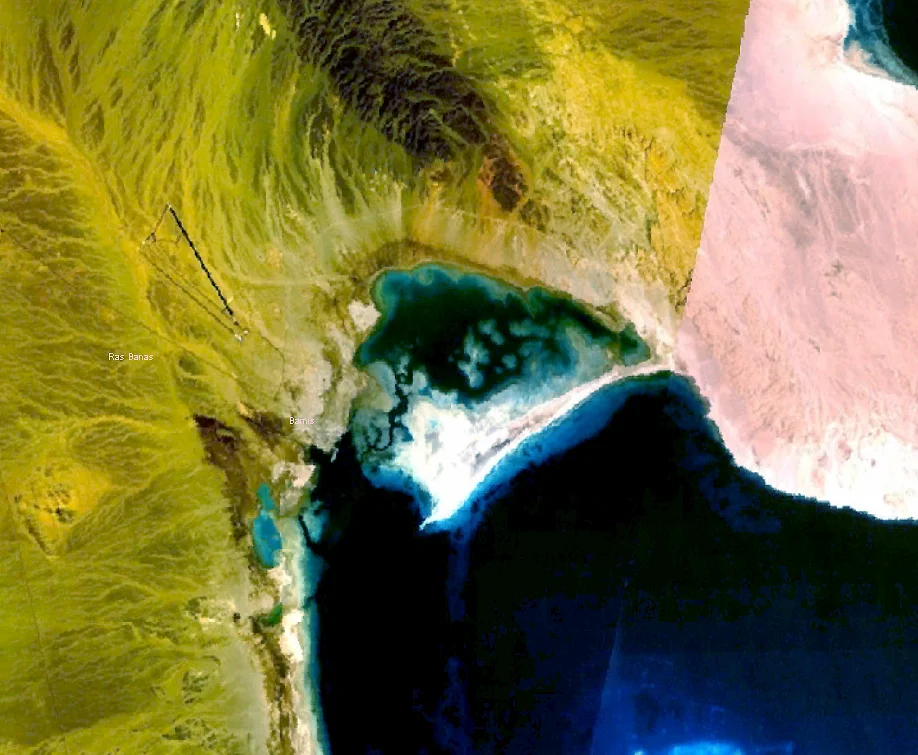
Berenike (Berenice Troglodytica) lies at 23.94°N, 35.49°E, on Egypt's southern Red Sea coast, about 140 km south of Marsa Alam and roughly 260 km east of Aswan. From the air the site sits on a narrow coastal plain between the Red Sea Mountains and the shore, near the sheltered bay at Ras Banas; the ancient harbor is now silted and marked by a sandbar at its entrance. Zabargad Island lies offshore to the north. Nearest airport is Berenice/Banas Cape (HEBR), immediately adjacent on the Ras Banas peninsula; Marsa Alam International (HEMA/RMF) is the main regional gateway about 140 km north. Recommended viewing altitude 3,000-7,000 ft to pick out the coastal ruins against the desert and the curve of the old harbor; visibility over the southern Red Sea coast is typically excellent year-round.
Nearby Stories
- Wadi El Gemal National Park 31 km away
- Zabargad Island 37 km away
- Halaib Triangle 142 km away
- Wadi Allaqi 160 km away
- Aswan 194 km away
- The Travels of Ibn Battuta 196 km away
- Edfu 211 km away
- Al-Ula 334 km away