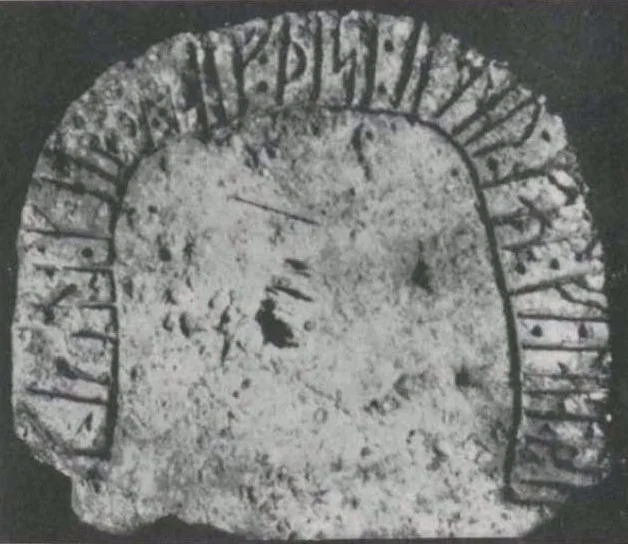

Berezan' Runestone
"Grani made this vault in memory of Karl, his partner." Eleven words, cut into stone by a Viking trader who had come thousands of miles from a cold northern island to the mouth of the Dnieper, and who buried his companion there rather than carry him home. When a professor from Odessa turned up the Berezan Runestone in 1905, he had found the only runic inscription ever discovered in southern Ukraine, and inside its terse Old Norse a small, aching human story: two men in business together, one of them dead on a distant shore, the other determined to mark the loss.
The Stone at the River's Mouth
The Beresan Runestone, catalogued by scholars as X UaFv1914;47, was discovered in 1905 by Ernst von Stern, a professor at Odessa, on Berezan Island where the Dnieper River meets the Black Sea. Its setting explains its presence. The island's sheltered bays gave anchorage to Scandinavian ships working the great trade route from the Varangians to the Greeks, the water road that ran from the Baltic down the rivers of Rus to Constantinople. Sven B.F. Jansson, who would later become Sweden's National Antiquarian, wrote of the stone's importance as evidence of just how far these northern travelers ranged. Berezan was a natural waypoint, a place sailors had always paused, and it was here that Grani chose to lay Karl to rest, on an island the Byzantines knew as the isle of Saint Etherius.
Two Men from Gotland
Where exactly Grani and Karl came from is a puzzle scholars read in the stone itself. The Old Norse word carved here for the memorial, hvalf, meaning vault or coffin, appears in runic inscriptions only on Gotland and in a few late carvings from Västergötland, both in present-day Sweden. The shape of the stone and the way it was set up point the same direction, toward Gotland, that famous Baltic island of merchant-farmers whose traders reached astonishingly far. The likeliest story is this: the two Gotlanders were traveling to or from Constantinople, partners in the risky, lucrative long-distance trade, when Karl died. Rather than abandon his companion or attempt the impossible journey home with a body, Grani prepared a proper resting place on an island that sailors had visited for centuries, and marked it in the way his people marked their dead.
A Rare Voice from a Vanished World
That the stone survives at all makes it precious. Few runic inscriptions have ever been found in Eastern Europe, partly because stone was scarce there, and partly because Scandinavians in these lands more often carved runes onto wooden poles raised over burial mounds, a practice the Arab traveler Ibn Fadlan described after meeting Norsemen on the Volga. Wood rots; stone endures. By the time raising runestones became truly fashionable back home in the eleventh century, most of the Scandinavian settlers scattered through Russia, Belarus, and Ukraine had already been absorbed into the Slavic majority around them, and the stream of new arrivals had dried up. The window in which a memorial like Grani's could be made in this place was narrow, and it closed. What remains is a single stone in the Odesa Historical Museum, and eleven words, keeping the memory of a man named Karl far longer than his partner could ever have imagined.
From the Air
The runestone was found on Berezan Island, 46.60°N, 31.41°E, at the mouth of the Dnieper-Bug estuary near Ochakiv, though the stone itself now resides in the Odesa Historical Museum. From 2,000-4,000 feet the island appears as a small, flat-topped landmass alone in open water where the estuary opens to the Black Sea. Nearest airports are Mykolaiv (UKON) and Odesa (UKOO) to the west.
Nearby Stories
- Mykolaiv Regional Museum of Local History 4.4 km away
- Kuialnyk Estuary 17 km away
- Tendra Spit 22 km away
- Racecourse of Achilles 26 km away
- Adziogol Lighthouse 27 km away
- Mykolaiv Observatory 39 km away
- Strategic Missile Forces Museum 141 km away
- Danube Delta 174 km away