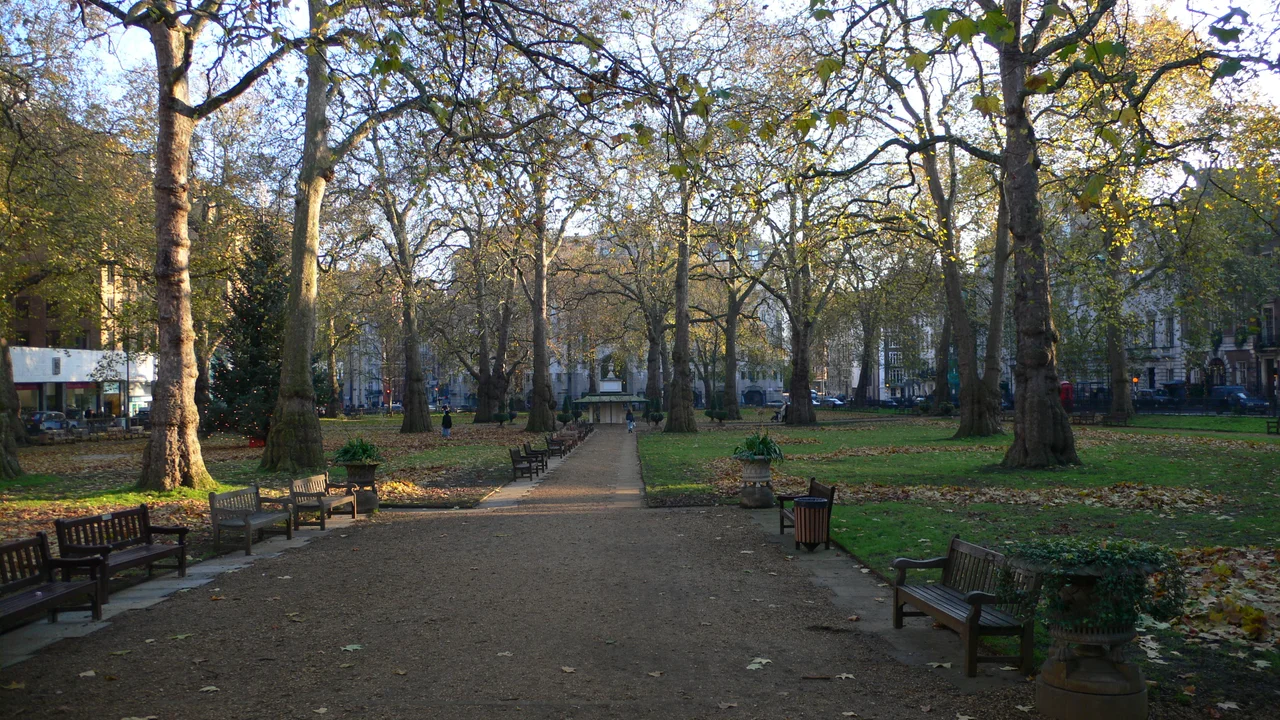

Berkeley Square
The plane trees at the center of Berkeley Square were planted in 1789 — the year the Bastille fell — and they are still there, now among the oldest trees in central London. In 2008 one of them was declared the most valuable street tree in Britain by the London Tree Officers Association, assessed for its size, health, historical significance, and the density of people living near it. The French Revolution changed the world; the trees grew on.
A Garden That Was a View
Berkeley Square began as the bottom of a private garden. In 1696, John Berkeley, 3rd Baron Berkeley of Stratton, sold Berkeley House on Piccadilly to William Cavendish, 1st Duke of Devonshire, but kept the southern portion of the garden — including the site of what would become the square. Berkeley specifically undertook, with legal force, not to build on the retained land, preserving the view from the rear of the ducal residence. This restrictive covenant is one of the older surviving examples of its kind in English law. The square was laid out in the mid-eighteenth century by architect William Kent, whose other significant contribution to the site was the staircase-hall of Number 44 — sometimes described as his masterpiece. The garden's fountain, added in 1865, was donated by the third Marquess of Lansdowne and replaced a statue of George II that had stood there since 1727 before being removed in 1827.
A Who's Who of Residents
Berkeley Square accumulated one of the more remarkable rosters of inhabitants of any London address. Horace Walpole lived at Number 11 from 1779 until his death in 1797. George Canning, Prime Minister in 1827, resided at Number 50. Winston Churchill lived at Number 48 as a child. Robert Clive of India bought Number 45 in 1761 and died there in 1774. Charles Rolls — co-founder of Rolls-Royce — was born at the square in 1877. John Byng, the executed Vice-Admiral whose court-martial became a byword for institutional injustice, also lived here. At Lansdowne House, which once stood on the square's south side, residents included three prime ministers — the Earl of Bute, the Marquess of Lansdowne, and William Pitt the Younger — as well as Harry Gordon Selfridge and William Waldorf Astor, described at the time as the richest man in America. Today most of the grand townhouses serve as offices for hedge funds, private equity firms, and wealth management businesses. Only Number 48 remains wholly residential.
Fiction, Ghosts, and a Nightingale
Berkeley Square has attracted fictional residents with the same enthusiasm as real ones. P. G. Wodehouse placed Bertie Wooster near the square — his flat on Berkeley Street, the Drones Club a short walk away. The building at Number 50 has been styled 'The Most Haunted House in London.' Rudyard Kipling set a 1891 satirical poem here, its protagonist giving up the ghost at his house in Berkeley Square. The 1940 song 'A Nightingale Sang in Berkeley Square' made the square's name internationally recognizable, associated in Britain with Vera Lynn and in America with the Glenn Miller Band. Whether any nightingale ever actually sang there is a separate question — the square is in the middle of Mayfair, not known for its bird life — but the image has proved stubbornly appealing. The song was written in the south of France by Eric Maschwitz, who was apparently homesick for London.
Mayfair's Living Room
The square functions today as a relatively quiet oasis in one of the most expensive and commercially dense neighborhoods in the world. The gardens are Grade II listed on the Register of Historic Parks and Gardens. They are, by horticulturalists' standards, quite plain — mostly grass and paths — but the plane trees give the space a scale and presence that no amount of flowers could provide. One tree in the southwest corner is a designated Great Tree of London. A bronze sculpture of Velasquez's Reina Mariana by Manolo Valdes stands on the eastern side, adding an incongruous contemporary note. The square is served by Green Park Underground station on the Piccadilly, Jubilee and Victoria lines, and Bond Street on the Central and Jubilee lines — making it one of the better-connected open spaces in central London, which perhaps accounts for the near-constant foot traffic of Mayfair's financial workers crossing it at speed.
From the Air
Berkeley Square sits at coordinates 51.5097°N, 0.1458°W in Mayfair, central London. From altitude, look for the green rectangle of the garden in the dense urban fabric of the West End, about 600 meters north of Green Park. Buckingham Palace is 1km to the southwest. London City Airport (EGLC) is 13km to the east; Heathrow (EGLL) is 23km to the west.
Nearby Stories
- Stevenage 5.7 km away
- Malling Abbey 5.7 km away
- 1952 Farnborough Airshow Crash 7.7 km away
- Ingatestone Hall 8.2 km away
- Hellfire Caves 9.1 km away
- The Carrington Event: The Solar Storm That Could Happen Again 9.8 km away
- Bletchley Park 16 km away
- Castle Hedingham 23 km away