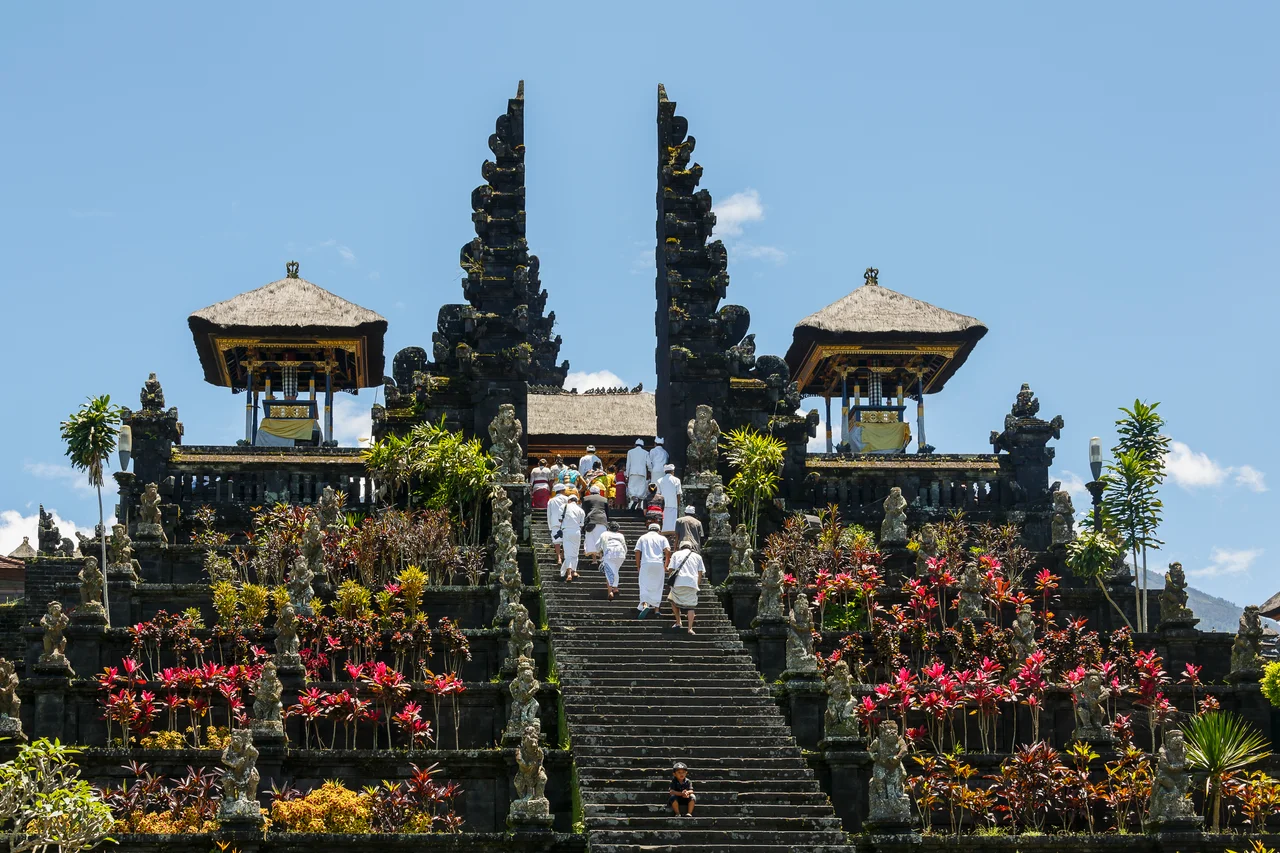

The Mother Temple: Bali's Stairway on the Volcano
In 1963, Mount Agung erupted with a fury that killed approximately 1,700 people. Lava flows coursed down the slopes, burying villages and reshaping the landscape of eastern Bali. At Pura Besakih, the Mother Temple, the island's most sacred site, the faithful watched the rivers of molten rock approach -- and stop. The lava missed the temple complex by mere meters. The Balinese interpreted the near-miss as divine intention: the gods wished to demonstrate their power, not destroy the monument their people had built. Whether miracle or topography, the result was the same. Besakih survived, as it has survived for centuries, clinging to the side of a volcano that could erase it at any moment.
Foundations Older Than Memory
The precise origins of Besakih are lost. But the stone bases of Pura Penataran Agung, the central and most important temple in the complex, resemble megalithic stepped pyramids dating back at least 2,000 years, suggesting the site was sacred long before Hinduism arrived. What is known is that by 1284, when the first Javanese conquerors settled in Bali and brought Hindu worship with them, Besakih was already a place of spiritual significance. By the 15th century it had become the state temple of the Gelgel dynasty, the most powerful rulers in Balinese history. The temple's authority grew alongside the dynasty's, until Besakih was not merely a place of worship but the spiritual axis of the entire island -- the point where human devotion met volcanic power, where the earthly realm reached toward the divine.
Twenty-Three Temples, One Axis
Besakih is not a single building. It is a complex of 23 separate but interconnected temples arranged on parallel ridges, all aligned along a single axis that points upward toward the summit of Mount Agung. The architecture is a choreography of ascent: stepped terraces, flights of stone stairs, brick gateways, and courtyards rise through six levels toward the main sanctuary, Pura Penataran Agung. The entrance begins with a candi bentar, the split gateway that in Balinese architecture symbolizes the division between the outer world and the sacred interior. Beyond it, the Kori Agung gateway leads to the second courtyard. Meru towers -- multi-tiered pagoda-like structures representing the cosmic mountain -- punctuate the skyline. At the symbolic center of the main sanctuary sits the padmasana, the lotus throne, dating to roughly the 17th century. It is the ritual focus of the entire complex: the point where offerings are made to the supreme god, Sang Hyang Widhi Wasa.
Seventy Festivals a Year
Besakih is not a museum. It breathes with ceremony. At least 70 festivals are held at the complex each year, because nearly every shrine within the 23 temples celebrates its own annual anniversary. The calendar governing these celebrations is the Pawukon, the 210-day Balinese cycle that structures religious life across the island. The grandest ceremony is the Bhatara Turun Kabeh, held during sasih kadasa, when the gods are believed to descend from heaven to inhabit the temple. During these occasions, the complex fills with thousands of worshippers dressed in white, carrying towers of fruit and flowers on their heads as offerings. Incense smoke drifts between the meru towers. Gamelan music rises from the courtyards. The temple becomes what its architects intended it to be: not a monument to the past but a living connection between the human world and the divine, renewed with every offering laid upon the lotus throne.
Sacred Ground, Contested Ground
Besakih's spiritual importance has not shielded it from earthly problems. For years, visitors approaching the temple encountered unofficial toll collectors -- local youth demanding payments for unsolicited guide services, tarnishing the experience and Bali's broader tourism reputation. In March 2023, President Joko Widodo inaugurated a new arrangement of facilities for the sacred area, emphasizing that the temple must be maintained with respect so that its aura of holiness can be felt by all who enter. The intervention reflected a growing recognition that Besakih's future depends on balancing access with reverence. The temple draws both pilgrims and tourists in enormous numbers, and without careful management, the sheer volume of visitors risks overwhelming the site. Yet Besakih has endured worse than crowds. It has survived earthquakes, eruptions, and the passage of empires. The volcano above it remains active, a constant reminder that the sacred and the dangerous are, on this island, the same thing.
From the Air
Located at approximately 8.37S, 115.45E on the southwestern slopes of Mount Agung (3,031 m), Bali's highest peak. The temple complex is visible from medium altitude as a terraced clearing on the forested mountainside, roughly 1,000 meters above sea level. Mount Agung's distinctive conical profile dominates the eastern Bali skyline and serves as an unmistakable landmark. Ngurah Rai International Airport (WADD/DPS) in Denpasar lies approximately 75 km to the southwest. The caldera of Mount Batur is visible to the northwest. Approaching from the south, the terraced rice paddies of central Bali give way to the steeper, drier slopes of Agung. Weather is tropical; cloud cover frequently develops around the peak by midday, so morning approaches offer the clearest views.
Nearby Stories
- Nusa Lembongan: Where the Seaweed Farmers Became Surf Guides 8.4 km away
- Eight Patrols and a Midnight Torpedo 9.8 km away
- The Day Seririt Fell Silent 25 km away
- The Words Written on Leaves 28 km away
- Lombok 33 km away
- Alas Purwo: Where Java Begins and the Surf Never Stops 55 km away
- Forty-Five Men and Thirty-Six Depth Charges 70 km away
- Java's Little Africa 71 km away