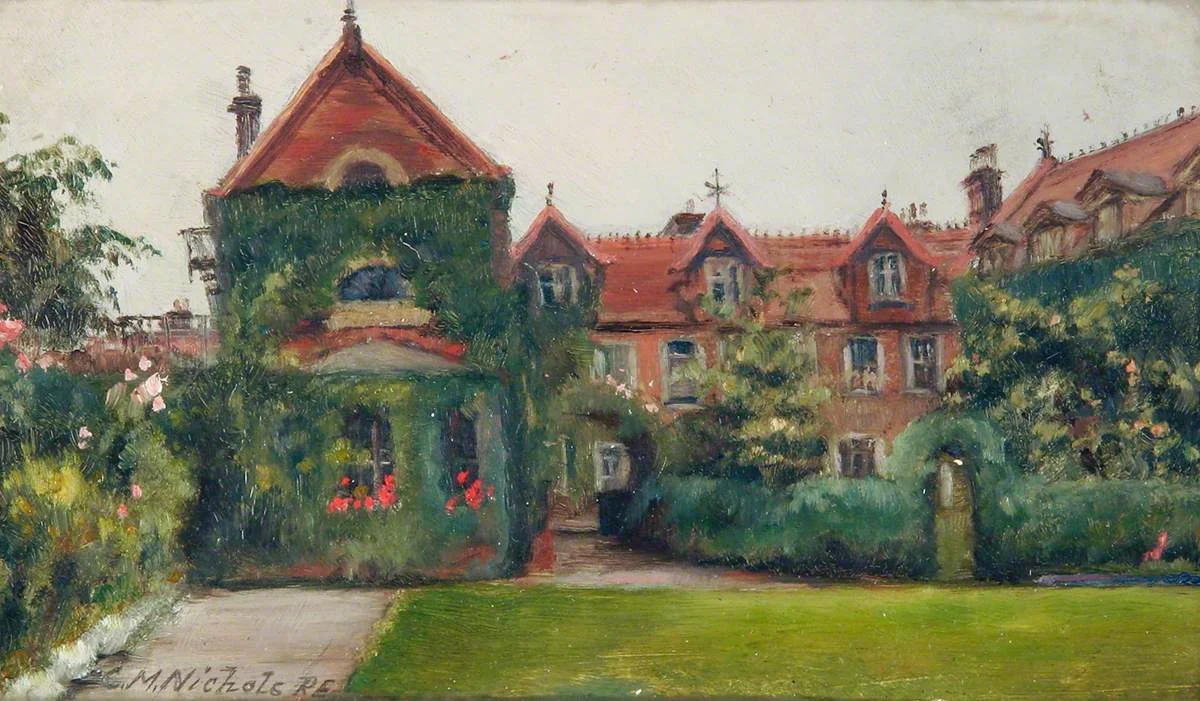
_-_Bethel_Hospital,_Norwich_-_NWHCM_,_1940.75.8_,_F_-_Norfolk_Museums_Collections.jpg)
Bethel Hospital, Norwich
Mary Chapman lost her husband in 1700 and outlived him by 24 years. She had no children. They had talked, during their 18 years of marriage, about founding a charity, and Samuel had chosen the name: Bethel, meaning 'house of God' in Hebrew. The reason was personal. Mary and Samuel had both watched family members struggle with what their century called lunacy, conditions we would now describe as mental illness. Mary felt gratitude that her own mind had been spared, and compassion for those whose minds had not. In 1712 she secured a thousand-year lease at peppercorn rent on a piece of central Norwich land. She built a house on it. The foundation stone, dated 1713, declared that the building was for 'the benefit of distrest Lunaticks' and that it could never be put to any other use. It was the first purpose-built hospital for mental illness in Britain.
The Site of the Great Blow
The land Mary chose had a violent past. It sat where Committee House had stood, a building that symbolized Parliament's authority over Norwich during the English Civil Wars. In April 1648, during a pro-royalist riot, 98 barrels of gunpowder stored in the Committee House detonated, in what became known as the Great Blow, the largest accidental explosion recorded in 17th-century England. Buildings collapsed across the surrounding streets. Norwich was still patching itself together decades later when Mary Chapman chose this scarred patch of ground for her hospital. Whether the choice was symbolic, practical, or both, is not recorded. The street it stood on was renamed Bethel Street for the hospital.
1713 to 1724: Mary's Hospital
The early Bethel was small. Construction cost 314 pounds, 2 shillings, and 6 pence. Carpenter Richard Starling and mason Edward Freeman built two wings and two stories. The hospital opened with no doctors. Henry Harston, who was in charge of the house in October 1719, appears to have been a layman without medical qualifications. So did his successor Robert Waller. The care given was largely custodial: protection of patients against, in the wording of the period, 'exploitation, self-injury or assault.' For its time this was a meaningful improvement on the available alternatives, which were the streets, the workhouse, or the cells of Bedlam in London. Mary Chapman died on 8 January 1724. Her will turned the hospital into an independent public trust managed by seven trustees.
The 18th Century: Strait-Waistcoats and Surplus
Reading the 18th-century records of Bethel Hospital requires holding two truths at once. The treatment was, by modern standards, brutal: the 1743 inventory included handcuffs, padlocks, chairs, and staples; in 1749 a bathroom and strawroom were converted into a 'Cellar for the worst of the Lunatics to be put in'; in 1758 the hospital ordered three strait-waistcoats for 'disorderly lunatics.' But the patients were not abandoned, not chained in workhouse corners, not exhibited to paying tourists as Bedlam's were. They had identities, advocates, a trust that paid for their care, and an institution whose declared purpose was their recovery rather than their containment. Patient numbers grew from 25 in 1743 to almost 50 by 1760. By 1765 the hospital had been incorporated; its trustees became governors; it ran a substantial surplus.
Quakers, Gurneys, and Reform
The 19th century brought new ideas about mental illness and new families to the Bethel's governing committee. The Gurney family, prominent Norwich Quakers and bankers, took an increasing role. By 1824 the committee's religious affiliations had shifted from the original Anglican to predominantly Quaker, the same denomination that produced Elizabeth Fry, the Quaker prison reformer, who happened to be a Gurney by birth. Average patient stay in the first half of the 19th century was 14 years. In 1791 the hospital added eight beds; patient numbers doubled from 31 in 1793 to 65 in 1806, with non-paying charity patients dropping from 40% to 20% of the population. In 1875 the hospital had 70 patients, and by 1931 it had 128. The building expanded repeatedly: the front facing Bethel Street was remodelled in 1899 by architect Edward Boardman.
NHS, Closure, and Listed Survival
In 1948 the National Health Service was created, and the Bethel was absorbed as an annex of Hellesdon Hospital. The institution that had begun as one woman's private act of charity now belonged to the British state. In 1974 the building became an outpatient unit for children needing psychiatric treatment. It closed by 1995, replaced by more modern facilities elsewhere in the city. The Grade II* listed building still stands in central Norwich, awaiting the conversion to a new use that has been under discussion for decades. For 282 years, on the same street, with a name chosen by a grieving widower for a charity that he did not live to see open, this place housed people whose minds had given them more pain than they could carry. Mary Chapman, who started it, had never been one of them; she had only loved some who were.
From the Air
Bethel Hospital sits at 52.62798 degrees north, 1.28955 degrees east, on Bethel Street in central Norwich, England. The site is in the dense historic core, a few hundred meters southwest of Norwich Castle. Nearby aviation: Norwich Airport (EGSH) is roughly 3 nautical miles north-northwest. Recommended viewing altitude is 1,500 to 2,500 feet AGL to see the Grade II* listed building in its tight urban context alongside the cathedral, castle, and other medieval landmarks. The eroded site of the 1648 Great Blow is part of the streetscape itself.
Nearby Stories
- Sheringham 2.7 km away
- Wingfield Castle 4.4 km away
- Castle Acre Castle and Town Walls 6.3 km away
- Brancaster 7.1 km away
- West Stow Anglo-Saxon Village 9.3 km away
- Four Days' Battle 80 km away
- Battle of Lowestoft 80 km away
- SM U-97 110 km away