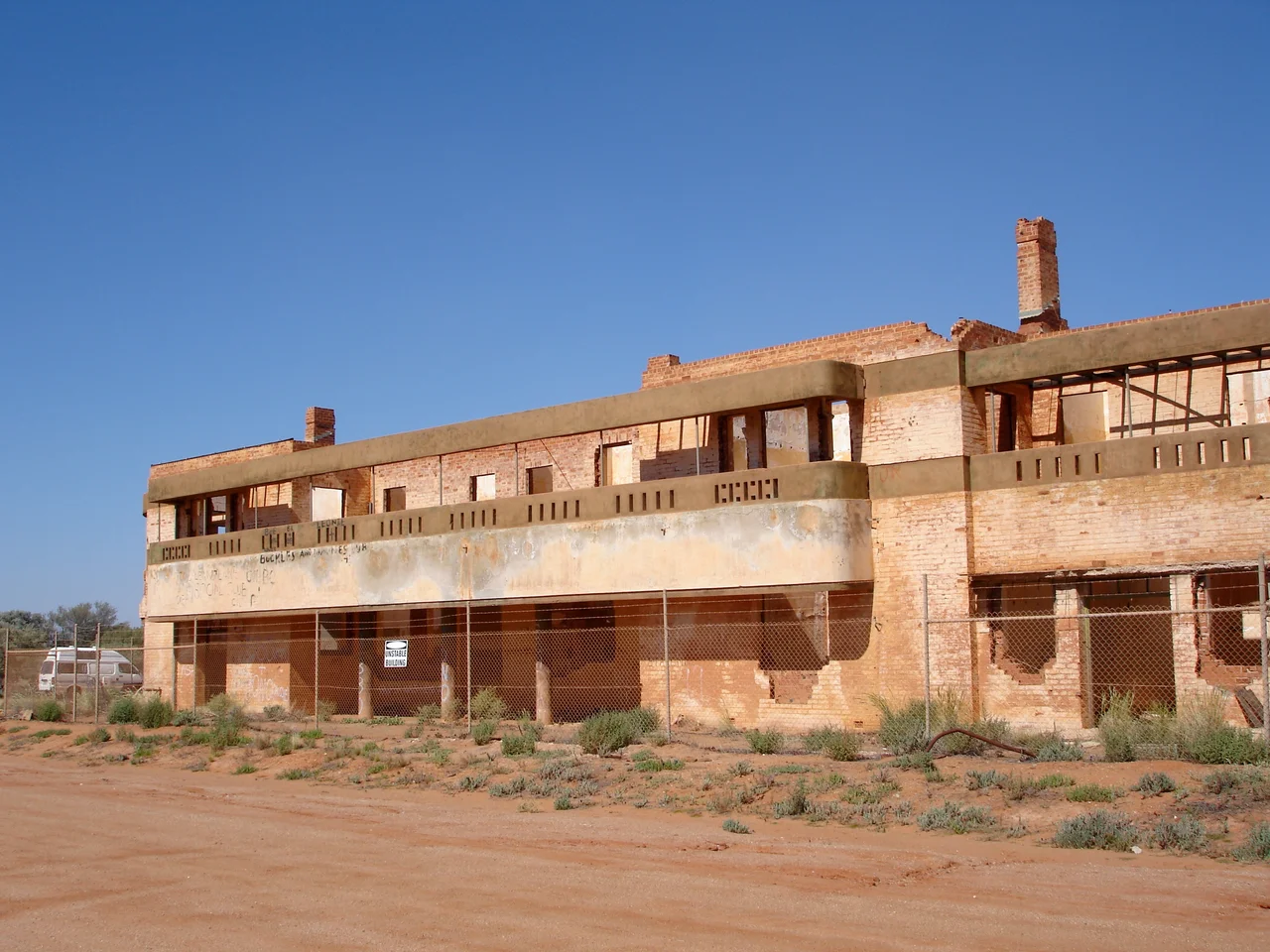

Big Bell, Western Australia
Most goldfields towns grew by accident, a tangle of tents that hardened into streets. Big Bell was different - it was planned. In 1935 the Premier Gold Mining Company announced it would develop the Big Bell mine, and a town was laid out to serve it, gazetted in 1936 with proper roads and a population that soon swelled to around 850. The centrepiece was a two-storey art deco hotel whose bar, by local reckoning, was one of the longest in the country. Today the hotel is a roofless brick shell, and the streets it anchored survive only as faint dirt lines in the scrub.
A Bar Worth the Trip
The Big Bell Hotel opened in 1937, a large two-storey building in brick with the clean, confident lines of its art deco era - colonnades along the north and east faces, a graceful curved corner, a tiled roof catching the desert sun. It was the kind of building meant to tell a young town it had arrived. And it had a claim to fame that has outlasted the roof: the hotel was reputed to have one of the longest bars in Australia. In a remote mining town where the work was hard and the heat relentless, that bar was the social engine - the place where shifts ended, deals were struck and the week was washed away. The walls still stand; the legendary bar is long gone.
The Railway That Came and Went
A town built around a single mine needs a lifeline, and Big Bell's was the railway. The Cue-Big Bell Railway Act passed in November 1936, after the Western Australian government struck an agreement with the American Smelting and Refining Company to build the line. The first train rolled into Big Bell on 6 January 1937, though the line was not officially opened until that August. Its history mirrors the mine's fortunes exactly. Services stopped in September 1944 as wartime priorities bit, then revived the next year as the war in Europe wound down and the mine reopened. The line finally closed on the last day of 1955, and a 1960 act formally struck it from the books. The rails came up; the embankment remains.
Gold by the Tonne
The gold here was first found in 1904 by Harry Paton, and a mine was quickly established, though ownership changed hands repeatedly before the Premier company gave the field its modern shape. Over its working life from 1904 to 1955 the historic Big Bell mine produced some 730,000 ounces of gold. When the mine shut in the mid-1950s the town emptied almost overnight, virtually deserted within a season. But the ore body was far from exhausted - once described as Australia's biggest unexploited gold deposit, it drew miners back in the 1980s and again in the 2020s under modern operators, the workings now run from a fly-in camp rather than a town with a hotel.
A Town You Read from the Air
Mining ceased again in 2003, and by 2007 the processing plant was dismantled and trucked off to feed a mine near Westonia, hundreds of kilometres south. What it left behind is a townsite best appreciated from above. Not many buildings remain standing, but the original road grid is still etched into the ground as dirt tracks, so clear that the whole layout of Big Bell reads plainly from the air - the blocks, the streets, the shape of a community planned on paper and abandoned to the desert. The brick hull of the hotel anchors the pattern, a single recognisable landmark in a diagram of a town that used to be.
From the Air
Big Bell sits at about 27.34 degrees south, 117.66 degrees east, roughly 30 km southwest of Cue, on terrain near 1,400 ft MSL. It is an unusually rewarding ghost town to overfly: the grid of former streets is clearly visible as pale dirt lines, with the two-storey brick ruin of the Big Bell Hotel as the obvious anchor point, and the modern mine workings nearby. Cue Airport (ICAO: YCUE) is the closest aerodrome to the northeast; Mount Magnet (YMOG) lies about 74 km south and Meekatharra (YMEK) about 112 km north. A pass at 3,500 to 5,000 ft MSL captures the full town footprint. The Murchison sky is typically clear and hard-edged; watch for dust and heat shimmer on hot afternoons.
Nearby Stories
- Wilgie Mia 13 km away
- Mullewa–Meekatharra railway 20 km away
- Austin, Western Australia 28 km away
- Nannine, Western Australia 30 km away
- Boolardy 54 km away
- Yarrabubba 69 km away
- Sandstone, Western Australia 123 km away
- Ajana 243 km away