
One Billion Barrels of Black Gold
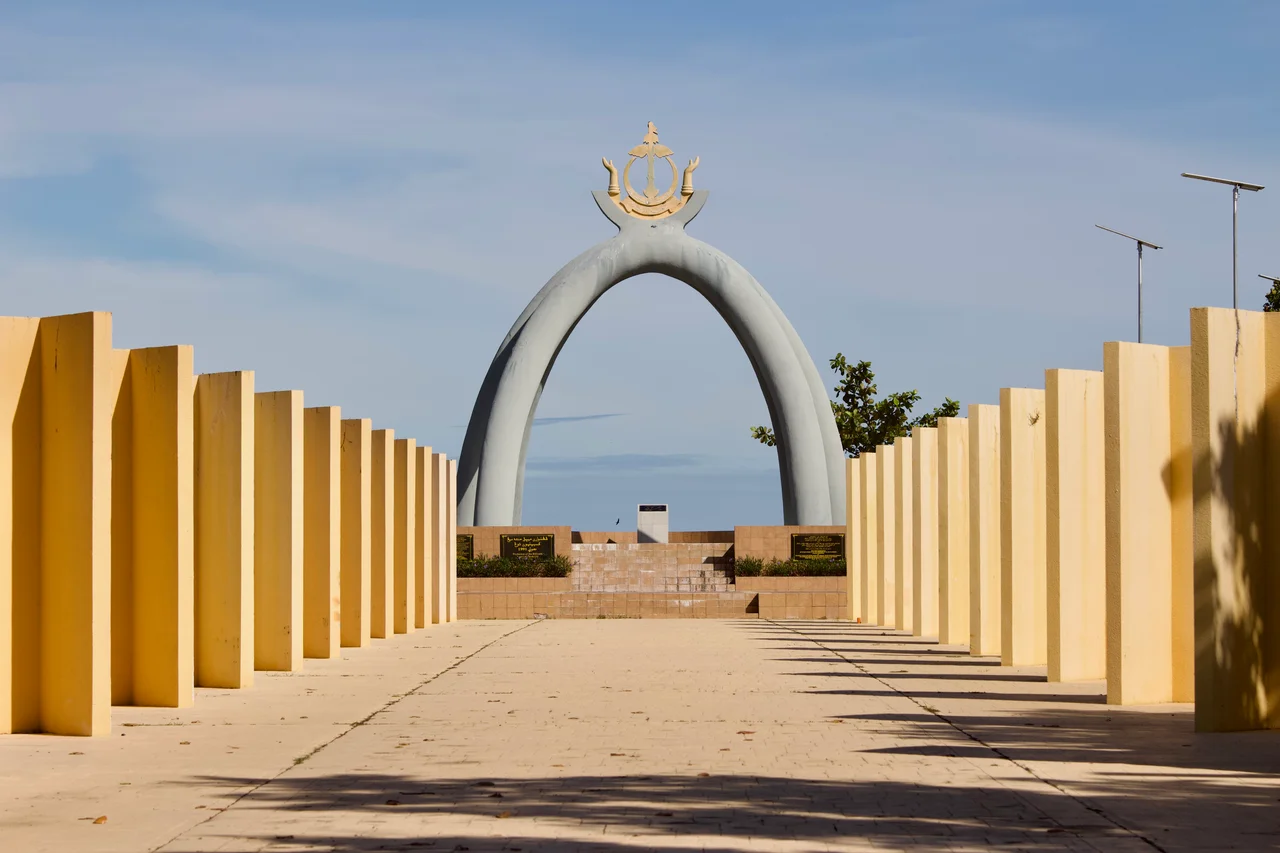
The monument sits where it has to sit -- on Seria Beach, steps from the spot where Well S-1 first struck oil on April 5, 1929. Five concrete pipes rise from a raised platform paved with Islamic geometric tiles, forming an arch that frames the South China Sea beyond -- their number a reference to the Five Pillars of Islam. At its apex, gilded in gold leaf, is the coat of arms of Brunei. On July 18, 1991, the Seria field produced its billionth barrel of crude -- a date that was also Sultan Hassanal Bolkiah's 45th birthday and the 62nd anniversary of oil's discovery in Brunei. The monument commemorating this milestone was formally unveiled on May 8, 2004, in ceremonies marking the 75th anniversary of Brunei's oil industry. Three milestones, one monument, one reckoning with what a single well in a coastal mangrove swamp had made possible.
The Well That Changed Everything
Seria Well No. 1 was drilled using the cable-tool method on the coastline of what was then an unremarkable stretch of mangrove and sand. It reached a depth of 978 feet and produced 760 cubic meters of gas along with its oil. The well's productive life was brief -- it ceased flowing on June 30, 1929, after yielding 5,320 barrels. But S-1 proved the geology. The Seria anticline, a geological fold straddling the present-day coastline, held oil in Upper Miocene sandstone, and plenty of it. By 1935, thirty-six wells had been completed in the field. By 1936, that number reached fifty-three. The British Malayan Petroleum Company, later Brunei Shell Petroleum, expanded operations along the coast, and the nodding donkey pump jacks that replaced the original drilling rigs became the defining feature of the Seria landscape -- rows of green-painted mechanical arms bobbing rhythmically against the sea.
Five Pipes, Five Pillars
The monument's design is deliberate in its symbolism. Five concrete pipes rise from the platform to form the arch, their number a reference to the Five Pillars of Islam -- faith, prayer, charity, fasting, and pilgrimage -- the spiritual framework of the sultanate that oil wealth sustains. Brunei Shell Petroleum commissioned the structure, and the entirely concrete construction gives it a permanence befitting its subject. Along the pathway approaching the arch, interpretive panels tell the story of oil and gas exploration in Brunei -- from early prospecting in the Belait District to the offshore operations that expanded production in later decades. Surrounding the monument, the petroleum company placed actual oil production equipment: pump jacks, drilling tools, and a railway locomotive that once served the field's internal transport network. The effect is part memorial, part open-air museum. Visitors walk through the industrial machinery that built a nation's wealth before arriving at the monument that commemorates the result.
A Tiny Nation's Enormous Fortune
To grasp what one billion barrels meant for Brunei, consider the country's scale. A sultanate smaller than Delaware, with a population that has never exceeded half a million, sits atop reserves that have generated a GDP per capita among the highest in Asia. Oil and gas revenues fund free healthcare, free education, subsidized fuel and electricity, and public-sector employment for a significant portion of the population. There is no income tax. The Sultan of Brunei, one of the world's wealthiest monarchs, resides in a palace with 1,788 rooms. All of this traces back to a well on a beach. The Seria field was not the only source -- offshore discoveries in the 1960s expanded production further -- but it was the foundation. The Billionth Barrel Monument marks the moment that foundation proved its depth.
Nodding Donkeys on the Shore
Walk the beach near the monument and the Seria oil field makes itself felt. Pump jacks -- the nodding donkeys, named for their rhythmic bowing motion -- line the shore, painted forest green as if the petroleum company hoped they might blend into a landscape they have thoroughly transformed. Pipelines run across the sand. The hum of extraction is constant. Once this was mangrove swamp; now it is an industrial coastline producing hydrocarbons around the clock. The juxtaposition is surreal. Families picnic on the beach between working pump jacks. The monument stands at the entrance to this scene, a gateway between the recreational shoreline and the machinery that funds the nation. From the air, the pattern is unmistakable -- a line of mechanical arms stretching along the coast, each one dipping and rising in its own slow tempo, drawing wealth from the earth as they have for nearly a century.
From the Air
Located at 4.617N, 114.317E on Seria Beach in Brunei's Belait District, along the South China Sea coast. The monument is at the beach entrance near the historic site of Well S-1. From the air, the Seria oil field is unmistakable -- rows of nodding donkey pump jacks line the coast for several kilometers. The monument's raised platform and arch structure are visible at lower altitudes. Nearby military installations of British Forces Brunei (Tuker Lines, Medicina Lines) are visible to the south. Nearest airport: Brunei International Airport (WBSB) approximately 80 km northeast. Anduki Airfield is closer but primarily serves oil industry operations. Recommended viewing altitude: 1,500-3,000 feet for monument and beach detail; 5,000-8,000 feet for the full extent of the Seria oil field along the coast.
Nearby Stories
- The Sultan's Gurkhas 2.4 km away
- The Town That Splits a Nation 12 km away
- Kelabit Highlands 20 km away
- The Billion-Dollar Playground That Michael Jackson Opened 45 km away
- The Ants of Borneo 56 km away
- Niah National Park 66 km away
- Similajau National Park 156 km away
- Luconia Shoals 185 km away