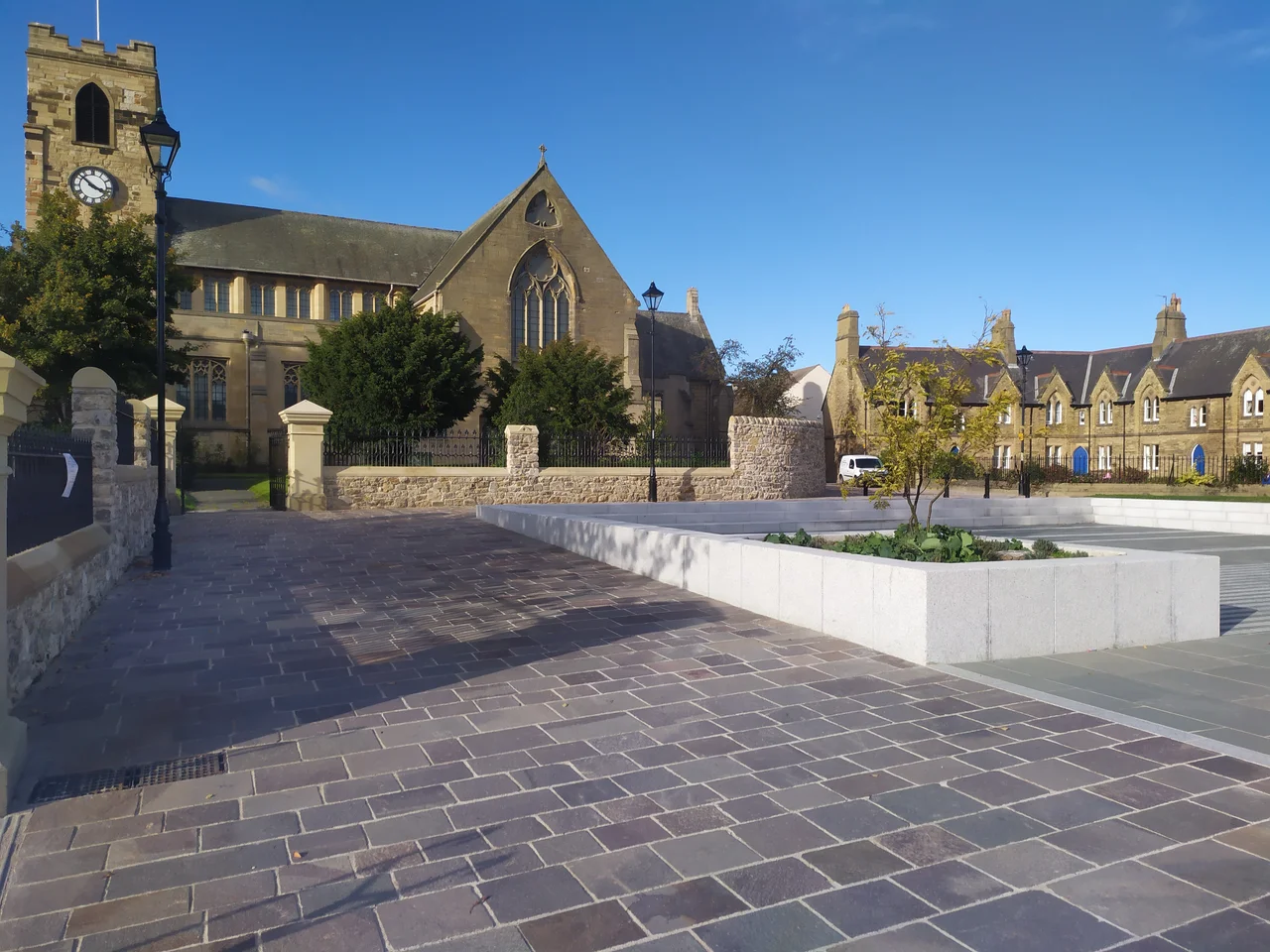

Bishopwearmouth
On 31 October 1828, in a parish that had been donated to the Bishop of Durham nearly nine hundred years earlier, Joseph Swan was born. He would go on to perfect the incandescent light bulb in 1879 - a year before Edison, in his own laboratory, with his own design. Wearside has never quite forgiven the world for forgetting. Swan's birthplace was Bishopwearmouth, the west side of modern Sunderland but once a separate village around its own ancient green and church. The settlement was formed in 930, when King Aethelstan granted the lands south of the River Wear to the Bishop of Durham, and the place still wears that early history in its street pattern and its surviving minster.
The Bishop's Land
Monkwearmouth, on the north bank of the river, had been founded 250 years earlier as a Benedictine monastery - the place where the Venerable Bede was raised. Bishopwearmouth, on the south bank, came later but came large: a parish covering some twenty square miles, taking in townships that would become the modern Sunderland suburbs of Ryhope, Silksworth, Ford and Tunstall. The 10th-century church stood at the heart of the village, surrounded by a green that was the centre of community life for centuries. Three medieval streets - High Row, Low Row, and the Lonnin, now Sunderland High Street - still trace their original shapes through the modern city. The Lonnin connected the bishop's village to the small fishing port at the river mouth that gave Sunderland its name.
The Rectory and the Door
Through the Middle Ages the rectory dominated Bishopwearmouth - a wealthy living with 130 acres of land spreading west toward what is now Chester Road and Bishopwearmouth Cemetery, plus a tithe barn, a park, and additional acres beside the river. The rectors lived very well indeed. The Bishopwearmouth Burn ran past the village into the Wear before urbanisation buried it. In 1855 the old rectory was demolished, but its doorway arch survived: it was carefully removed and rebuilt as a feature in the newly created Mowbray Park, where it stood for over a century. In the 1990s, local artists recreated the old rectory door and its signature lion knocker - an act of memory in a city that had lost most of its medieval fabric to industry.
Three Children of the Village
For a former parish church village, Bishopwearmouth produced an outsized cast of historical figures. Major-General Sir Henry Havelock, the British military commander whose statue still stands in Trafalgar Square, was born here on 5 April 1795. Joseph Swan, the inventor of the practical incandescent light bulb, was born in the village in 1828. The physician and antiquarian Thomas Coke Squance was a son of Bishopwearmouth. And Helen Kirkpatrick Watts - the women's suffrage activist who was deaf, an unusual voice in the movement - was born in the village in 1881 and lived until 1972. Four lives across two centuries, in a parish whose 1891 population was 87,648 before it was formally abolished and absorbed into Sunderland on 25 March 1897.
Sunderland Minster
The church of St Michael's, on the medieval green, was renamed Sunderland Minster in 1998 - a recognition that this had become the principal church of a city. The other Bishopwearmouth church, Christ Church, was declared redundant on 11 February 1998 and sold to become a Sikh temple and community centre, an exchange that quietly traces the demographic story of the modern city. From the air, the west side of Sunderland reads as denser brick than the river-side districts, with the Minster's tower as the tallest old marker. The line where the modern city street grid meets the curve of the medieval green is still legible from above - centuries of street planning compressed into a single neighbourhood.
From the Air
Located at 54.9058 N, 1.38879 W, on the west side of Sunderland city centre. Recommended viewing altitude 2,000 to 4,000 feet. Nearest airports: Newcastle International (EGNT) approximately 10 nm north-west, Durham Tees Valley (EGNV) further south. Visual landmarks include the River Wear curving through the city, Sunderland docks at the river mouth, Mowbray Park, and the tower of Sunderland Minster at the heart of the old village footprint.
Nearby Stories
- Seaton Carew 2.7 km away
- HMS Unity (N66) 6 km away
- George Stephenson's Birthplace 6.1 km away
- Raby Castle 9 km away
- Cragside 15 km away
- Whitby Abbey 21 km away
- German submarine U-2367 46 km away
- Alexander L. Kielland (Platform) 277 km away