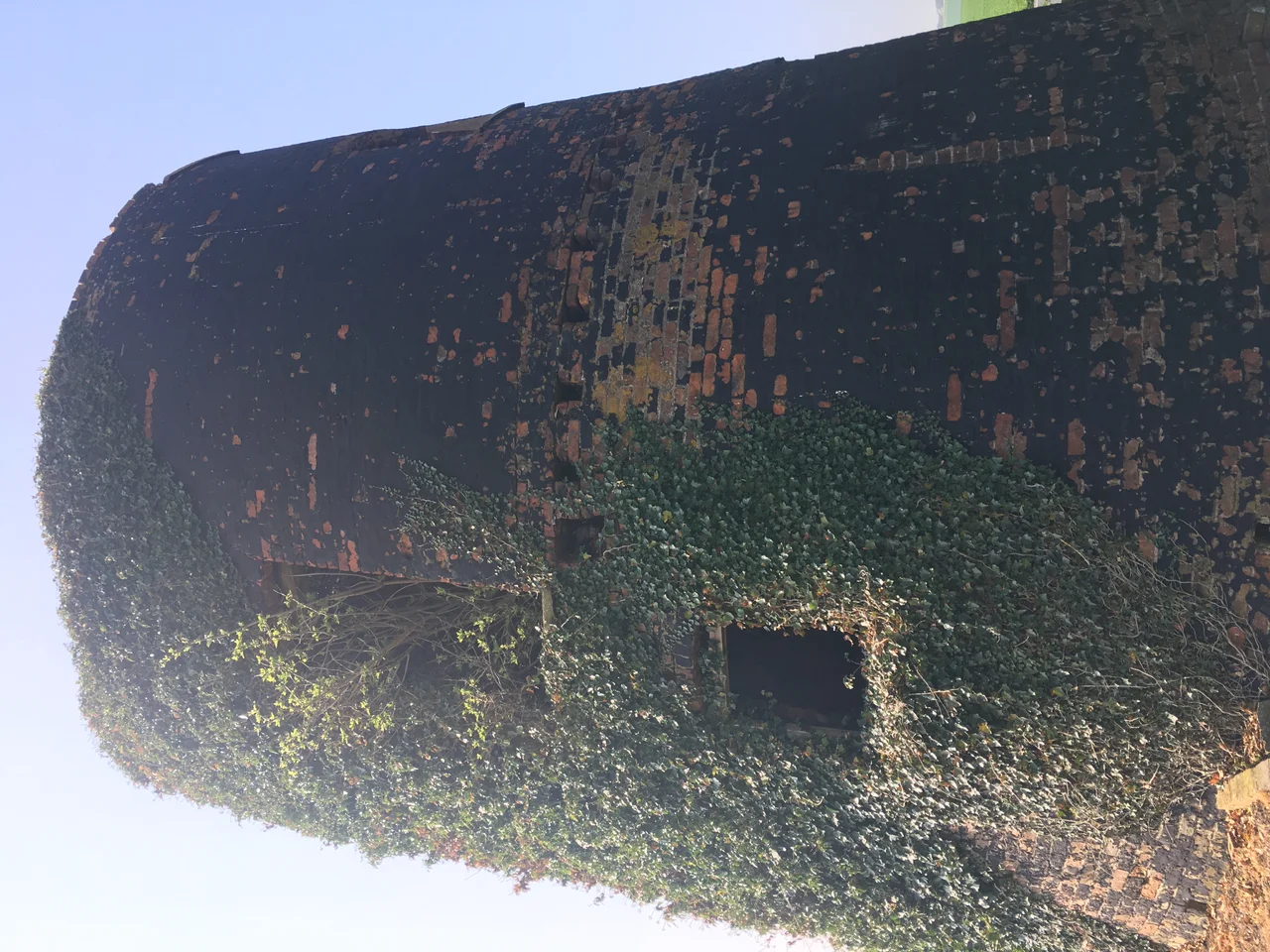

Black Mill, Waxholme
In 1917, an army signals officer named J.R.R. Tolkien was stationed in East Yorkshire, recovering from trench fever after the Somme. His wife Edith came to stay nearby. One afternoon she danced for him in a hemlock glade near the village of Roos, and he wrote about it for the rest of his life: she became Luthien Tinuviel, the elven princess, and he became Beren the mortal who loved her. Less famously, when he stood on Thirtle Bridge a few miles further south, he could see two towers on the flat Holderness horizon: the Withernsea lighthouse to the east and, halfway between, the dark truncated stump of an old windmill at Waxholme. Some readers of Tolkien have wondered ever since whether these were the original Two Towers.
Half a Mill Standing
Black Mill is also called Owthorne Mill, after a vanished village along this stretch of the eroding Holderness coast. A tower windmill has stood on this site since at least 1648. The last record of it working as a mill is around 1900, after which it became a landmark rather than a machine. The top of the tower was removed during the World Wars and used by the army as a coastal lookout, watching the grey North Sea for German shipping and Zeppelins. Only the bottom half of the brick tower remains now, dark and squat against the open fields, half a structure marking time in a landscape that has refused to stop changing.
The View From Thirtle Bridge
Walk from Roos to the coast along the country roads here and you reach Thirtle Bridge, a quiet crossing that gives onto a sweep of flat farmland leading to the sea. Less than two miles away, the white tower of Withernsea lighthouse rises 127 feet against the sky, slim and pale and unmistakably nautical. Halfway between Thirtle Bridge and the lighthouse, on slightly higher ground, sits Black Mill, dark where the lighthouse is light, blunt where the lighthouse is graceful. Local Tolkien scholar Phil Mathison made the connection in his book Tolkien in Holderness, and Michael Flowers of the Tolkien Society pointed out something striking: in Tolkien's own original rejected cover design for The Two Towers, the White Tower looks remarkably like a lighthouse. HarperCollins resurrected that cover in 1998 for their three-volume edition.
A Landscape That Made a World
Tolkien spent only months in East Yorkshire. He never wrote explicitly about Holderness in his Middle-earth books. The argument that Black Mill and Withernsea lighthouse inspired the Two Towers will always be a matter of literary speculation rather than proof. But the Holderness landscape clearly worked on him in some quiet, lasting way. The Roos hemlock glade became Luthien's dancing floor. The flat fields and shifting coast, the villages slowly slipping into the sea, the long views to distant towers across an empty horizon - these are not unlike the scenery a hobbit might cross. The Black Mill stump still stands, still watching, still inviting the suggestion that one of the strangest fantasies in English literature began with a quiet view from a country bridge.
From the Air
Black Mill sits at approximately 53.74N, 0.01E in the hamlet of Waxholme, just inland from the eroding Holderness coast between Withernsea and Hornsea. Recommended viewing altitude is 1,500 to 2,500 feet AGL. The distinctive white tower of Withernsea lighthouse is visible just over a mile south-east and provides easy orientation. The nearest airport is Humberside (EGNJ) approximately 20 nm west. The Holderness coast retreats at one of the fastest rates in Europe and the shoreline below has changed visibly within living memory.
Nearby Stories
- Humber Bridge 6.5 km away
- MS Piłsudski 7.8 km away
- SM UC-47 17 km away
- Sledmere House 19 km away
- Alford Windmill 19 km away
- RAF Scampton 20 km away
- HMS Cobra 26 km away
- Alexander L. Kielland (Platform) 317 km away