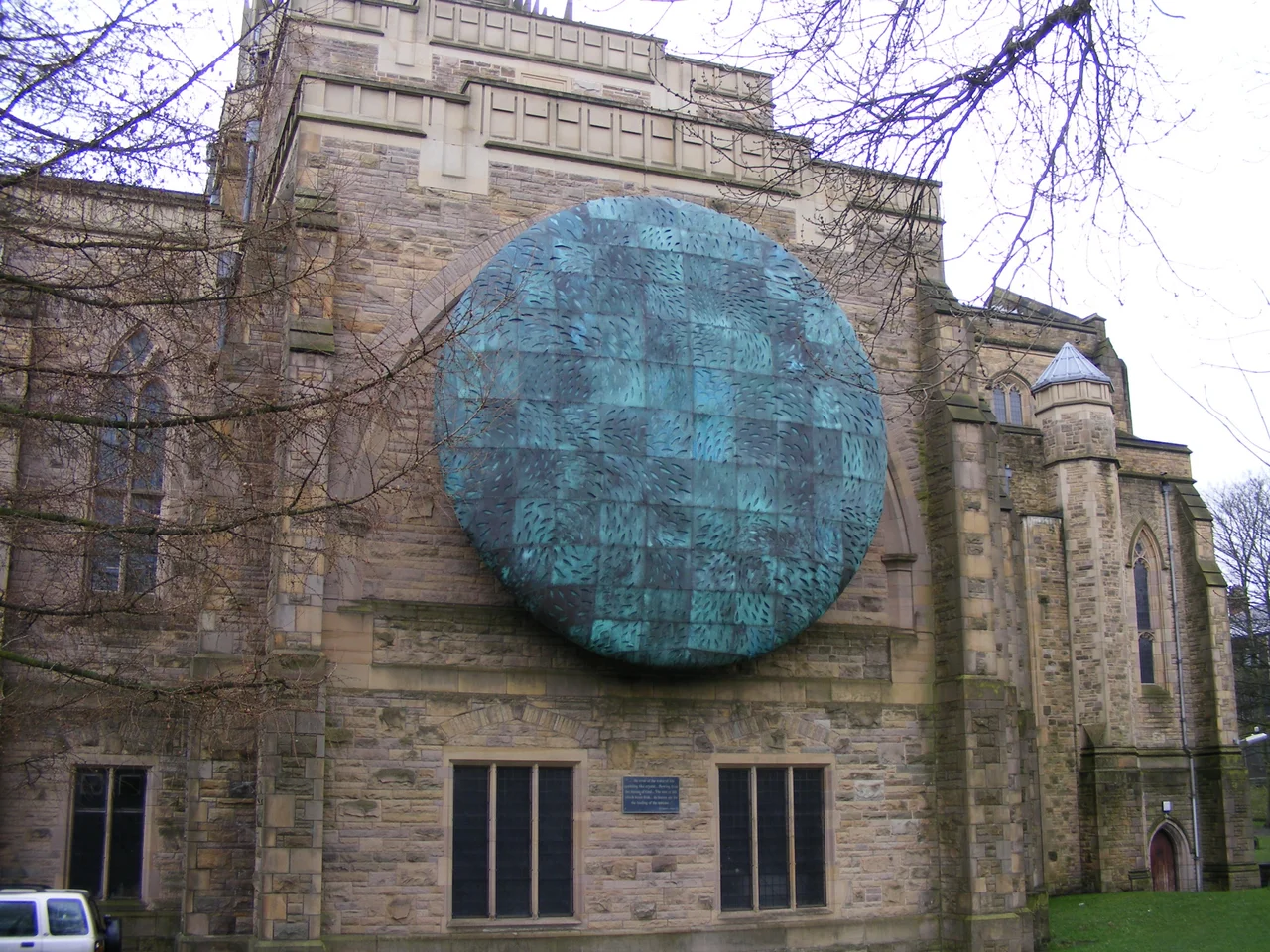

Blackburn Cathedral
When the slender aluminium spire above Blackburn's town centre catches the light at certain hours, the fifty-six panels of coloured glass in the lantern tower below it glow like a stained-glass beacon. It is a strikingly modern crown on what looks at street level like an ordinary Georgian parish church, and that mismatch tells the whole story of the building. Blackburn Cathedral is what happens when a 1826 nave gets a 1926 promotion to cathedral status, fundraises for a generation, breaks ground in 1938, gets interrupted by the Second World War, and finally consecrates the whole thing in 1977 after a lantern tower designed in 1967.
A Church for a Thousand Years
The site goes back further than the building. A church called Blagbourne is recorded here in 596 AD, in the early Christian missions to Anglo-Saxon Northumbria, which would make it one of the older Christian sites in northern England. A stone Norman church stood here after the Conquest. By the late eighteenth century the medieval church was old, the building was small for the booming cotton town spreading around it, and the parish demolished it in 1819 and 1820. John Palmer, a Lancaster architect, was commissioned to build the replacement in 1826: a clean Greek Revival nave with Gothic detailing, the kind of dignified market-town parish church Lancashire built by the dozen during the cotton boom.
Cathedral by Promotion
Palmer's church was a parish church for exactly one century. In 1926 the Diocese of Manchester was split, and the new Diocese of Blackburn needed a cathedral. Rather than building one, the diocese simply raised St Mary's to cathedral status. The Georgian nave became the cathedral nave, and the chapter began fundraising for the extensions a proper cathedral was supposed to have. By 1938 there was enough money to start. Work on the new east end began. Then the Second World War broke out, and Lancashire's cathedral builders, like most of the country's construction industry, stopped. Work resumed in the 1950s. The architect W. A. Forsyth died in 1950 and was succeeded by Laurence King, who designed the lantern tower that became the cathedral's signature.
The Lantern Tower
King's lantern tower was completed in 1967 and the cathedral itself was finished in 1977, more than thirty years after Forsyth's first stones went down. The tower's modernism, the aluminium spire and the panels of coloured glass that wash the interior with shifting light, sat oddly with Palmer's restrained Greek Revival nave. Many cathedral additions over the centuries do. By 1998 the concrete of the original 1960s tower was failing and it was rebuilt in natural stone, with the glass panels replaced. The east end roofs and parapets were rebuilt between 2000 and 2001. Mark Jalland's sculpture The Healing of the Nations, an abstract circular piece in steel and copper threaded with thousands of optical fibres that change colour at night, was installed on the exterior the same year. The cathedral was, after seventy years of construction, finally considered finished.
The Misericords
Eight fifteenth-century misericords sit in the north transept. They almost certainly came from Whalley Abbey, fifteen miles to the north-east, which was suppressed in the Dissolution of 1537. Where they were for the three hundred years between Whalley's suppression and Blackburn's nineteenth-century rebuild is unclear. They may have sat in a Lancashire builder's yard. They may have been kept in a private chapel. What is certain is that they survived, with their carved hidden faces and hinged seats designed to give monks somewhere to perch during long offices while still appearing to stand. Old wood with grim humour carved underneath, the misericords are quietly the oldest thing in the building.
The Working Cathedral
Elizabeth II made her first visit to the cathedral on 17 April 2014 for the Royal Maundy service, distributing Maundy coins to 88 men and 88 women in keeping with her age that year. The cathedral has shared a chapel with a Welsh Presbyterian congregation since 2023, a first-of-its-kind covenant between a cathedral and a non-Anglican denomination. During the COVID-19 pandemic in 2021, the crypt became one of the borough's largest public vaccination centres. The cathedral choir still sings the parish communion on Sundays, and the organ designed by Aristide Cavaillé-Coll in the 1870s still plays. The flagpole carved by Mark Bridges in 2009 is topped by a bishop's mitre painted in gold leaf with the Red Rose of Lancaster. Almost nothing about the building is original. Almost everything about it is Lancastrian.
From the Air
Located at 53.747N, 2.481W in central Blackburn, Lancashire. Manchester Airport (EGCC) lies 23 nm to the south-southeast and Blackpool (EGNH) 23 nm to the west. At 2,500 ft AGL, the cathedral's slender aluminium spire is visible at the centre of Blackburn town, set off against the surrounding red-brick mill town. The M65 motorway runs east-west through the town, with the A666 (Bolton Road) heading south. The Pennine Hills rise to the east. Typical Lancashire weather: low ceilings, frequent rain, prevailing southwesterly winds.
Nearby Stories
- Winwick rail crash 1.4 km away
- Hoylake Lifeboat Station 4.4 km away
- Murder of Lindsay Rimer 7 km away
- Mellor Mill 7 km away
- Embsay and Bolton Abbey Steam Railway 7.8 km away
- Piel Castle 11 km away
- Ashton Memorial 13 km away
- Hoylake 35 km away