.jpg)
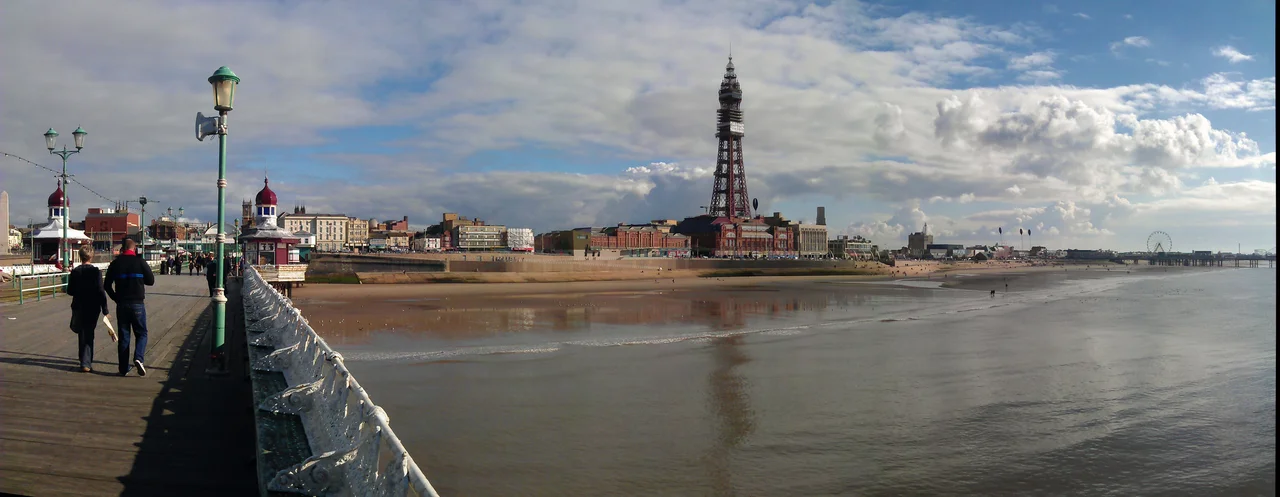
Blackpool Tower
On 22 December 1894 the Norwegian barque Abana, sailing from Liverpool to Savannah, was caught in a storm off the Lancashire coast and mistook a brand-new Blackpool landmark for a lighthouse. The captain steered toward it. The ship was driven onto the sands at Little Bispham. The crew survived; the Abana did not, and her timbers still surface at low tide. The thing the captain thought was a lighthouse had only opened to the public seven months before. Inspired by Gustave Eiffel's tower in Paris, raised by Lancashire architects James Maxwell and Charles Tuke and the Manchester engineers Heenan and Froude, Blackpool Tower stood 518 feet over the seafront, then the tallest man-made structure in the British Empire.
Built on Stubbornness
The Blackpool Tower Company was set up in 1890 by London-based Standard Contract & Debenture Corporation, which had bought an aquarium on Central Promenade with the intention of building an Eiffel replica on top of it. John Bickerstaffe, a former mayor of Blackpool, became chairman. The shares went on sale in July 1891. The prospectus took up the whole of page six of the Financial Times. Initially only two-thirds of the issue was taken up. With the company short of cash, Bickerstaffe bought up unsold shares himself - his stake grew from £500 to £20,000 - and personally rescued the venture from collapse. When the Tower finally opened on 14 May 1894, both Maxwell and Tuke were already dead. Total cost: about £290,000. Profit in 1896: £30,000. Bickerstaffe's gamble paid off.
30,602 Blocks of Hardwood
The Tower Ballroom, designed by Frank Matcham and opened in 1899, was built to keep visitors inside the building once they had paid to come in. The sprung floor measures 120 feet long and is made up of 30,602 blocks of mahogany, oak and walnut, fitted by hand. From 1930 until 1970 the resident organist was Reginald Dixon, known affectionately around the world as Mr. Blackpool, broadcasting live on the BBC Light Programme each week. The Wurlitzer organ rose theatrically through the floor at the start of every set. A fire in December 1956 destroyed the dance floor and gutted the restaurant beneath; restoration took two years and £500,000, with many original craftsmen coming out of retirement to do the work. Phil Kelsall has been resident organist since 1977 and was awarded the MBE for services to music in 2010, the same honour Dixon received before him.
Polar Bears and a Lion Called Wallace
Beneath the Tower, in a basement modelled on the limestone caverns of Derbyshire, was Dr. Cocker's Aquarium, Aviary and Menagerie - an attraction that pre-dated the Tower itself, having opened in 1873. The aquarium held 57 species of fresh and salt water fish, the largest tank holding 32,000 litres. The menagerie was less benign by modern standards. Lions, tigers and polar bears lived in cages under the Tower until the collection finally closed in 1973. One of those lions inspired a famous Marriott Edgar monologue from 1932, The Lion and Albert, in which a small boy is swallowed by a lion called Wallace; Stanley Holloway recited it for generations of British audiences. The aquarium was eventually replaced by the Blackpool Tower Dungeon.
A Circus That Floods
Tower Circus opened the same day as the Tower itself, 14 May 1894, and has not missed a season since - one of the longest continuously running circuses in the world. Frank Matcham designed the present interior in 1900, slotting a 42-foot ring between the Tower's four iron legs. The floor of the ring can be lowered into a pool of water at the end of each performance, allowing for Grand Finales with Dancing Fountains. Only four circuses in the world can still perform this trick. The Tower was painted gold by abseiling painters in 1994 for its centenary year; normally it wears its familiar dark red. In heavy winds the top sways visibly - up to an inch in a 70 mph blow - and a BBC writer once called it a magnificent Victorian engineering masterpiece. Painting the whole structure takes a team of specialists seven years from start to finish.
A Visual Reporting Point
During the Second World War, the crow's nest was removed and the structure repurposed as an RAF radar station known as RAF Tower. After Bickerstaffe family ownership ended in 1964, the building passed through EMI, Trust House Forte, First Leisure, and Trevor Hemmings' Leisure Parcs, before Blackpool Council bought it in March 2010 and brought in Merlin Entertainments to run the attractions. In 2025 the Council took the running back in-house under a new firm, Blackpool Tourism Ltd. From 380 feet up at the Tower Eye, glass-floored Skywalk visitors look straight down at the Comedy Carpet on the promenade - a vast pavement of catchphrases by artist Gordon Young. Look closely and you can read Bruce Forsyth's eternal nice to see you, to see you, nice. To general aviation pilots flying along the Blackpool coast, the Tower is simply known as the tall tower, a designated Visual Reporting Point on every chart.
From the Air
Blackpool Tower sits at 53.82 N, 3.055 W on Blackpool's Central Promenade, top elevation 518 ft above mean sea level. It is a designated Visual Reporting Point in Blackpool airspace, charted as 'the tall tower' for general aviation traffic working EGNH Blackpool, 1.5 nm east. From altitude in clear weather the Tower is visible 30+ nm in any direction along the Fylde Coast, distinctive against the flat coastal plain. The Blackpool Pleasure Beach lies 1.5 nm south. Manchester (EGCC) sits 35 nm southeast; Liverpool John Lennon (EGGP) 28 nm south. The Tower transmits FM radio (Radio Wave 96.5), so do not transit too close at altitude. Best viewed at dusk during the autumn Illuminations season, when the building itself is uplit and the seafront ribbon of lights extends six miles in either direction.
Nearby Stories
- RAF Cark 3.1 km away
- Bolton Steam Museum 3.2 km away
- Clitheroe Castle 4.5 km away
- Scarisbrick Hall 4.5 km away
- Hawes Junction Rail Crash 24 km away
- Abergele Rail Disaster 37 km away
- Egremont Castle 38 km away
- Celtic Array 60 km away