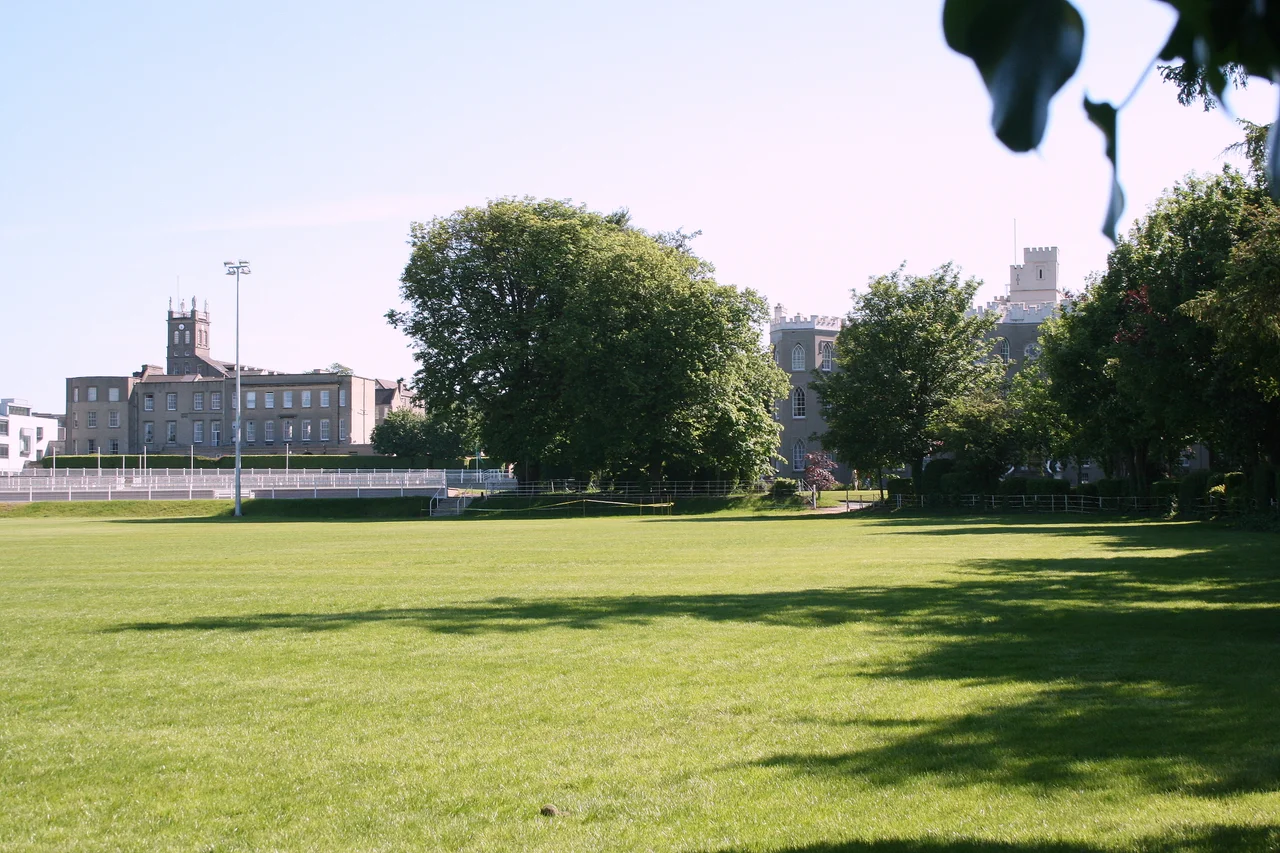

Blackrock College
In 1860 a young French missionary named Jules Leman bought fifty-six acres of parkland on the coast at Williamstown, between Blackrock village and the Irish Sea, and opened a school. He was twenty-six years old. His order, the Congregation of the Holy Ghost - the Spiritans - had two purposes for the new institution: train Catholic boys to become missionaries in the African and Indian missions the order maintained, and prepare the sons of Ireland's emerging Catholic middle class for university. Locals called it the French College. It was the first of five schools the Spiritans would open in Ireland. One hundred and sixty-five years later Blackrock College still occupies the same parkland, still teaches about a thousand boys, and is still trying to come to terms with the abuse perpetrated by its own priests across decades - revelations that broke publicly in 2022 and have not yet ended.
The French College Becomes Irish
Leman's bilingual experiment - French-speaking priests teaching Irish boys in Latin and English - quickly took root. By the 1880s Blackrock had a civil service training department and a university department whose students sat exams for the Royal University of Ireland. The university operation ran for over forty years until the rise of University College Dublin made it redundant in the 1920s, and the school focused on the Junior Certificate and Leaving Certificate examinations that have defined Irish secondary education ever since. Williamstown Castle - the boarding house on the campus that students simply call 'The Castle' - was built around 1780 as a country mansion by Counsellor William Vavasour, then extensively redeveloped by a later owner who added the castellated finish that gave it the name. Daniel O'Connell, the great nineteenth-century Catholic emancipator, dined there on occasion. For years his portrait hung in the room that is now the school's oratory. The Holy Ghost Fathers studied theology at Blackrock Castle from 1924 until 1933, then moved back to Kimmage Manor on the other side of the city.
De Valera's School
Eamon de Valera, six times Taoiseach and the third president of Ireland, studied at Blackrock College and later returned to teach mathematics there. The 1932 International Eucharistic Congress in Dublin - one of the largest religious events in twentieth-century Europe, drawing hundreds of thousands of pilgrims to Phoenix Park - was preceded by a garden party at Blackrock at which the papal legate, Cardinal Lorenzo Lauri, was welcomed. De Valera, then president of the executive council, attended, as did most of the Irish hierarchy. The president of Blackrock at the time was a young Jesuit-trained priest named John Charles McQuaid - the future Archbishop of Dublin who would dominate Irish Catholic life for thirty years, draft Articles 41 to 44 of the 1937 constitution alongside de Valera, and shape Irish public morality with an iron grip until his retirement in 1972. The Eucharistic Congress garden party was the moment Blackrock declared itself the school where Catholic Ireland would meet to be governed.
The Rugby Factory
Blackrock has won the Leinster Schools Senior Cup seventy-two times. The number is larger than the combined wins of every other school in the competition. Blackrock won the inaugural cup in 1887 and has lifted it at least three times in every decade since. The list of internationals it has produced reads like an All Blacks of Irish rugby: Fergus Slattery, Niall Brophy, Hugo MacNeill, Brendan Mullin from the amateur era; Brian O'Driscoll - 133 caps for Ireland, captain of the British and Irish Lions, generally regarded as the greatest player Ireland has produced - from the professional era; Leo Cullen, current Leinster head coach; Luke Fitzgerald, Victor Costello, Shane Byrne. The current Ireland team includes Blackrock graduates Garry Ringrose, Caelan Doris, Joey Carbery, Andrew Conway. The boys spend their school years at a campus with two 25-metre swimming pools, multiple grass and astroturf pitches, an athletics track, and the kind of rugby coaching infrastructure that begins to explain the trophies.
The Charities and the Songs
The Willow Wheelers cycling club, run for years by Christy McDaid, has been Blackrock's most distinctive charitable institution. Its annual 160-kilometre sponsored cycle has raised around 150,000 euro in recent years. Members travel each summer to support clean-water projects, schoolhouses, and infirmaries in Ethiopia, Vietnam, and Sub-Saharan Africa. The school maintains a sister institution in Kenya, also run by the Spiritans, that sixth-year boys travel to after the Leaving Certificate. The college's Catholic ethic of mission and service is not abstract; it is enacted every year in measurable money and time. Bob Geldof attended Blackrock in the late 1960s. Frank Duff, founder of the Legion of Mary, the worldwide Catholic lay movement, attended in the 1900s. Ruairi Quinn, the Labour Party leader who became education minister, has written that the 'sense of solidarity' with the Global South that Blackrock impressed on its students was a formative force in Geldof's organisation of Live Aid in 1985. The school produced the writer Flann O'Brien, the artist Robert Ballagh, the designer Paul Costelloe, and the broadcaster Ryan Tubridy.
The Reckoning
In 2022 the Spiritans publicly acknowledged that they had paid out more than 5 million euro in settlements for sexual abuse cases since 2004. By the end of that year 233 people had made allegations against 77 members of the order; at least six abusers were known to have operated at Blackrock College itself; 57 people had alleged they had been abused on the campus. Martin Kelly, the leader of the Spiritans in Ireland, admitted and apologised. A government scoping report ordered in response found almost 2,400 allegations of historic abuse at schools run by Catholic religious orders, including Blackrock. In 2024 a statutory commission of inquiry was announced. The McQuaid house at the school - one of six student houses, named for the same John Charles McQuaid who had presided over the 1932 Eucharistic Congress garden party and who himself faced credible posthumous abuse allegations - was renamed Browne in 2022, after James Browne, the school's very first student. Survivors of the abuse, now in their fifties, sixties, and seventies, have spent decades pressing for what only began to happen publicly in the 2020s. The school continues to teach and win rugby cups. The work of telling its full history goes on alongside everything else.
From the Air
Blackrock College sits at approximately 53.305 degrees N, 6.192 degrees W in Williamstown, on the southeast coast of Dublin Bay, 7 km southeast of Dublin city centre and 1 km inland from the sea. Dublin Airport (EIDW/DUB) lies 15 km north. Weston Airport (EIWT) sits 16 km west. The closest field is the small grass strip at Newcastle (EINC), 22 km southwest. Best viewing altitude 2,500-4,000 ft. From altitude the campus is identifiable as a substantial green block immediately inland of the N31 coast road, with the distinctive crenellated outline of Williamstown Castle ('The Castle') visible at its centre. The Dart line runs along the coast immediately east. Maritime climate, frequent low cloud, prevailing westerlies.
Nearby Stories
- Wicklow Mountains 12 km away
- Mornington 14 km away
- German submarine U-1051 16 km away
- Abbey of Kells 18 km away
- Irish Military Intelligence Service 20 km away
- HMS Manners (K568) 37 km away
- Templemore 42 km away
- Irish Sea Bridge 43 km away