.jpg)
Bloomsbury
Between roughly 1905 and 1939, in a series of rented houses around Gordon Square, a group of friends met to argue. They included a young woman named Virginia Stephen, who would later become Virginia Woolf; her sister Vanessa, who would become the painter Vanessa Bell; the economist John Maynard Keynes; the biographer Lytton Strachey; the novelist E. M. Forster. They lived nearby, often a few doors apart. They had complicated love affairs. They believed, as one of them put it, that the contemplation of states of mind was the most valuable thing in life. They were called the Bloomsbury Group, and the streets they walked between - Gordon Square, Tavistock Square, Brunswick Square, the British Museum, the green of Russell Square - are still walkable, almost exactly as they left them.
The Bedford Estate
Bloomsbury was rural until the seventeenth century. The earliest record of the name, Blemondisberi in 1281, refers to a member of the Blemund family who held the manor, originally from Blemont in western France. Henry VIII took the land into the Crown's possession at the dissolution of the monasteries in the 1530s and gave it to Thomas Wriothesley, first Earl of Southampton. It passed to the Russell family - the Dukes of Bedford - through the marriage of Lord William Russell to Rachel Wriothesley in the 1660s. The Russells laid out Bloomsbury as a planned, affluent residential district through the eighteenth and early nineteenth centuries, square by square. Bedford Square, the most complete survival, was built between 1775 and 1783 and still has its Georgian terraces almost untouched. Russell Square, the largest, had its gardens designed by Humphry Repton.
The British Museum
The British Museum first opened to the public in 1759 in Montagu House, an old aristocratic mansion that stood where the museum stands now. It is the oldest national public museum in the world. The original Smirke building - the long Greek Revival colonnade everyone photographs - was completed in 1852. At the centre stood the round, copper-domed Reading Room of the British Library, where Karl Marx wrote Das Kapital in the 1860s and where generations of scholars worked at the same blue leather desks. The Library moved out to its new building near St Pancras in 1998, and the space around the old Reading Room was reopened in 2000 as the Queen Elizabeth II Great Court, an indoor square roofed in a vast triangulated glass canopy designed by Norman Foster. It is now the largest covered public square in Europe, and one of London's most strange and pleasant interiors.
Universities
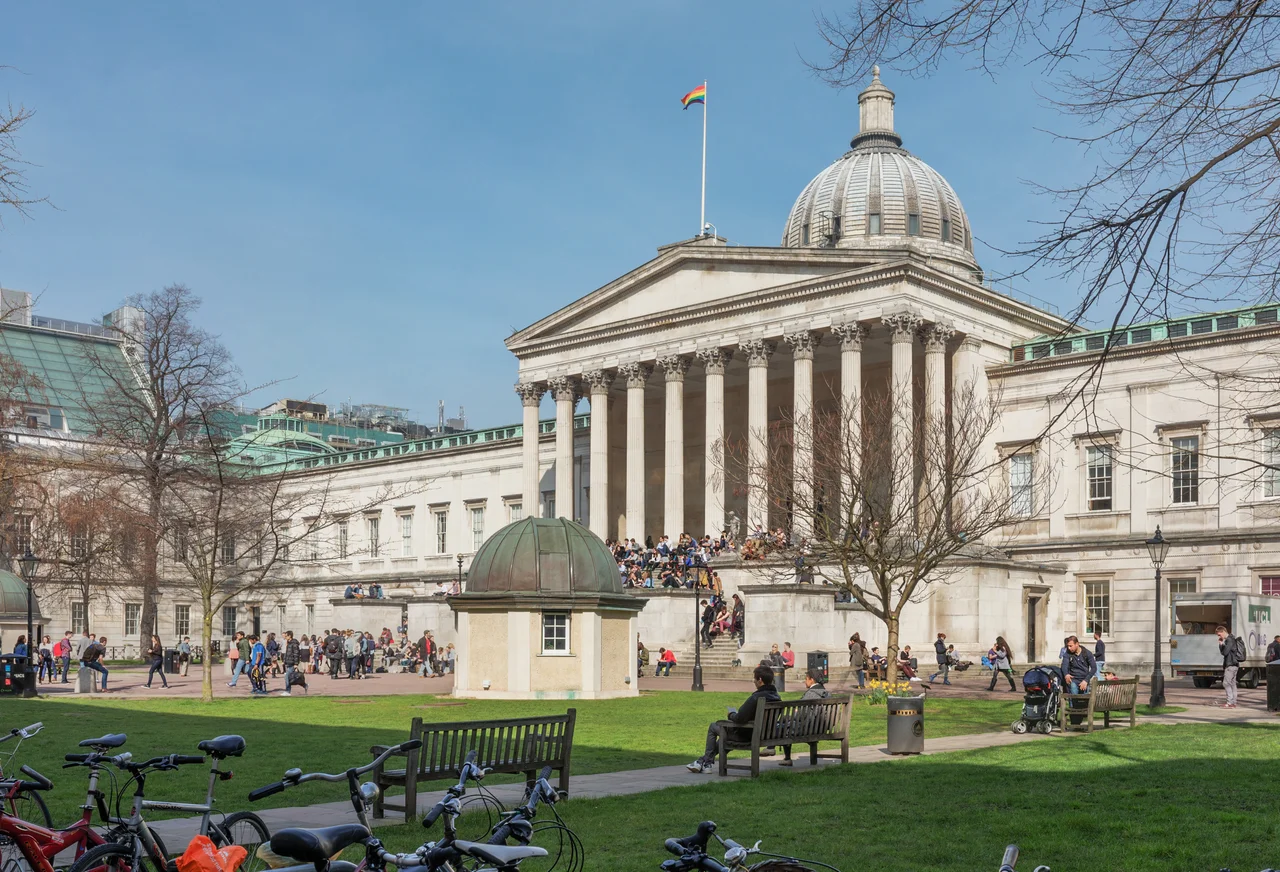
Bloomsbury became the academic quarter of London in the nineteenth century. University College London, founded in 1826 as the first English university to admit students regardless of religion - and the first to admit women on equal terms with men, in 1878 - occupies a long classical building on Gower Street. Senate House on Malet Street, the central administration of the federal University of London, is a great chalky-white art deco ziggurat completed in 1937. George Orwell worked in Senate House during the war and used it as the model for the Ministry of Truth in Nineteen Eighty-Four. The School of Oriental and African Studies, Birkbeck, the London School of Hygiene and Tropical Medicine, the Royal Veterinary College, the Royal Academy of Dramatic Art - all are here, along with London campuses of half a dozen American universities. The student population of the district outnumbers the resident population.
Gordon Square
Number 46 Gordon Square is where the Bloomsbury Group really began. After the death of their father Leslie Stephen in 1904, the four Stephen siblings - Vanessa, Thoby, Virginia, and Adrian - moved out of the Victorian gloom of Hyde Park Gate to a tall white-painted house in this Bedford Estate square. They began to entertain Thoby's friends from Cambridge - Lytton Strachey, Clive Bell, Leonard Woolf, Maynard Keynes. The conversations were unlike anything any of them had been allowed at home. Frankness about sex, about religion, about art. Vanessa married Clive Bell and stayed at number 46; Virginia and Adrian moved to Fitzroy Square, then to Brunswick Square, then to Tavistock Square at number 52, where she wrote Mrs Dalloway, To the Lighthouse, and The Waves. Number 52 was destroyed in the Blitz. Number 46 survives, owned by Birkbeck.
Hawksmoor's Church
St George's Bloomsbury, built by Nicholas Hawksmoor between 1716 and 1731, is one of the strangest churches in London. The Roman porch has six huge Corinthian columns. The steeple, by Hawksmoor's own admission, is modelled on the Tomb of Mausolus at Halicarnassus, one of the Seven Wonders of the Ancient World; on top stands a statue of King George I in Roman dress. Hawksmoor was Christopher Wren's pupil and the architect of half a dozen of London's most peculiar churches. St George's is now a working Anglican parish church with a small museum in the crypt. Just south is St Giles in the Fields, the Poet's Church, rebuilt in 1733; Andrew Marvell is buried there. Just east, on Bloomsday in 1956 - the 16th of June - the poets Ted Hughes and Sylvia Plath married in the small parish church of St George the Martyr Holborn on Queen Square.
Coram's Fields
In 1739 a retired sea captain named Thomas Coram persuaded the king to charter a hospital for abandoned children in Bloomsbury. The Foundling Hospital, the country's first incorporated charity, took in babies left at its gates and raised them. Hogarth was a governor; Handel composed for its chapel; Dickens lived nearby and gave money. The hospital moved out in 1926 and was demolished, but the eight-acre site was preserved as a playground and outdoor sports field for children, by terms that admit no adult unless accompanied by a child. Coram's Fields is one of the city's few green spaces governed by that rule. Sheep graze in one corner. The original colonnade of the hospital still stands at the southern edge. The Foundling Museum, in the surviving wing, tells the story of the children who were left and the lives they had after.
From the Air
Bloomsbury is centred at 51.5231°N, 0.1250°W in central London, just north of Holborn and west of King's Cross. From 1,500-2,500 ft AGL look for the great square footprint of the British Museum on Great Russell Street, with the white art deco tower of Senate House to the north and Russell Square as the largest green space in the grid. The squares of Bloomsbury - Russell, Bedford, Tavistock, Gordon, Bloomsbury - form a recognisable green pattern in the city's grey. Nearest airports: London City (EGLC) 5 nm east, London Heathrow (EGLL) 15 nm west, RAF Northolt (EGWU) 13 nm northwest. King's Cross and St Pancras stations sit at the northern edge of the district.
Nearby Stories
- Stevenage 5.7 km away
- Malling Abbey 5.7 km away
- 1952 Farnborough Airshow Crash 7.7 km away
- Ingatestone Hall 8.2 km away
- Hellfire Caves 9.1 km away
- The Carrington Event: The Solar Storm That Could Happen Again 9.8 km away
- Bletchley Park 16 km away
- Castle Hedingham 23 km away