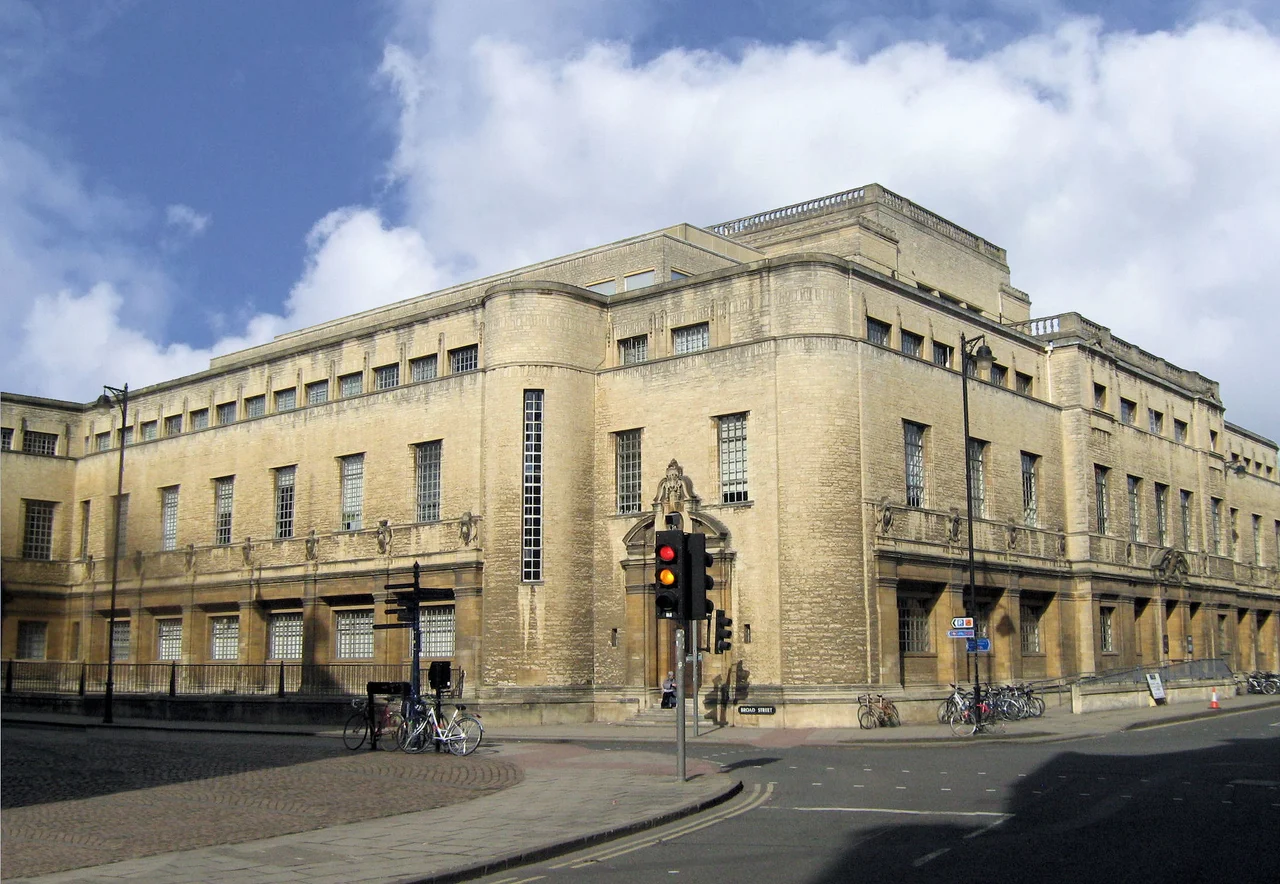

Bodleian Library
Every new reader at the Bodleian must agree to a formal declaration before being granted access. They swear not to bring fire or flame into the library, not to kindle any kind, and to obey all rules. The Admissions Office keeps translations in more than a hundred languages so that readers can swear it in their first tongue. The Latin original, written when libraries were unheated because fires were that dangerous, did not yet forbid tobacco smoking. Almost everything else about the Bodleian is also older than it has any reasonable right to be.
The Library That Almost Died
There had been a library at Oxford since the 14th century, founded under the will of Thomas Cobham, Bishop of Worcester, with a small collection of chained books above the University Church of St Mary the Virgin. Humphrey, Duke of Gloucester - brother of Henry V - donated a magnificent collection of manuscripts between 1435 and 1437, and the university built a room to house them above the Divinity School. That room is still called Duke Humfrey's Library. Then the university simply stopped caring. After 1488 the books went unreplaced, the manuscripts went unreturned, and by the late 16th century the furniture had been sold. Only three of Duke Humphrey's original books survived in the collection. The space remained, empty and reproachful, until Sir Thomas Bodley wrote to the Vice Chancellor in 1598 offering to refit the library at his own cost - 'to reduce it again to his former use.' The Bodleian formally re-opened on 8 November 1602.
An Ark to Save Learning
Bodley was a diplomat with a collector's appetite and a centralizer's instinct. By June 1603 he was sourcing manuscripts from Turkey. The first Chinese book arrived the same year, despite the fact that no one at Oxford could read it. In 1605, Francis Bacon presented a copy of The Advancement of Learning and described the Bodleian as 'an Ark to save learning from deluge.' Bodley's most consequential move came in 1610: he negotiated an agreement with the Stationers' Company in London to deposit a copy of every book they registered into the library. This is the origin of British legal deposit. The Bodleian today is still one of six libraries in the UK entitled to a copy of every book published in the country, plus, under Irish law, every book published in the Republic of Ireland. The collection passed 1 million books in 1914. It passed 12 million in 2015. It is now over 13 million printed items.
Five Buildings, Five Centuries
The Bodleian is not one building but five, clustered around Broad Street and Radcliffe Square. The 15th-century Duke Humfrey's Library still occupies its space above the Divinity School. The 17th-century Schools Quadrangle was built from 1613 to 1619 with a central tower called the Tower of the Five Orders, ornamented in ascending courses with columns of all five classical orders - Tuscan, Doric, Ionic, Corinthian, and Composite - a piece of architectural showing-off that doubles as a textbook. Nicholas Hawksmoor designed the Clarendon Building between 1711 and 1715 to house the Oxford University Press. The Radcliffe Camera - a vast circular reading room - was annexed in 1860. The Weston Library, originally the New Bodleian by Giles Gilbert Scott of red telephone box fame, was rebuilt behind its 1940 facade and reopened in 2015. A tunnel under Broad Street still connects the Old Bodleian to the new building. The pneumatic Lamson tube system that once delivered manuscript requests was switched off in July 2009.
What the Stacks Hold
The treasures are dizzying once you start counting. Four of the seventeen surviving copies of Magna Carta. One of only 21 complete Gutenberg Bibles. The First Folio of Shakespeare. A first edition of Don Quixote. The only surviving manuscript of the Song of Roland in Old French. The Codex Mendoza, an Aztec record commissioned for the Spanish king. The Codex Bodley, a pre-conquest Mixtec pictorial manuscript. Cædmon's Hymn in Old English. The oldest known copy of the Rule of Saint Benedict. The original manuscript of Kenneth Grahame's The Wind in the Willows. Manuscripts of Mary Shelley's Frankenstein, of Kafka, of Tolkien, of John le Carré. Music by Bach, Mendelssohn, Beethoven, Chopin, Mozart, and Schubert. Four scrolls from Herculaneum that survived Vesuvius. In November 2015 the library acquired Shelley's lost Poetical Essay on the Existing State of Things - a pamphlet from 1811 thought to have helped get him sent down from Oxford, missing for two centuries until a copy turned up in a private collection.
Hogwarts, the Hospital Wing, and the Mendip Cleft
The Bodleian's architecture is so persuasively old that filmmakers cannot leave it alone. The Divinity School plays the Hogwarts hospital wing in the Harry Potter films, and also the room where Professor McGonagall teaches the students to dance. Duke Humfrey's Library is the Hogwarts library itself. The Bodleian also appears in Brideshead Revisited, The Madness of King George, The Golden Compass, Another Country, and Wonka. Novelists love it too: Michael Innes set the climax of Operation Pax (1951) inside an imaginary underground bookstack reached through a chute called 'the Mendip cleft' hidden in Radcliffe Square. Deborah Harkness used the real Bodleian and the Ashmole 782 manuscript as the engine of her 2011 novel A Discovery of Witches. The library is so embedded in fiction that visitors sometimes look genuinely disappointed to learn that the bookstack is just a bookstack.
From the Air
Located at 51.7540N, 1.2551W in central Oxford, between Broad Street and the Radcliffe Camera in Radcliffe Square. The Tower of the Five Orders and the dome of the Radcliffe Camera are visible landmarks among Oxford's spires. Best viewed from low altitude (1,500-3,000 feet AGL). Nearest airports: London Oxford Airport (EGTK, 6 nm north-northwest) and RAF Benson (EGUB, 12 nm south). London Heathrow (EGLL) lies 38 nm southeast. The cluster of Oxford college rooftops, the round Radcliffe Camera, and the spire of the University Church of St Mary the Virgin make Oxford one of the most recognizable city centers in England from the air.
Nearby Stories
- St George's Chapel, Windsor Castle 7 km away
- RAF Honeybourne 7.8 km away
- Sulgrave Manor 8.9 km away
- Cotswolds 9 km away
- Chesham 9.4 km away
- Avebury 11 km away
- Donnington Castle 12 km away
- Ampthill Park 14 km away