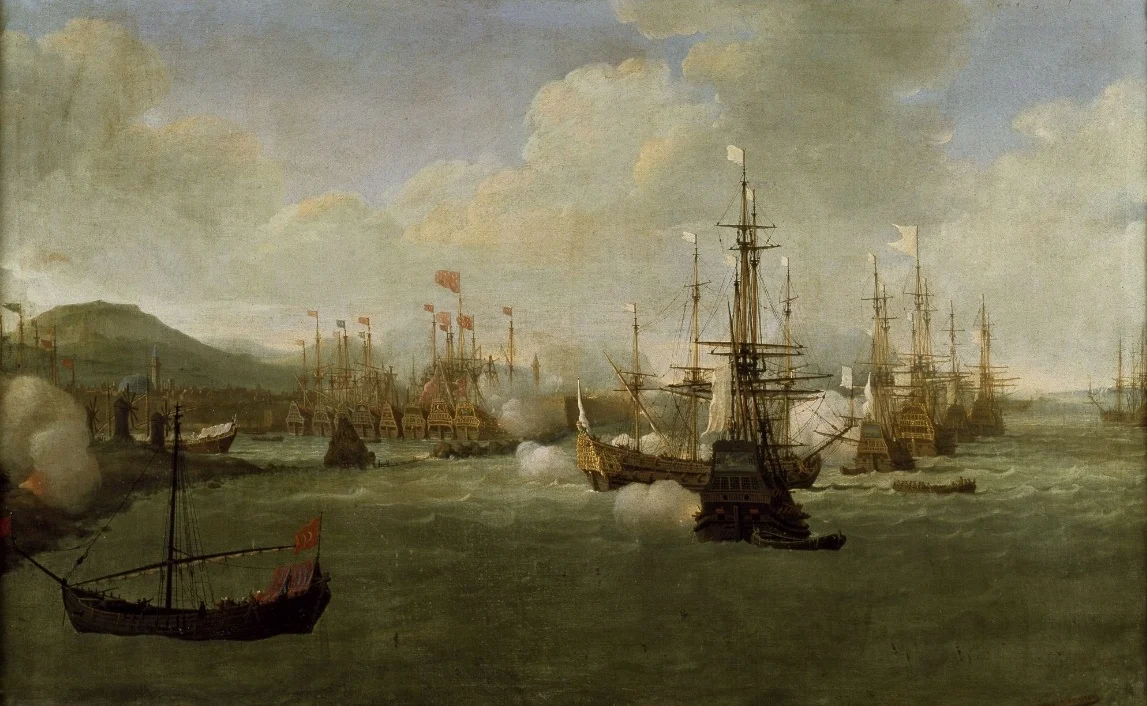

Bombardment of Chios (1681)
On the morning of 23 July 1681, eighteen ships rode at anchor in the mouth of Chios harbor flying friendly flags, and the townspeople had little reason to fear them. Then the flags came down and the war colors went up. Over the next four and a half hours the French squadron of Admiral Abraham Duquesne poured roughly four thousand cannonballs into the castle and the city. When the smoke cleared, houses and mosques lay in ruins, somewhere between 110 and 130 civilians were dead, and around 800 lay injured. The dead were both Muslim and Christian, ordinary residents of a busy Aegean port who had been caught in a quarrel that was never really about them.
A Hunt for Pirates
France in 1681 was waging a long campaign against the corsairs of the Barbary states — Tripoli, Tunis, and the Regency of Algiers — who operated under the loose umbrella of the Ottoman Empire. That summer a French squadron of six ships, four of them galleons, sailed from Toulon under Abraham Duquesne, one of the most respected commanders of Louis XIV's navy. They joined other French ships and entered the Aegean on the trail of Tripolitanian vessels. After a clash near Cuha Island in early June, the French chased six Tripolitanian ships that had taken shelter at Chios. When Duquesne arrived off the port on 23 July, he found eight enemy ships there — and two captured French vessels among them.
The Flags Come Down
What followed was an act that strained the rules even of that ruthless age. Chios was Ottoman territory, and the Ottomans were not at war with France; indeed the two powers had long counted themselves allies. Duquesne's deception — anchoring under peaceful colors before opening fire — turned the harbor into a killing ground. The cannonballs meant for the Tripolitanian corsairs also tore through a living city. The toll was carefully recorded afterward: roughly 60 to 80 Muslim residents and 50 Christian residents killed, around 800 wounded, and damage to homes and places of worship across the town. These were merchants, families, and laborers of an island famous for its mastic and its mixed, layered population, not combatants in anyone's war.
A Fleet Held Hostage
Word reached Istanbul, and the Ottoman response was firm but measured. Kapudan Pasha Bozoklu Mustafa Pasha sailed with 33 galleys, arriving on 7 August to blockade both the port and the French fleet inside it. The diplomacy turned sharp. The French ambassador in Istanbul, Count Joseph de Guilleragues, was reprimanded, then imprisoned for six months for giving evasive answers, and the Grand Vizier Kara Mustafa Pasha demanded a fine and compensation from Louis XIV himself. Bozoklu Mustafa Pasha stayed at Chios for five months, holding Duquesne's ships effectively hostage until a guarantee of payment arrived. For all the firepower France had shown, its squadron now sat trapped in the very harbor it had bombarded.
Settled with Gifts
The reckoning came not in battle but in tribute. Around ten months after the bombardment, on 17 May 1682, the gifts and compensation Louis XIV had promised reached the Ottoman court and were presented to Sultan Mehmed IV. The settlement even included a payment reckoned by survey for those who had died — Bozoklu Mustafa Pasha had counted the dead and the damage. The Tripolitanian ships released their two captured French vessels and their prisoners. The Ottomans, who considered France an old friend, chose to resolve a provocation that might have justified war by accepting compensation instead. The corsairs Duquesne had been chasing were almost a footnote; the people of Chios, who paid the heaviest price, were not even party to the deal struck over their heads.
From the Air
The bombardment struck the harbor and old town of Chios, on the island's east coast facing the Anatolian mainland, at roughly 38.40°N, 26.02°E. The medieval castle (Kastro) and the waterfront were the targets; both still anchor the modern town. Chios International Airport (LGHI) lies just south of the town along the same coastal strip. Flying the strait between Chios and the Turkish coast at 3,000–5,000 ft shows how exposed the harbor mouth is to ships anchored offshore — the position from which Duquesne's squadron opened fire. The Turkish coast and Çeşme sit only about 7–10 km east across the water; İzmir (LTBJ) is roughly 70 km away. Clear summer visibility makes the whole bay and its approaches easy to trace.
Nearby Stories
- Psara 18 km away
- Battle of the Oinousses Islands 28 km away
- St. Helena Church 35 km away
- Battle of Corycus 35 km away
- Greek Islands 60 km away
- Temple of Artemis at Ephesus 61 km away
- Adramyttium 94 km away
- Skyros 101 km away