
Bombing of Plaza de Mayo
The first bomb fell on a trolleybus full of children, and killed everyone aboard. It was just past midday on 16 June 1955, in the very heart of Buenos Aires, when thirty aircraft of the Argentine Navy and Air Force appeared over Plaza de Mayo and began to bomb and strafe the square. Their target was the Casa Rosada and the man inside it, President Juan Perón. But the people who died that day were overwhelmingly ordinary civilians — office workers and union members, passers-by, parents, and the children on that trolley — caught in the open in the middle of an ordinary working afternoon.
A Country at the Breaking Point
Juan Perón had governed Argentina since his 1946 election victory, remaking the country with industrialization, nationalized railways, public works, and higher wages for workers who revered him. By 1955 he had been in power nine years, and his footing had grown unsteady. The death of his wife, Eva Perón, in July 1952 had cost him much of his popular warmth and political strength. His deepening conflict with the Roman Catholic Church sharpened the crisis further. When a national flag was allegedly burned during a Corpus Christi procession by Perón's opponents, the government called for public demonstrations to condemn it — and a faction of the military saw its moment to strike, intending the bombing as the opening blow of a coup.
The Attack
At 12:40 in the afternoon, a force of thirty naval aircraft — among them North American AT-6 trainers, Beechcraft AT-11s, and lumbering Catalina flying boats — lifted off from Morón Air Base. Perón had been warned and was urged into a bunker beneath a nearby building. Two companies of rebel marines advanced on the Casa Rosada, hoping to seize it, while loyal troops and armed Peronist civilians moved to defend the government. Over the radio, a union leader called on the workers of Buenos Aires to gather at the city center in defense of the constitutional government. They came — and that call, answered in good faith, drew thousands of people directly into the path of the bombs.
The Crowd in the Square
As workers poured out of the central subway and filled the streets around the Presidential Palace, the rebel aircraft — propeller-driven AT-6 trainers and lumbering flying boats — bombed and strafed civilians gathered in the open, then circled and struck again. Later in the afternoon, rebel forces seized loyalist Gloster Meteor jet fighters from Morón Air Base and pressed them into strafing runs as well. A police observer recorded large numbers of people arriving by truck through the early afternoon, massing in the walkways around the palace, only to be caught defenseless when the heaviest air attacks came around three o'clock. The pilots reportedly bombed survivors as they pulled out of their final dives. These were not soldiers on a battlefield. They were the residents of a city, killed in its central plaza on a winter afternoon.
Counting the Dead
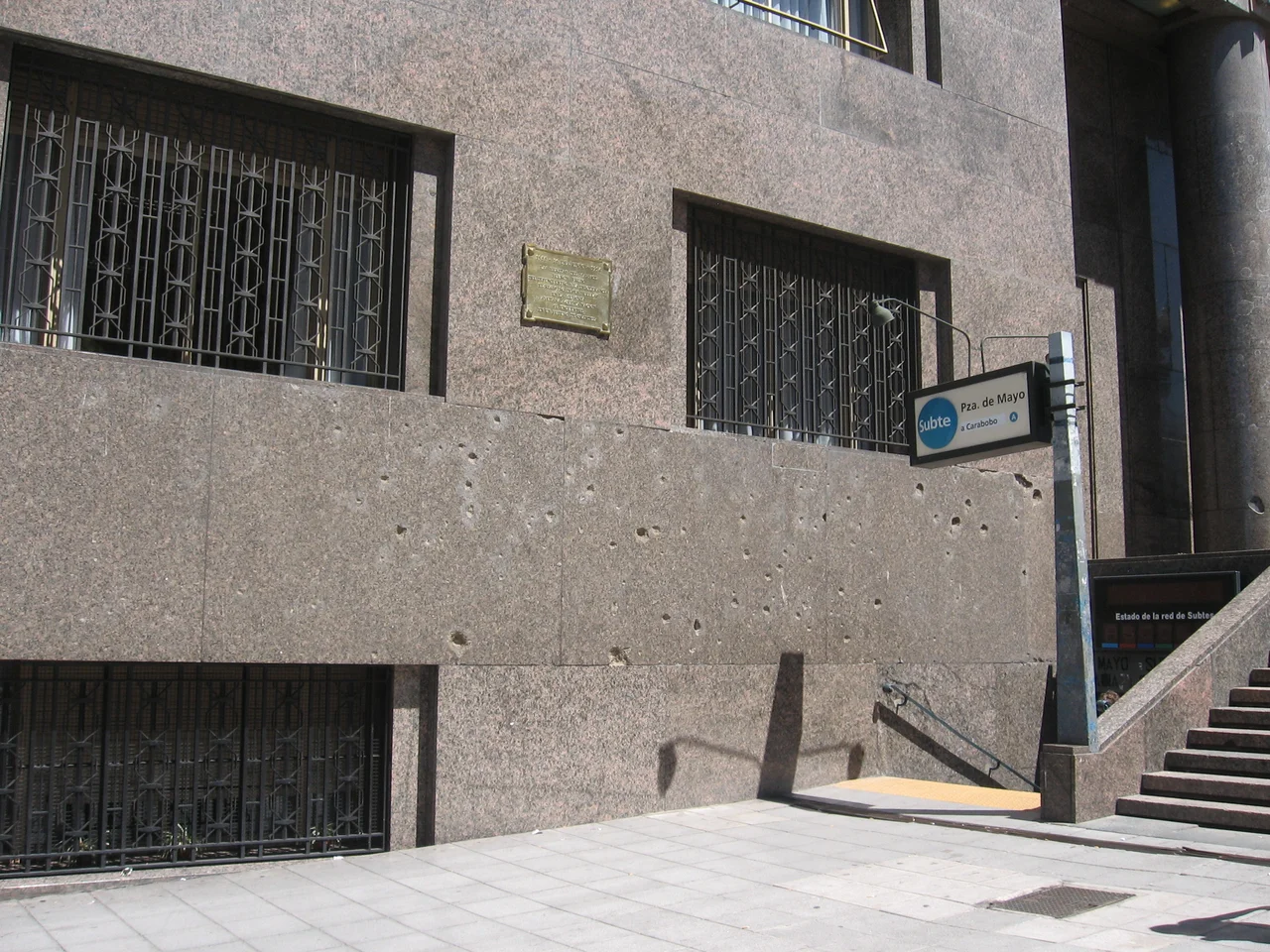
The full toll has never been settled, and that uncertainty is itself part of the wound — some of the dead could never be identified. The number of identified bodies was placed at 308, including six children, which by several accounts makes the day the deadliest such attack in Argentine history; an early official police report, collating the named and unnamed dead across the city's hospital morgues, counted 136. In 2023 the Argentine Chamber of Deputies issued an updated accounting that recorded 111 trade unionists among the killed, and six minors, one of them just three years old. Behind every number stands a person who left home that morning expecting to return. Bullet and shrapnel scars still marked buildings on the south side of the square decades later.
What Came After
The coup that day failed. Defeated in the air and on the ground, the rebel pilots were ordered to fly to Uruguay and seek asylum, dropping their remaining bombs along the way; most landed at Carrasco, and one Meteor ditched in the Río de la Plata, its pilot pulled from the water by a local resident. That night, in revenge for the Church's perceived support of the coup, Peronist crowds burned churches across Buenos Aires. The reckoning was only deferred. In September 1955 the broader armed forces rose successfully in the coup known as the Revolución Libertadora, drove Perón from power, and opened a long stretch of military rule. But 16 June is remembered first not for its politics — it is remembered for the people who died in the square.
From the Air
Plaza de Mayo sits at the historic core of Buenos Aires at roughly 34.61°S, 58.37°W, fronting the Río de la Plata and the modern Puerto Madero docklands. From the air the square is unmistakable: an open civic space ringed by landmark buildings, with the pink Casa Rosada on its eastern side and the broad Avenida de Mayo running west toward the Congress. The attacking aircraft launched from Morón Air Base, about 18 km west. Today Aeroparque Jorge Newbery (ICAO: SABE) is the nearest field, roughly 5 km north along the waterfront; Ministro Pistarini International (Ezeiza, ICAO: SAEZ) lies about 25 km southwest, and El Palomar (ICAO: SADP) about 18 km west. A clear approach over the river gives the fullest sense of how exposed the square — and the crowds within it — would have been from above.
Nearby Stories
- Ezeiza Massacre 1.9 km away
- Luján, Buenos Aires 5.1 km away
- Curutchet House 13 km away
- Colonia del Sacramento 17 km away
- Martín García Island 28 km away
- Atucha Nuclear Power Plant 37 km away
- Lobos 43 km away
- Cry of Asencio 87 km away