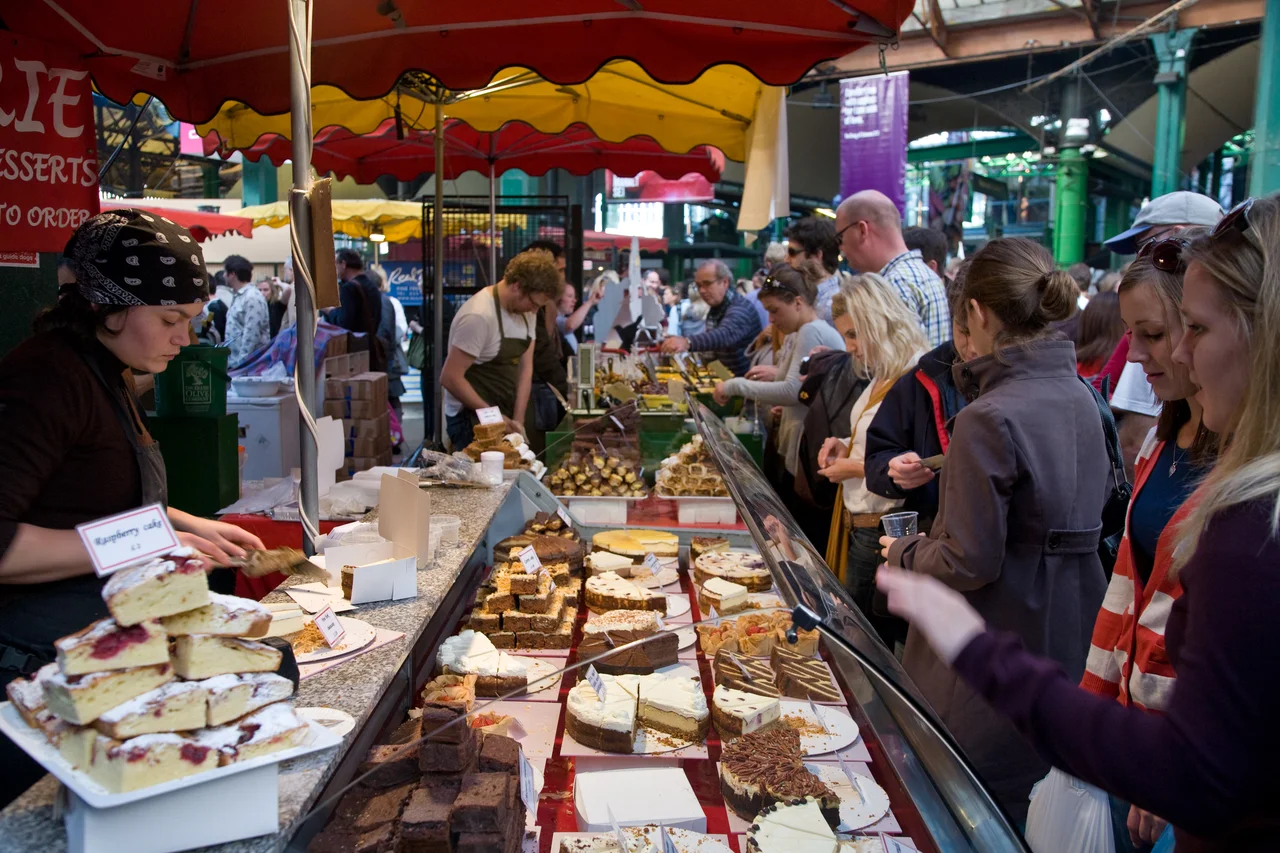

Borough Market
Parliament abolished Borough Market in 1754 because it had become such a traffic problem. The market adjoined the end of London Bridge, and the congestion it created was deemed intolerable. A second Act of Parliament that same year established a replacement market nearby, on a 4.5-acre site in Rochester Yard, and in 1756 trading resumed. That resilience — shut down by one Act of Parliament, reborn by another within months — speaks to how essential this market was, and still is, to London's southbank.
A Market Since the Eleventh Century
The market's own claim is that it has existed since 1014 — citing the Norse historian Snorri Sturluson, who described Southwark as a 'great market town' in reference to events of that year. The first documentary mention of a market at this location dates to 1276. It was originally positioned to catch trade flowing across London Bridge — the only Thames crossing — and remained at that strategic position for centuries. Edward VI granted the City of London a royal charter in 1550 to control all markets in Southwark, confirmed by Charles II in 1671. The present buildings were designed in 1851 by Henry Rose, with an Art Deco entrance added on Southwark Street in 1932. A notable architectural feature, added during a 2001 refurbishment, is the South Portico from the Floral Hall at Covent Garden — the ornate ironwork structure dismantled when the Royal Opera House was rebuilt in the 1990s and re-erected here in 2004.
Under the Railway Arches
The market's relationship with the railways above it is one of the stranger pieces of London urban history. From 1860, railway companies needed to extend lines from London Bridge station to new stations at Cannon Street and Blackfriars, and then on to Charing Cross. This required a viaduct straight through Borough Market territory. But the Borough Market Act of 1756 legally prevented the trustees from selling or alienating their property. The solution was a flying leasehold: the railway company was given the right to build over the market for only as long as trains ran on the line. The market simply continued trading in the arches beneath. Every time the railway has needed to widen its viaduct, the trustees have received full compensation. The market still trades under those Victorian railway arches today, the rumble of trains providing a constant soundtrack to the cheese and bread stalls below.
From Wholesale to Destination
For most of the twentieth century Borough Market was a working wholesale market, supplying greengrocers across London with fruits and vegetables. It was the main supplier, along with Covent Garden, of produce to the retail trade. The transformation to a specialty food destination began in 1998 when food writer Henrietta Green was invited to hold a Food Lovers' Fair there, which recruited several long-term artisan traders. The change accelerated through the 2000s. Today the market sells cheese, meat, game, artisanal bread, fresh produce, and prepared food — operated as a charitable trust administered by volunteer trustees who must live in the area. Borough Market has appeared as a film location in Bridget Jones's Diary, Lock, Stock and Two Smoking Barrels, and Harry Potter and the Prisoner of Azkaban.
Attack and Resilience
On the night of 3 June 2017, three attackers drove a vehicle over London Bridge and then moved into the Borough Market area, where they killed seven people before being shot dead by armed police. The attack was devastating for the community of traders and visitors who had made the market their daily world. Borough Market closed for eleven days. When it reopened, the response was deliberate and defiant — the market's trustees choosing to emphasize continuity and community. Traders returned. The stalls went back up. The market that had survived abolition by Parliament in 1754, railway construction in the 1860s, and the Blitz, absorbed this tragedy too, and continued. It is open six days a week, closed on Mondays.
From the Air
Borough Market sits at coordinates 51.5056°N, 0.0908°W in Southwark, immediately south of Southwark Cathedral and adjacent to London Bridge. From altitude, look for the distinctive green market structure below the railway viaducts on the south bank. The Shard is 300 meters to the east. London City Airport (EGLC) is 9km to the east; Heathrow (EGLL) is 27km to the west.
Nearby Stories
- Stevenage 5.7 km away
- Malling Abbey 5.7 km away
- 1952 Farnborough Airshow Crash 7.7 km away
- Ingatestone Hall 8.2 km away
- Hellfire Caves 9.1 km away
- The Carrington Event: The Solar Storm That Could Happen Again 9.8 km away
- Bletchley Park 16 km away
- Castle Hedingham 23 km away