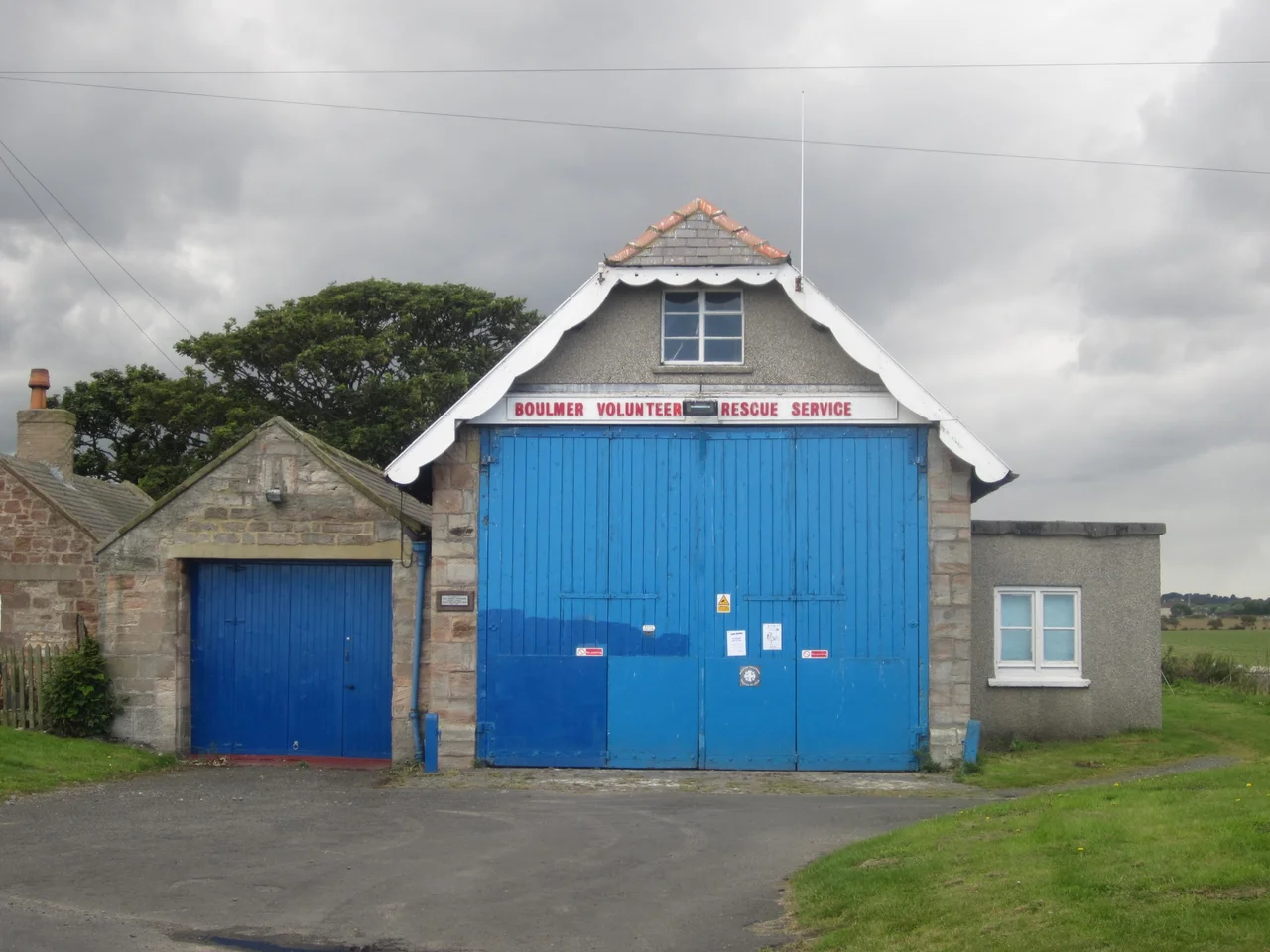

Boulmer Lifeboat Station
In March 1926 the Lifeboat magazine ran a quietly extraordinary statistic about a village called Boulmer. Of its roughly one hundred and fifty inhabitants, perhaps a hundred and fifteen, about eighty percent of the population, took some active part in launching the village lifeboat. The boat ran on heave and grit. Men rowed and crewed her. Women hauled the launch ropes in the dark, knee-deep in winter sea, and shoved the carriage out into the surf so that their husbands and brothers could reach the wrecks beyond the rocks. For their unpaid labour the women of Boulmer were eventually granted The Thanks of the Institution Inscribed on Vellum, the RNLI's formal recognition for those who would never wear an oilskin themselves.
A Village Buys a Lifeboat
Boulmer's lifeboat station came into being in 1825, almost three decades before the RNLI as we know it existed. William Clarke, a local man, wrote to the Royal National Institution for the Preservation of Life from Shipwreck, the RNLI's earlier name, asking for a boat. The Newcastle Shipwreck Association took on the day-to-day running. A thirty-two-foot stone boathouse went up on the beach. A twenty-seven-foot ten-oared North Country, or Greathead-type, lifeboat was built by Thomas Wake of Sunderland and delivered to the village. That first boat would serve twenty-seven years and save thirty-two lives. On 2 November 1844 she made three trips out to the wreck of the Iris in heavy surf and pulled off all eight of the brig's crewmen. Lieutenant John Brunton of the coastguard, who had directed the rescues, was awarded the institution's silver medal for that day's work.
The Duke's Replacement Boat
By 1851 the original boat was past its working life, and the village asked for a new one. The replacement came from James Beeching of Great Yarmouth, the same boatbuilder who had won the Duke of Northumberland's design competition for a self-righting lifeboat that same year. The Duke himself paid the hundred and thirty pounds for the new thirty-foot pulling-and-sailing lifeboat. He named her Prudhoe, after the title he had held before becoming Duke. Local fishermen rowed and sailed her out of Boulmer for decades. She was followed by a series of successively larger lifeboats, and in 1931 by the village's first motor-powered boat, the L. P. and St. Helen, paid for by three benefactors and built by S.E. Saunders of Cowes. Tractors arrived to handle the launches. The Forward Wheel Drive tractor T26, placed into service in 1930, hauled the boat across mud and out a hundred and fifty yards into the sea in twenty-four minutes.
The Women Who Launched the Boat
The Boulmer lifeboat could not have functioned without a great many people who never went to sea. The launch involved hauling a heavy boat and carriage across soft sand and through breaking surf, and in a village this small there was no professional crew available. The women of Boulmer did the work. They turned out for callouts at three in the morning in winter blizzards, in the December nights the RNLI archive carefully records. They held ropes, shoved carriages, climbed into freezing water to push. In 1908 Robert Stanton, a long-serving member of the launching team, suffered a stroke while helping launch the boat to the schooner Caecilie of Hamburg on 6 March; he died four years later. His son James Straker Stanton later served as assistant coxswain. The lifeboat magazine's tribute to the village's women, written in 1926, reads now like a small reminder that maritime rescue history is full of unpaid labour that someone finally noticed.
After the RNLI
The RNLI station at Boulmer closed in 1968, after a hundred and forty-three years of service. The village, however, declined to give up. In 1969 the Boulmer Volunteer Rescue Service was established as an independent operation, and it still answers calls from the same stretch of rocky coast. RAF Boulmer just inland from the village now operates as a radar and rescue coordination centre, and a working partnership has grown up between the village's volunteer crew and the helicopters and aircraft that operate out of the airfield. Boulmer has not stopped being the small place that pulls boats out of the surf together. It simply changed which institution wrote the cheques.
From the Air
Boulmer Lifeboat Station sits at 55.42 degrees north, 1.58 degrees west, on the Northumberland coast, about 5 miles due east of Alnwick and roughly midway between Berwick-upon-Tweed and Newcastle-upon-Tyne. From the air the village's small harbour and the lifeboat house at the south end of the beach are easy to spot, as is the nearby RAF Boulmer airfield just inland. Newcastle International (EGNT) is roughly 35 miles south. Best viewing at lower altitudes in clear weather, when the rocky inshore reefs that made the village's lifeboat work essential are visible against the long stretch of sand.
Nearby Stories
- Ashington 1.8 km away
- Cheviot Hills 3.4 km away
- Battle of Nesbit Moor (1402) 12 km away
- Hadrian's Wall Path 18 km away
- Berwick-upon-Tweed Lifeboat Station 27 km away
- Saltburn Pier 68 km away
- German submarine U-2367 84 km away
- Alexander L. Kielland (Platform) 271 km away