
Boydell Shakespeare Gallery
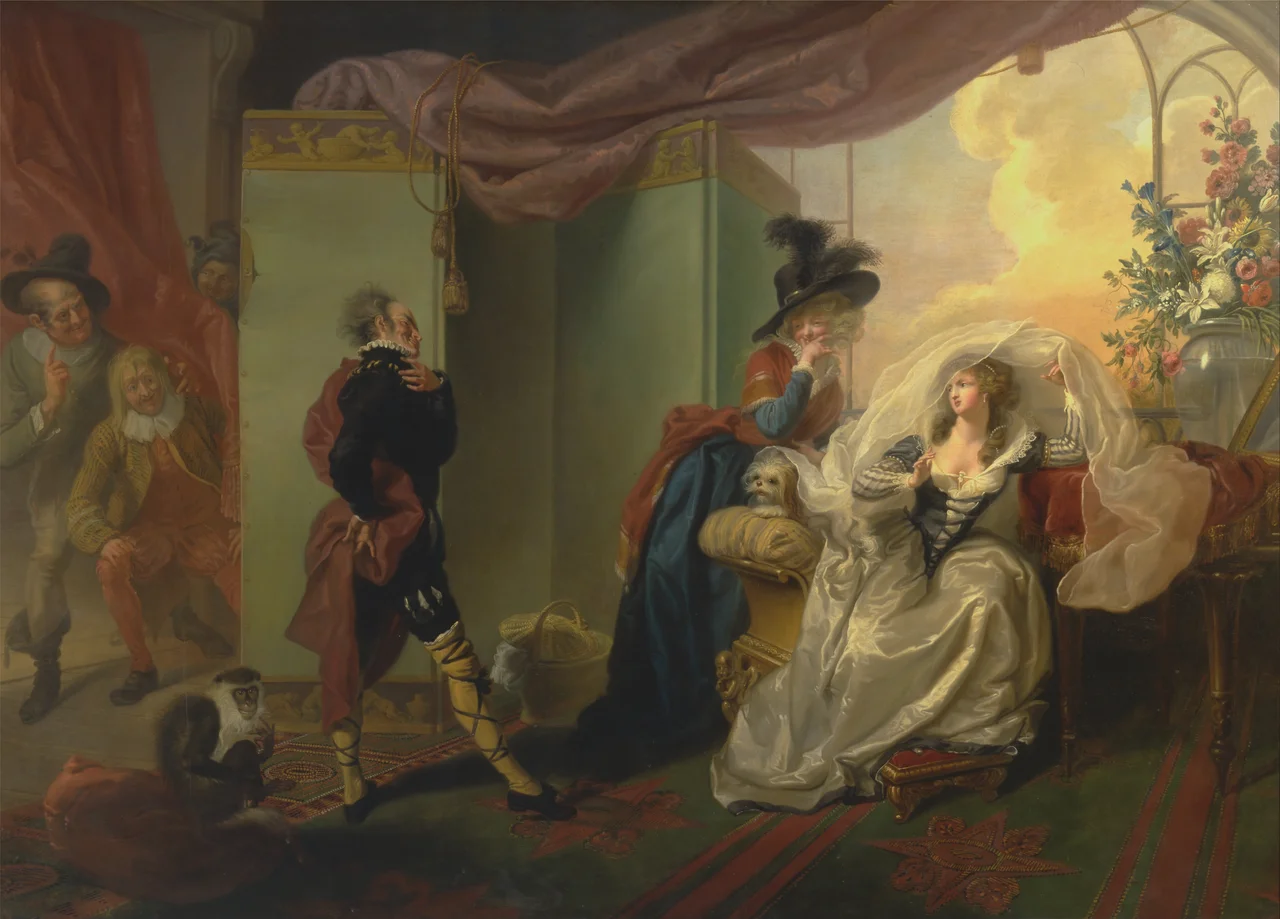
John Boydell wanted to do something almost absurdly ambitious: invent a national school of English painting using William Shakespeare as scaffolding. In 1789 he opened a gallery at 52 Pall Mall, in a neighbourhood that mixed gentlemen's clubs with one of London's more upscale brothels. Inside hung 34 paintings commissioned from the most eminent artists Boydell could persuade - Reynolds, Romney, Fuseli, Kauffman, West - each illustrating a scene from the plays. By the time the venture ended sixteen years later, the walls held somewhere between 167 and 170 canvases, Boydell was effectively bankrupt, the gallery was emptied at lottery, and the architecture of the building had quietly given the world a new classical order.
The Print-Seller's Wager
Boydell was a print-seller and engraver who had built a fortune exporting English prints to a Europe that had previously condescended to the country's visual arts. His scheme married self-interest to patriotism: commission paintings of Shakespeare scenes, exhibit them in a purpose-built gallery, then sell engravings of those paintings and a deluxe illustrated edition of the plays. The prints would pay for the paintings; the paintings would lend prestige to the prints. As the print collector Christopher Lennox-Boyd put it, "had there not been a market for such engravings, not one of the paintings would have been commissioned." Boydell paid generously, between £105 and £210 to painters and between £262 and £315 to engravers. James Northcote, one of the contributors, later wrote that Boydell "did more for the advancement of the arts in England than the whole mass of the nobility put together." When Sir Joshua Reynolds at first declined the commission, Boydell pressed a £500 down payment on him - extraordinary for an artist who hadn't even agreed to paint a specific picture. Reynolds eventually accepted, and ultimately took £1,500.
An Order Built from Fossils
The Pall Mall building was designed by the architect George Dance the Younger. Its rounded-arched doorway, glazed fanlight, and panelled band course made for a perfectly respectable neoclassical façade. But Dance did something curious with the pilasters: he topped them with capitals whose volutes spiralled in the shape of ammonite fossils. He had invented, for this single building, what became known as the Ammonite Order - a fifth classical order, never widely adopted, but real enough to enter architectural reference books. In a recess between the pilasters stood Thomas Banks's sculpture Shakespeare attended by Painting and Poetry, for which Banks was paid 500 guineas. Below it, on a panelled pedestal, ran a line from Hamlet: "He was a Man, take him for all in all, I shall not look upon his like again." The whole façade declared its programme - that English art could rise to Shakespeare's level, given the right setting and the right patron.
Neoclassicism Meets the Coming Storm
When the gallery opened on 4 May 1789, two months before the storming of the Bastille, it was a hit. The Daily Advertiser ran a weekly column on it during exhibition season. The Public Advertiser predicted it would form "such an epoch in the History of the Fine Arts, as will establish and confirm the superiority of the English School." Inside, two artistic moods coexisted uneasily. James Northcote's measured neoclassical compositions hung alongside Henry Fuseli's contributions, which the scholar Frederick Burwick observed "reveled in the monumental and grotesque." Fuseli's Macbeth scenes, with their muscular dreamlike figures and hooded witches dissolving into mist, were unmistakably pointing toward Romanticism. William Hazlitt would later note that "any person would be more struck with Mr. Fuseli at first sight, but would wish to visit Mr. Northcote oftener." The gallery was, in effect, watching a movement change in real time.
The Caricaturist's Knife
Not everyone admired the enterprise. James Gillray, England's most savage caricaturist, produced a print titled Shakespeare Sacrificed; or, The Offering to Avarice. In it, a kneeling figure (Boydell himself, unmistakable) burns papers on an altar fanned by a fool, while a small gnome perched on a volume marked "subscribers" clutches money bags. The smoke rises into a swirl of fanciful images. Gillray's point was that Boydell was using Shakespeare's reputation as fuel for commerce - genius converted into subscription money. The accusation stung partly because it was partly fair. Boydell's project was both a labour of love and a speculative venture, and as the venture went on the speculative part grew. The illustrated edition swelled to 96 illustrations across nine volumes. The print folio, A Collection of Prints, From Pictures Painted for the Purpose of Illustrating the Dramatic Works of Shakspeare, was reconceived several years in: Boydell decided the folio prints should differ from the edition's illustrations, so collectors would buy both. In all, 31 artists contributed.
The Lottery and the Lost Paintings
What killed the gallery was not Gillray but France. The Revolutionary Wars cut off the European print market Boydell had spent decades cultivating, and the income stream that was supposed to fund the paintings collapsed. By 1804, with the venture insolvent, Boydell petitioned Parliament for permission to dispose of the gallery and its contents by lottery. The Shakespeare Gallery Lottery was drawn in January 1805, just months after Boydell's death the previous December. The paintings were dispersed; most have since vanished. Today only about forty of the original 167 or so can be identified with confidence. The building's interiors changed hands, the Ammonite Order capitals were eventually lost when the structure was redeveloped, and Pall Mall absorbed the site into its later commercial fabric. What survives is mostly the prints - thousands of them, still circulating through auction houses and rare-book rooms - and the strange architectural ghost of those ammonite volutes, the only fifth classical order that England ever produced. Boydell got, in the end, exactly what he had set out to make: a body of English Shakespearean art that travelled the world. He just didn't get to keep the gallery that housed it.
From the Air
The Boydell Shakespeare Gallery site sits at 52 Pall Mall in the City of Westminster, near 51.506°N, 0.137°W. The original building is long gone; modern Pall Mall buildings occupy the spot, a short walk east of St James's Palace and south of Piccadilly. From the air, look for the regular grid of Pall Mall running east-west between Trafalgar Square and St James's. Nearest airport is London City (EGLC) about 7 nm east, with London Heathrow (EGLL) 13 nm west. This is inside London's controlled airspace; not a feature for low-level flight, but visible context for any approach over central London at 3,000+ ft AGL.
Nearby Stories
- Stevenage 5.7 km away
- Malling Abbey 5.7 km away
- 1952 Farnborough Airshow Crash 7.7 km away
- Ingatestone Hall 8.2 km away
- Hellfire Caves 9.1 km away
- The Carrington Event: The Solar Storm That Could Happen Again 9.8 km away
- Bletchley Park 16 km away
- Castle Hedingham 23 km away