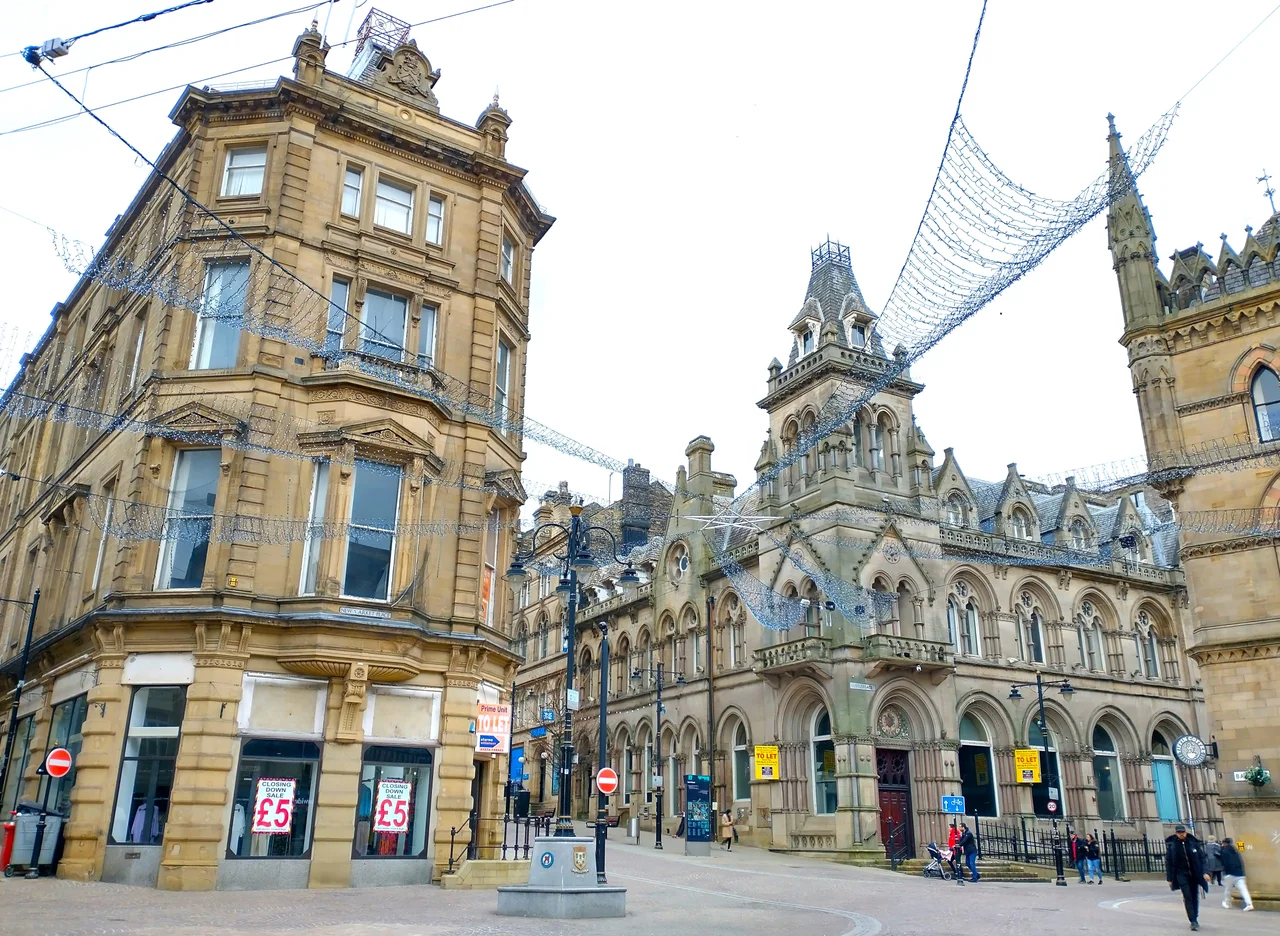

Bradford
Bradford is a city that does not flatter itself. It sits in a bowl in the Pennine foothills, ten miles west of Leeds, half a million people in the metropolitan borough, the great Victorian wool mills still standing along its streets in various stages of repair and reuse. Around twenty-seven percent of residents identify as Asian, most of them with family roots in Mirpur in Pakistan, where the traditional weavers came in the 1950s and 1960s just in time to watch the mills they had been recruited for begin to close. The food, the festivals, and the football all reflect that history. So do the cathedral, the cinemas, and the new identity the city has built around its 2025 turn as UK City of Culture.
The Wool Century
Bradford was small until the nineteenth century. Then it became the worsted capital of the world. Cottage weaving gave way to mass production. Dyeing, finishing and metal-bashing trades grew alongside. The population grew tenfold in a generation. German-Jewish wool merchants set up offices in what is still called Little Germany, the warehouse district east of the cathedral. Irish flax workers came from County Mayo, escaping famine. Yorkshire farmers left the land and walked into the mills. The city built great neo-Gothic public buildings, packed its terraces with workers, and accepted appalling pollution and overcrowding as the price of the boom. A few industrialists pushed back. Titus Salt built the model village of Saltaire a few miles north of the city in 1853, after he had given up on Bradford itself. Most others did not.
Decline and Reinvention
The textile trade began its long decline after the Second World War, undercut by cheaper imports from Asia. The city's identity took a long time to catch up. Factories went brownfield. The city centre got tatty. The turn began in 1983 when the National Museum of Photography, Film and Television (now the National Science and Media Museum) opened in the heart of the city. Film tourism followed. Bradford was named UNESCO's first City of Film in 2009. The Broadway shopping centre opened in 2015, on the site of demolished 1960s buildings near the cathedral. In 2025 the city took its turn as UK City of Culture, with year-long programming that filled mills, theatres and parks. Bradford City football club and the Bradford Bulls rugby league side were both promoted in 2025; the city's two main spectator sports were both in their top tier for the first time in decades.
Bronte Country and the Moors
West of the city the Pennines rise sharply. Bradford is the gateway to Bronte Country. Thornton, a village four miles west, is where Patrick Bronte was curate from 1815 and where the three sisters and their brother Branwell were born at 74 Market Street; the remains of his Bell Chapel still stand beside its replacement. Five miles further on, Haworth is where the family moved when Patrick was appointed curate at St Michael and All Angels; it is where the children grew up and where the sisters wrote. Beyond Haworth, the moor climbs to Top Withens, the ruined farmhouse some readers identify with the Earnshaw house in Wuthering Heights. Closer to the city, Saltaire is a ten-minute train ride; Bingley sits beside the spectacular Five-Rise Locks on the Leeds and Liverpool Canal.
Eating and Visiting
Bradford is famous for curry. The city has held the Curry Capital of Britain title multiple times. Many of the best restaurants are family-run places in the Manningham, Great Horton and Manchester Road areas, where Pakistani Punjabi cooking has been refined over three generations. Morrisons, one of the four big British supermarket chains, was founded in the Bradford suburb of Thornbury in 1899 by a market trader called William Morrison; the company is still headquartered in the city. Bradford Mela, one of the largest South Asian festivals in Europe, fills Lister Park every July. The Family Film Festival comes in August. The Widescreen Film Weekend, at the Pictureville Cinema within the National Science and Media Museum, runs in late September and early October. The city is well-policed in the centre; common sense applies outside it after dark, but the crime rate is lower than Leeds or Manchester.
Getting Around
Leeds Bradford Airport is ten miles northeast along the A658, served by flights from much of Western Europe and within the UK. It has no rail link; buses 737 and 747 run from Bradford Interchange every thirty minutes, taking around fifty. Manchester Airport is the long-haul option, an hour and forty by train via Huddersfield. Bradford Interchange combines the bus station and one of the two main rail stations; Forster Square station, recently rebuilt, handles the Airedale line via Saltaire and Bingley to Skipton. Driving in central Bradford is a chore. Walking is better. The city is small enough to cross on foot, and most of what visitors come to see, the cathedral, the National Science and Media Museum, City Hall, Little Germany, and the bus into Saltaire, is within a half-hour walk of the Interchange.
From the Air
Bradford city centre sits at 53.79 N, 1.75 W in a bowl in the Pennine foothills of West Yorkshire. Leeds Bradford Airport (EGNM) is ten miles northeast. Manchester Airport (EGCC) is thirty-six miles south-southwest. From altitude, look for the dense grey city centre in its bowl, with the Pennine moors rising sharply to the west toward Haworth and the Calder Valley, and the conurbation merging with Leeds eastward along the M62 corridor. Distinctive landmarks include the Italianate tower of Salts Mill at Saltaire to the north, the Alhambra Theatre dome in the city centre, and Lister's Mill chimney in Manningham. Best viewed from 4,000 to 6,000 feet on a clear day.
Nearby Stories
- Hovingham Hall 6 km away
- RAF Elvington 7.6 km away
- Battle of Hatfield Chase 9.1 km away
- Wentworth Castle 11 km away
- Murder of Suzanne Capper 12 km away
- Pendle Hill 13 km away
- RAF Topcliffe 15 km away
- Hawes Junction Rail Crash 26 km away