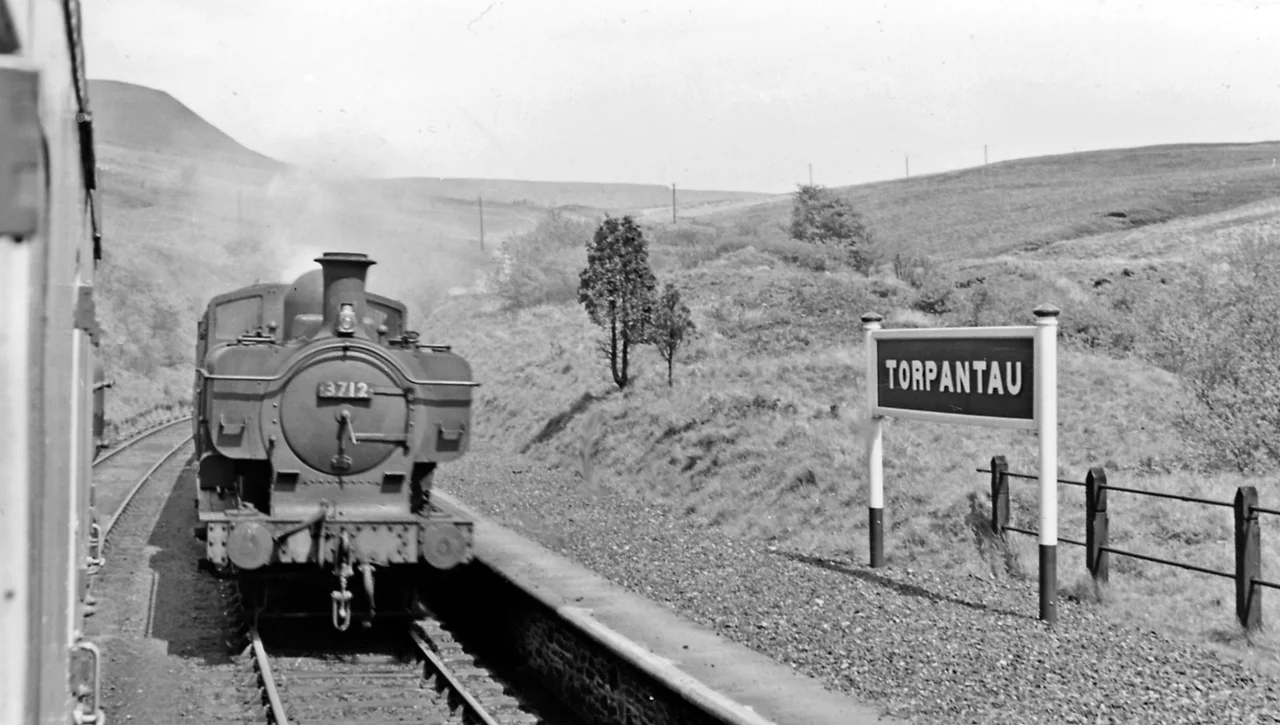

Brecon and Merthyr Tydfil Junction Railway
By 1913, a railway nobody had really wanted was hauling almost three and a half million tons of coal a year over a 1-in-38 gradient through the Brecon Beacons. The Brecon and Merthyr Tydfil Junction Railway - shortened to B&MR by everyone who actually worked on it - had been authorised in 1859 to connect two towns. Within a decade it had given up on being a passenger line and become something else entirely: a mineral artery, climbing in and out of the high country south of Talyllyn at gradients steep enough to bring tank locomotives close to stalling. The South Wales coalfield was at its peak. The B&MR was always short of money, always too steep for comfort, and survived against the odds until the railways were grouped in 1923 and it disappeared into the Great Western.
Why Brecon Needed a Railway
Brecon was a medieval regional centre, set at the confluence of the River Honddu and the River Usk, with the ridge of the Brecon Beacons rising to the south. Getting anywhere had always been difficult. The first turnpike road connected eastward to Abergavenny and south-westward to Swansea. The Brecknock and Abergavenny Canal arrived in 1800, then in 1816 came the Hay Railway - a horse-drawn plateway twenty-four miles long that ran north to Hay-on-Wye. By the 1850s the steam age had reached Wales, and Brecon wanted in. The Brecon and Merthyr Bill of 1859 proposed a line from Brecon south over the mountains to Dowlais, joining the existing Dowlais Railway near the great ironworks at the head of the South Wales Valleys. Parliament authorised it. The first section opened in 1863.
Acquiring a Plateway and a Reason to Exist
The original brief - link Brecon to Merthyr - was hard. The mountains demanded a rope-worked incline at one end and prodigious cuttings at the other. Then the directors made a decision that changed the company's purpose. They bought the Rumney Railway, a horse-drawn plateway running south from Rhymney towards Newport docks, and started converting it for steam. Suddenly they had something far more valuable than a Brecon-to-Merthyr commuter line: a route from the heart of the coalfield to a tidewater port. Passenger services on the southern section opened between Pengam and Newport Dock Street on 14 June 1865, after Captain Rich of the Board of Trade had twice refused inspection and finally agreed at the third attempt. Coal traffic started running in 1867. The little rural project had become a mineral railway.
Money Trouble From the Start
The trains were being worked by contractors - Thomas Savin and John Ward - who paid the proprietors five percent on their capital and kept whatever was left. In 1865 or 1866, depending on which historian you trust, Savin went bankrupt. The B&MR suddenly had no operator, no income, and missed debenture payments at speed. The company went into administration. Restrictive clauses in its Acts of Parliament meant it could not complete its own Merthyr branch. To reach Newport Docks it had to cross a mile of the Monmouthshire Western Valley line, and the Monmouthshire refused to make that facility available. A stand-off followed. Eventually the use of the line was conceded, and on 7 July 1884 the through running began. By then the Newport Docks company had reconstituted itself as the Alexandra (Newport and South Wales) Docks and Railway and had become the dominant force. The B&MR was financially dependent and continued so for the rest of its independent life.
The Gradients and the Trains That Climbed Them
What made the B&MR distinctive was its terrain. The line emerging from the south-east portal of the Beacons tunnel descended for seven miles at 1-in-38 - a 2.6 percent gradient - down the side of Glyn Collwyn towards what became, after 1931, Talybont Reservoir. Climbing the other way demanded everything a tank locomotive could give. The company's stock at the 1922 grouping was 47 locomotives - all tank engines, no tender locomotives at all - mostly 0-6-0T and 0-6-2T arrangements built for grunt rather than speed. They were spread across five depots: 29 at Bassaleg near Newport, 13 at Brecon, two at Dowlais, two at Rhymney, one at Talyllyn. The Machen workshops, half a mile east of Machen station, overhauled the entire fleet but mostly built wagons. One locomotive, number 25, was part-built by Robert Stephenson and Company and finished at Machen in 1898 - a small piece of railway royalty completed in a Welsh valley shed.
The Slow Decline and the Cycle Path
When the railways were grouped in 1923, the B&MR vanished into the Great Western Railway. Its trains kept running, but the world it served was already going. The Merthyr and Dowlais ironworks were declining or closing through the interwar years. A 1933 traffic-pooling arrangement with the London Midland and Scottish Railway diverted much of the remaining mineral traffic to easier routes, avoiding the long Beacons climb entirely. The hillside above New Tredegar turned unstable, closing the line temporarily in 1916. Passenger operation ceased in 1962. As of 2020, only a short stub to a quarry at Machen remains rail-connected. Much of the rest is now footpath and cycleway. The National Cycle Network runs Route 4 along the former line between Machen and Trethomas, Route 469 between Bargoed and Fochriw, and the Taff Trail Route 8 between Torpantau and Talybont Reservoir. The 1-in-38 gradient that defeated railway economics now defeats cyclists instead.
From the Air
The former B&MR's southern terminus is in Newport at roughly 51.5956°N, 3.1303°W; the line ran north some 60 miles through the South Wales Valleys to Brecon. Several sections, particularly through the Brecon Beacons north of Talyllyn, are now cycle paths visible from the air as straight cuttings through hill country. Nearest airport for the southern end is Cardiff (EGFF), 12 miles south-west; Bristol (EGGD) lies 30 miles east across the Severn. The former route is best viewed at lower altitudes, where the line cuts and embankments can be picked out among Brecon Beacons heather and forestry. The Talybont Reservoir, near the line's steepest gradient at Glyn Collwyn, is a striking visual landmark at the northern end of the climb.
Nearby Stories
- Coal tips in Wales 2.3 km away
- Charfield Railway Disaster 5.9 km away
- Llanthony Priory 11 km away
- Llanthony Secunda Priory 14 km away
- Porlock 14 km away
- Cheddar Gorge 16 km away
- Longleat 21 km away
- Battle of Cadfan 33 km away