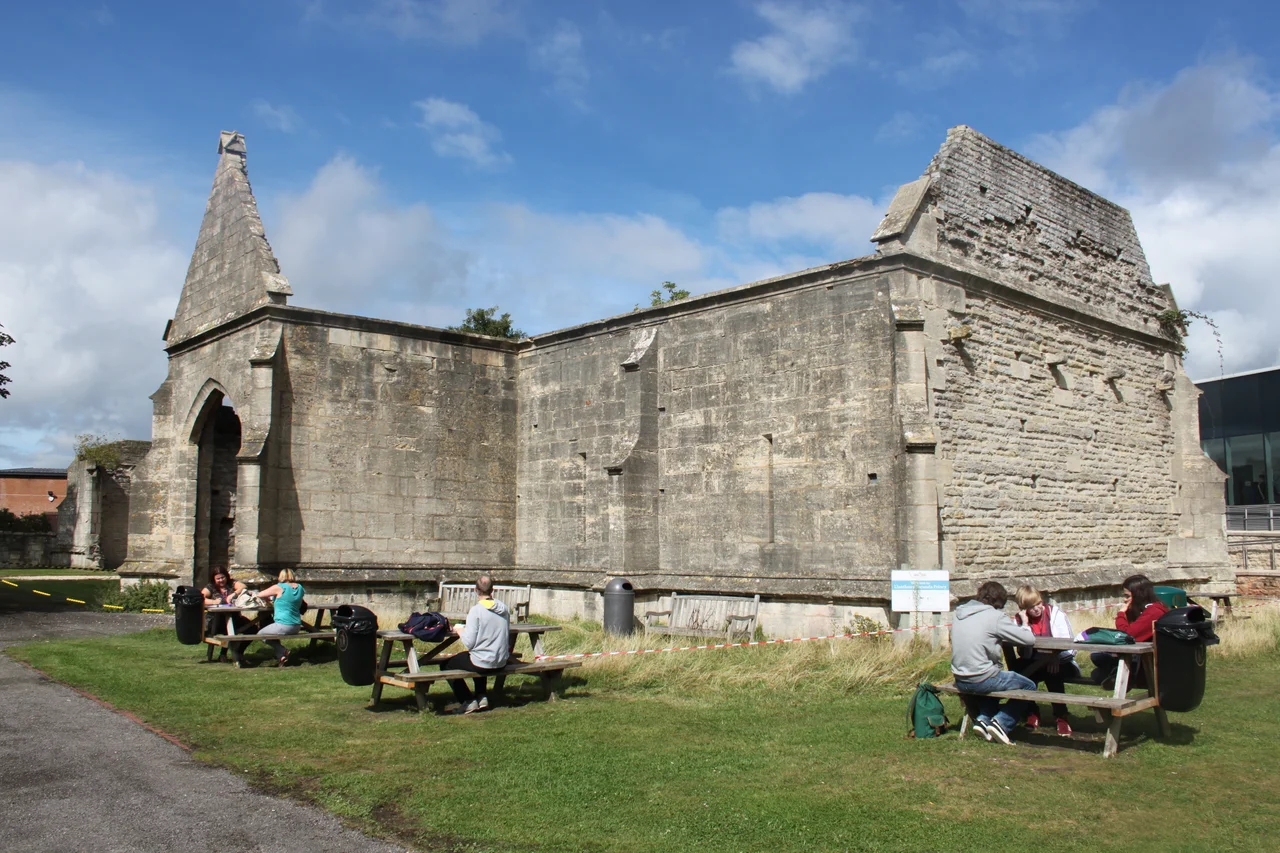

Llanthony Secunda Priory
The canons of Llanthony Priory in the remote Vale of Ewyas had a problem in 1135. Welsh raiders kept attacking their monastery, and the prayers were getting harder to finish. So they walked east, out of the Black Mountains, down into the safer Severn Vale and into Gloucester. The next year their patron Miles de Gloucester, hereditary Sheriff of Gloucestershire and a magnate of vast power, gave them land just outside the city walls. They called the new place Llanthony Secunda - the second Llanthony - and they meant to stay only until things calmed down in Wales. They stayed for four hundred years.
Cheese for the King
Llanthony Secunda quickly stopped being a refuge and became a serious establishment. The canons turned out to be remarkable cheesemakers. In 1502, the Archbishop of Canterbury and the Prior of Llanthony together sent a gift of 'Lanthony Cheese' to Elizabeth of York, wife of Henry VII - the kind of gift you only send if you know it will be welcome. In 1530 the prior sent cheese, carp and baked lampreys to Henry VIII at Windsor. Lampreys were a courtly delicacy, eel-like fish that Henry's great-great-grandfather Henry I had reportedly died from eating too many of. Gloucester had a tradition of sending the first lamprey of the season to the king, and a Christmas lamprey pie with a raised crust - a custom that, according to local tradition, started under Henry I, who held court at Gloucester each Christmas and could not get enough of them.
Burial Place of the Bohuns
Miles de Gloucester, the founder, was buried in the chapter house after he died, and three of his sons followed him into the ground - Roger, Mahel and Henry. His daughter Margaret married Humphrey de Bohun, and through her the priory became the family mausoleum of one of medieval England's great houses, the Earls of Hereford. Henry de Bohun was buried here. So was Humphrey de Bohun, 2nd Earl of Hereford. Two centuries later, Anne of Gloucester, granddaughter of King Edward III, was laid here in 1438 alongside her husband William Bourchier, 1st Count of Eu. The chapter house and the chapel must have grown crowded with tombs and inscriptions. Most are gone now, dispersed when the priory was dissolved under Henry VIII and granted to Arthur Porter. The bodies presumably remain in the ground, but the markers do not.
Humpty Dumpty's Cannon
A century after the priory was dissolved, its ruined walls became a Royalist gun emplacement. During the Siege of Gloucester in August 1643, King Charles I tried to take the city, and one of his commanders set a huge cannon on top of the old priory ruins, aimed at Gloucester's city wall. The cannon had been shipped from Holland to Bristol and dragged up to Gloucester at considerable trouble. It was supposed to break the siege in a single blow. Instead, on the first shot, it exploded. Some claim this was the origin of Humpty Dumpty - the great cannon sitting on a wall, the great fall, and all the king's horses and all the king's men failing to put it back together. Historians dispute it. The true origin of Humpty Dumpty remains unknown. But the story circulates around Llanthony Secunda's walls anyway, the way good stories do.
Restoration
After centuries as a working farm with the medieval gatehouse, range and tithe barn standing among hayfields, Llanthony Secunda was rescued by trust and grant. The Llanthony Secunda Priory Trust received restoration funding in 2013, and the work was completed by August 2018, when the site reopened to the public. The surviving structures - the medieval gatehouse, parts of the prior's lodging, and a stretch of fifteenth-century wall - now sit on a Grade I listed and Scheduled Ancient Monument site, just southwest of Gloucester city centre across the canal. Llanthony has also given its name to the disused Llanthony Lock and to the Llanthony Weir on the River Severn, both built around 1870. The lock was bought in 2008 by canal restorers hoping to relink Gloucester Docks with the long-dead Herefordshire and Gloucestershire Canal. Slowly, things come back.
From the Air
Located at 51.861 degrees north, 2.257 degrees west, on the southwest edge of Gloucester just across the Gloucester and Sharpness Canal from the city centre. Best viewed from 1,500 to 3,000 feet. The ruined walls and the medieval gatehouse form a recognisable L-shape on the south bank of the canal. Look for the wider expanse of Gloucester Docks immediately east-northeast and the M5 motorway running north-south two miles east. Nearest airport is Gloucestershire Airport (EGBJ) seven miles east-northeast.
Nearby Stories
- Grosmont Castle 4.8 km away
- Charfield Railway Disaster 9.8 km away
- Stratford-upon-Avon Canal 9.9 km away
- Droitwich Spa 11 km away
- Caerleon 12 km away
- Wigmore Castle 13 km away
- Church of the Holy Trinity, Stratford-upon-Avon 27 km away
- Marlborough Castle 29 km away