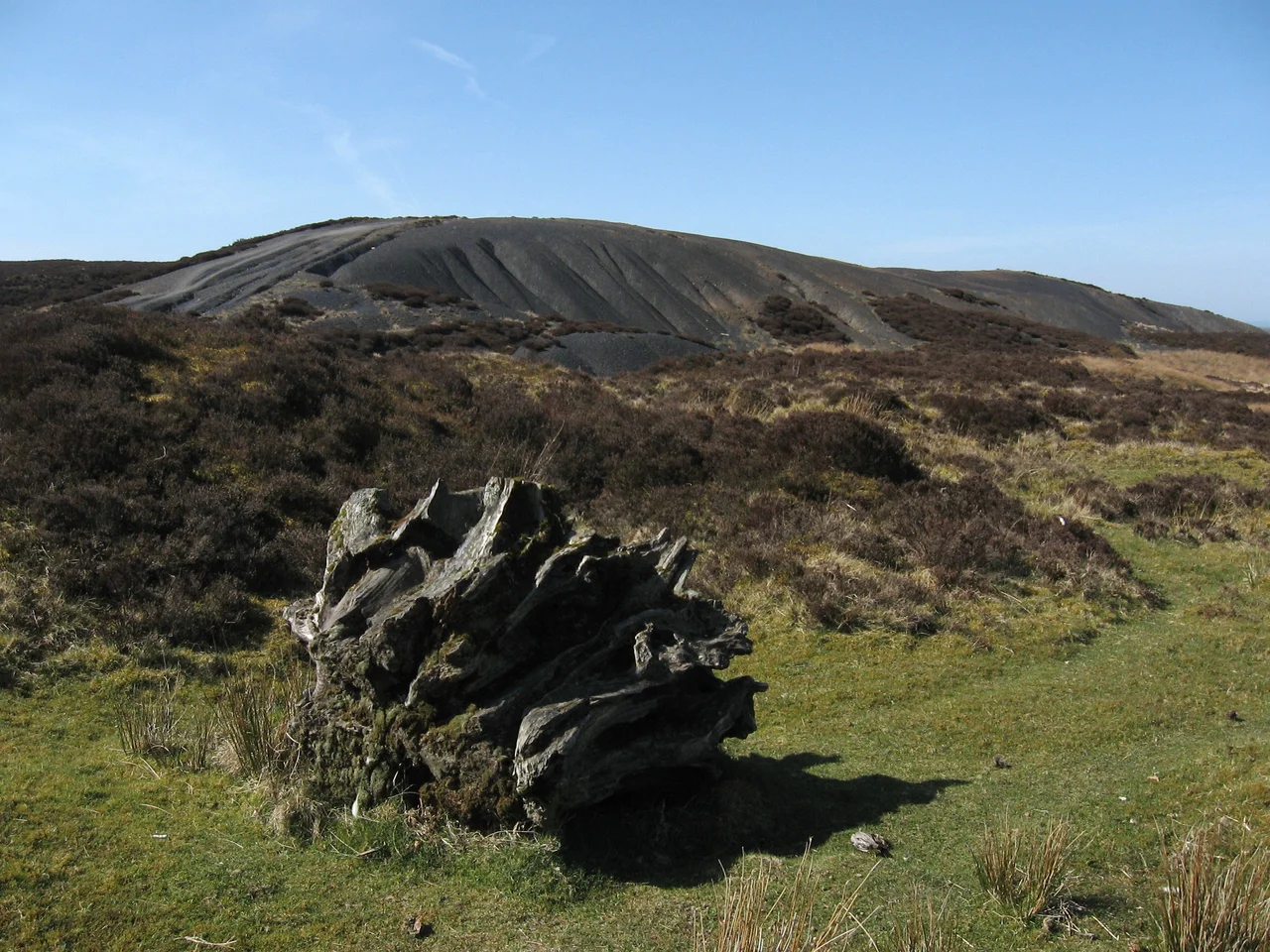

Coal tips in Wales
At 9.15 on a wet October morning in 1966, a coal tip on the slope above Aberfan gave way. Saturated by groundwater, the 30-metre pile of mine waste slid down the hillside and engulfed Pantglas Junior School. One hundred and sixteen children and twenty-eight adults died. The tip was not in a remote glen. It had been built directly above a school, above a village, above streams nobody had bothered to map. Six decades later, that morning still defines how Wales thinks about coal tips - because there are still more than 2,500 of them, and on a Welsh hillside, gravity is patient.
What the Industry Left Behind
When the South Wales coalfield was producing at full tilt, miners hauled up the seams and the spoil. The spoil - rock, shale, low-grade coal, anything that was not the seam itself - got piled wherever was nearest and downhill of the pithead. Decades of this added up. Wales today holds roughly 40 percent of all the UK's coal tips: 2,573 of them by the 2024 count, mostly stitched along the valleys of the south. From the air, they look like dark grey teardrops dripping out of the green. Most have been there long enough that grass has reclaimed them; a few have been planted with trees; some still wear the bare slate-coloured face of the day the last truck dumped its load. None of them are going anywhere on their own.
Storm Dennis and the Reckoning
On 16 February 2020, Storm Dennis dumped weeks of rain on the valleys in a weekend. At Tylorstown in the Rhondda Fach, on the western slopes of Cefn Gwyngul, the Llanwonno coal tip moved - a long, dark scar opening down the hillside above the village. Nobody died. But the slip prompted an uncomfortable question. How many other tips were out there, exactly? When the Coal Authority went looking for the national list, it discovered there was no national list. By July 2020, inspectors had identified 2,144 tips. Of those, 327 were classed as high risk. The Welsh and UK governments set up a Coal Tip Safety Taskforce. In 2023 an interactive map was published of the 350 disused tips that need more frequent inspection - a public document that put names and grid references on hazards most people had walked past their whole lives.
The Bill and the Argument
Making 2,000 ageing coal tips safe is estimated to cost between £500 million and £600 million across ten to fifteen years. Rhondda Cynon Taf alone, the worst-affected county, would need around £82.5 million. The argument over who pays has been politically uncomfortable. Coal tip safety is devolved to Wales, which means the UK Treasury maintains it is a Welsh problem. Welsh politicians counter that the tips pre-date devolution by a century or more - the coal was hauled out under London's authority, and the spoil was dumped under London's law. In late 2024, the UK pledged £25 million for 2025-26. Combined with Welsh commitments, that brings the pot to roughly £100 million through 2026, against an estimated £600 million bill. Plaid Cymru called the move "an important step" but "not enough." The arithmetic agrees with them.
A New Authority
In December 2024 the Welsh Government published the Disused Mine and Quarry Tips (Wales) Bill. It would create a Disused Tips Authority for Wales by April 2027 - a new body with a register, a regulatory regime, and the power to compel private landowners to repair tips they did not build but happen to own. The bill addresses something that has nagged at the Aberfan inheritance for six decades. Most tips are now in private hands. There has never been a single agency responsible for asking the question that should have been asked in 1966: is this thing going to stay where we put it? The new authority does not undo the past. But it tries, finally, to name what has always been true on a Welsh hillside - that a pile of waste left above a village is a promise nobody made and everybody owes.
The View From Above
Fly the line of the South Wales Valleys - up the Rhondda Fach, over Tylorstown, across the ridge into the Cynon and the Taff - and the tips read like a map of an industry. Long dark fingers descend from the watersheds. Many sit directly above small towns; nearly all of them lie above streams. The greenest valleys hide the youngest tips, freshly planted to lock the slopes down with roots. The blackest still show their geology. They are a landscape feature now, as permanent to South Wales as the hedgerows of Sussex - except that hedgerows do not slide.
From the Air
Located approximately 51.61N, 3.54W in the heart of the South Wales Valleys, with tips concentrated across Rhondda Cynon Taf and neighbouring counties. Nearest airport is Cardiff (EGFF, about 18 nautical miles south); Swansea (EGFH) sits to the west. The valleys run roughly north-south; flying along them at 2,500-4,000 feet AGL, the tips are clearest in low autumn or winter light, when bare patches contrast against grass and the dark fingers reading down from the ridgelines become unmistakable. The Aberfan memorial garden, on the site of Pantglas Junior School, sits at the southern end of the Merthyr valley.
Nearby Stories
- Brecon and Merthyr Tydfil Junction Railway 2.4 km away
- Abergwili 3.6 km away
- Whiteford Lighthouse 7.1 km away
- Llanthony Priory 13 km away
- Hinkley Point C nuclear power station 14 km away
- Porlock 15 km away
- Brecon Beacons National Park 20 km away
- Moreton House, Bideford 35 km away