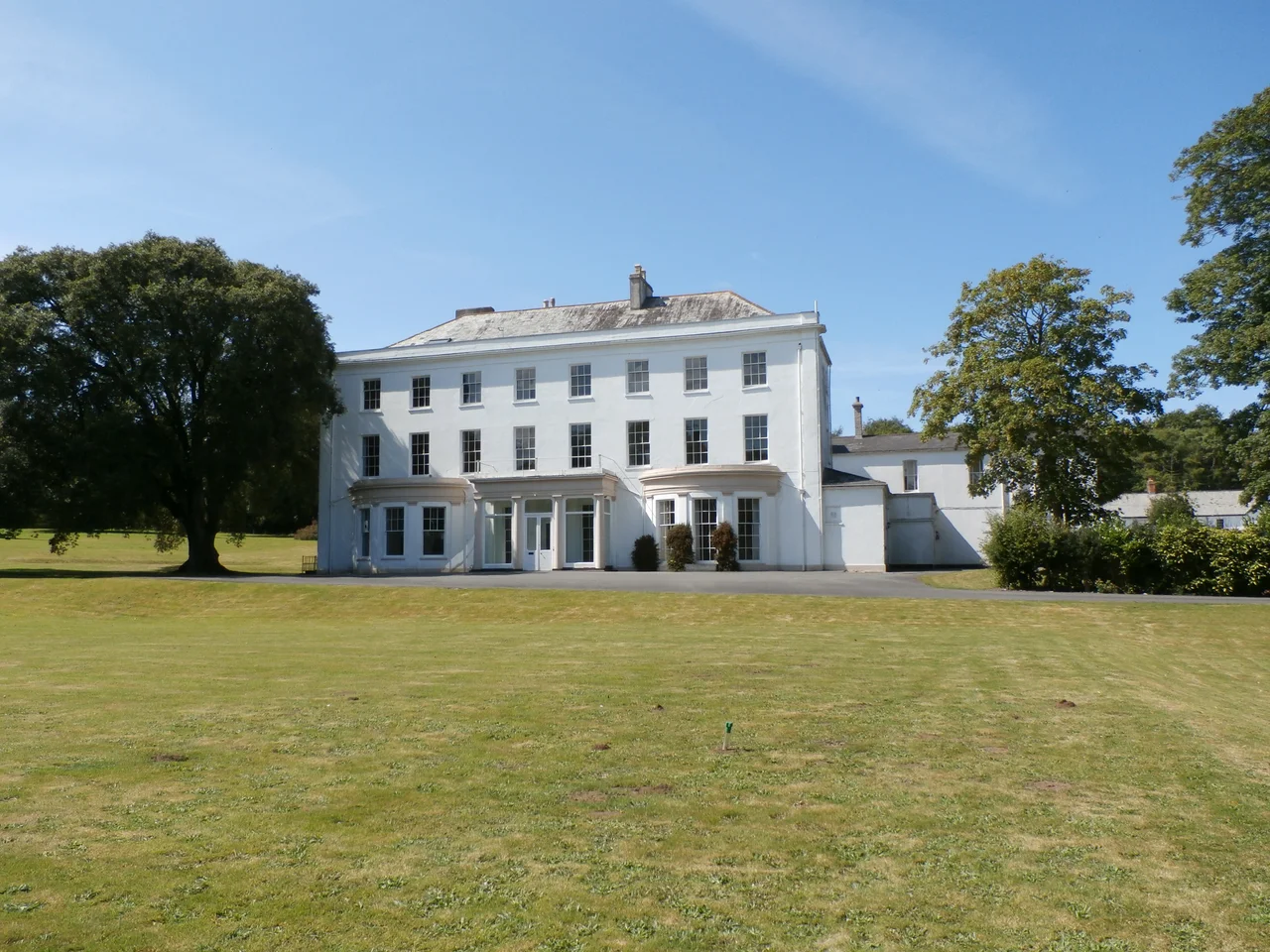

Moreton House, Bideford
Tobacco built this house. The Bucks of Bideford were ship owners and merchants who ran their fleet across the Atlantic to Virginia and Maine starting in the 17th century, when Bideford was the leading tobacco port in England. From those profits they bought land - more and more of it - until by the end of the 18th century their estates almost ringed the north side of the town. In about 1760, one of them, George Buck, rebuilt what was then called Daddon House as his own residence. It was rebuilt again in 1821, renamed Moreton House, and stands today off the road between Bideford and Abbotsham - a Georgian survivor with five acres of what was once a great park.
Bucks and Their Antlers
The family's name is also their heraldry: per fess embattled argent and sable, three buck's attires each fixed to the scalp counterchanged - three sets of stag antlers, half white, half black, a literal canting on the surname. The arms still hang in Bideford Town Hall in portraits. George Buck acquired the advowson of Bideford - the right to appoint the rector - from the heirs of the last Grenville lord of the manor, William Granville, 3rd Earl of Bath, who had died in 1711. The Bucks were now patrons of the parish church as well as its largest landowners. George's son George Stucley Buck died in 1791 at 36, leaving his father to outlive him. His portrait, painted by a follower of George Romney, hangs in Bideford Town Hall in military uniform.
A Change of Name
Lewis William Buck, the younger brother who eventually inherited, was MP for Exeter and then North Devon, sat in the Commons from 1826 to 1857, and inherited Hartland Abbey under the will of his great-aunt Charlotte Hooper Morrison. By the time his son took over, the Buck family had quietly accumulated four substantial Devon properties: Moreton, Hartland Abbey, Affeton, and North Molton. In 1858 that son - George Stucley Buck - assumed by royal license the name and arms of Stucley, an older Devon family his ancestor had married into. The following year he was created the first Stucley Baronet. He repaired Affeton's medieval gatehouse, restored Hartland Abbey, and used the rebuilt gatehouse as a shooting lodge during the grouse season.
A Garden, a War, a Sale
The gardens at Moreton became locally famous - two lakes, fountains, waterfalls, formal herbaceous borders, all laid out by Sir Hugh Stucley, who took his greatest personal pleasure in landscape gardening. Sir Hugh served as Mayor of Bideford, making him the 37th member of his family to do so. He sat on Devon County Council from 1906 and became a county alderman in 1908. When the Second World War came, Moreton House was lent to King's Mead Preparatory School, which had been evacuated from Seaford in Sussex from 1939 to 1945. Sir Hugh moved into the lodge and looked after the youngest boys, those too small to be proper boarders. Five-year-olds played croquet on the lawns where the family had walked for a century.
Grenville College and After
The Stucley family sold Moreton House in 1956. It was bought by Grenville College, a private school that occupied the site until 2009. Various subsidiary buildings - Scott House, Crabbe House - went up in the grounds for school use. When the school closed, its playing fields became a housing development. In 2014 the house and what was left of its park - just five acres - went on the market for 500,000 pounds, a surprisingly modest price for a Georgian country house, even one increasingly hemmed in by Bideford suburbs. The original name of the estate is preserved a short distance south: Daddon Court, an industrial estate, marks the location.
What the Land Remembers
From above, the house and stable block sit in a green pocket between modern Bideford and the Abbotsham road, with the Torridge estuary just to the east. The family's mark on the surrounding county is harder to see but easy to trace: Hartland Abbey to the west, Affeton to the south, North Molton further inland, all linked by marriage and inheritance through this one Bideford merchant lineage. The current baronet, Sir Hugh Stucley, regards Affeton as the family's main seat. Hartland Abbey is open to the paying public. Moreton House is private. The Bucks' Atlantic trade ended, the tobacco mills in Bideford, Maine are long gone, and the Virginia plantations were sold off generations ago - but the houses they built with that money are still standing.
From the Air
Moreton House sits at 51.01 N, 4.23 W, just west of central Bideford. Best viewed from 1,500 to 2,500 feet, with the Torridge estuary and Lundy Bay visible to the north. Nearby aerodromes: Eaglescott to the southeast, Dunkeswell further inland, Newquay (EGHQ) and Haverfordwest (EGFE) as larger alternates. Expect modest coastal turbulence near the cliffs north of Bideford in westerly winds.
Nearby Stories
- HMHS Glenart Castle 11 km away
- Castle Drogo 12 km away
- Exmoor 13 km away
- North Cornwall Railway 14 km away
- Mumbles Lifeboat Disaster 21 km away
- Horton and Port Eynon Lifeboat Station 28 km away
- Padstow Lifeboat Station 29 km away
- Castlemartin Training Area 34 km away