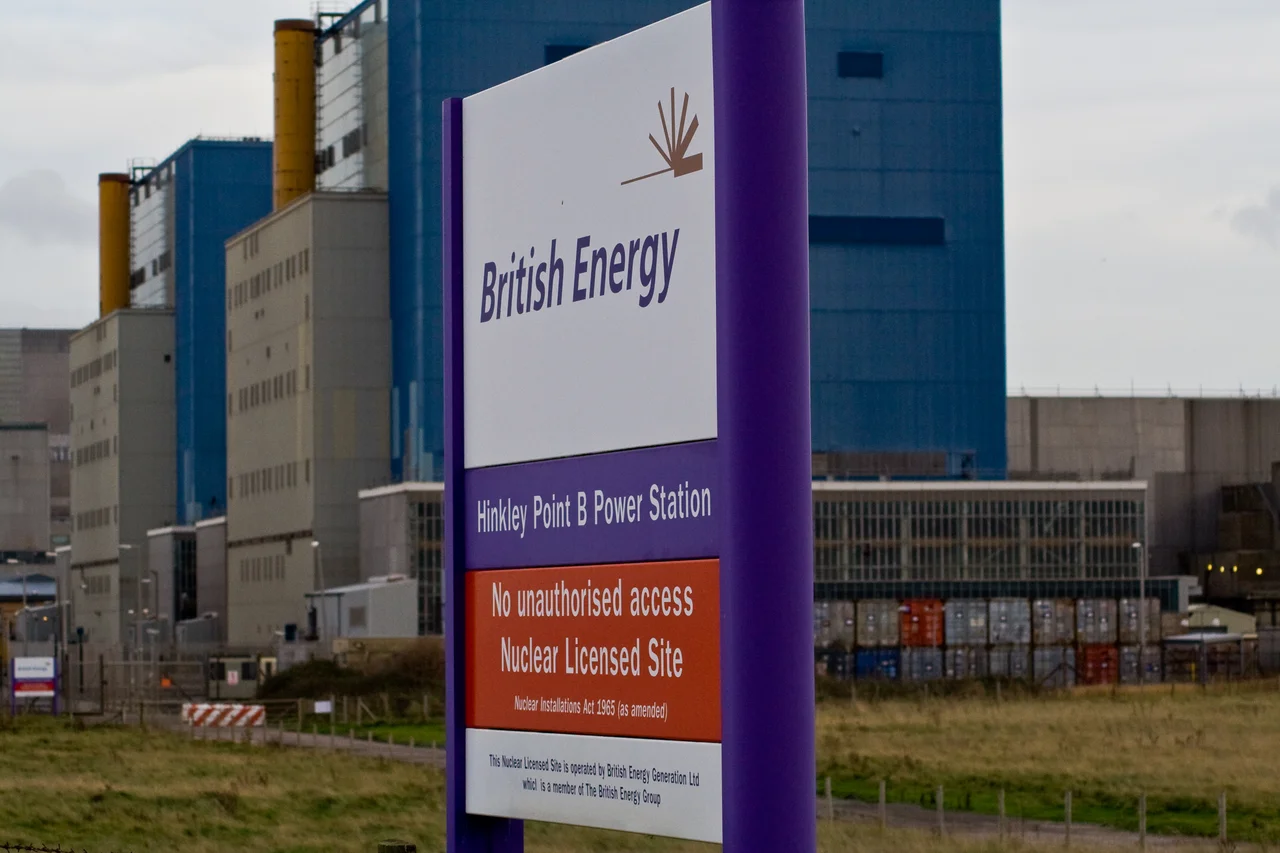

Hinkley Point C nuclear power station
Forty-seven billion pounds. That is the upper estimate, in 2024 prices, of what it will cost to finish the two reactors taking shape on this stretch of Somerset coast. By that measure, Hinkley Point C is the most expensive object ever constructed in human history, a single project whose price tag exceeds the gross domestic product of most countries. The Severn Estuary slides past with its enormous tides. Mud flats stretch toward the Bristol Channel. And rising above the seawall, year by year, stands a concrete cathedral to baseload electricity, built by a French utility, partly financed by China, and intended to keep British lights on for sixty years.
A Coast Already Industrial
Hinkley Point was never pristine. The promontory has hosted nuclear generation since the 1960s, when Hinkley Point A's Magnox reactors began producing power, followed by Hinkley Point B's advanced gas-cooled reactors in 1976. Both stations are now closed or being decommissioned, their concrete bulks weathering into the landscape like ruined keeps. When EDF announced in 2008 that it would build a third station here, the choice surprised no one. The infrastructure was in place, the local workforce understood nuclear, and the cold Severn waters offered cooling for the new reactors. What surprised people was the price. And the time. And how both would keep climbing.
The Crane Called Big Carl
Construction at Hinkley Point C demands tools at a scale matching its ambition. The Sarens SGC-250 double ring crane, the largest of its kind in the world, dominates the site. The workers call it Big Carl. It arrived in hundreds of deliveries, assembled on rails so it can move across the construction zone, and it is responsible for lifting around seven hundred heavy fabrications, including the five major sections of each unit's steel containment liner and dome. The first reactor base required a thirty-hour concrete pour in December 2018, laying down roughly two thousand cubic metres in a single continuous operation. When the platform was finished, it weighed 4,500 tonnes and rose 3.2 metres thick from the bedrock. That was just the floor.
A Strike Price and a Bet
The economics are what make Hinkley Point C a story about more than concrete. In October 2013 the British government agreed to pay EDF a guaranteed price of £89.50 per megawatt-hour for the electricity, indexed to inflation, for thirty-five years. At the time critics called it economically insane. One analyst at Liberum Capital wrote that he was flabbergasted that the UK government had committed future generations of consumers to the costs that would flow from this deal. The argument for the strike price was straightforward: without it, no private investor would touch a project this large, this risky, and this slow. The argument against it has grown louder as offshore wind has plunged in cost and renewables have outpaced expectations. By 2025, the discounted estimated value of future top-up payments to EDF had reached £49.8 billion.
The People Who Build It
At its peak, the Hinkley Point C site employs around ten thousand workers. They arrive by bus from across Somerset on a fleet operated by Somerset Passenger Solutions, a joint venture set up specifically to move construction crews to and from the headland. Up to 160 buses run during the busiest phases. Temporary worker accommodation rises in blocks beside the site, replacing the brickworks that once stood here. By EDF's 2020 count the project had created 10,300 jobs and channelled £1.67 billion through regional companies. The scale invites comparison with the great public works of the past, though this one is privately financed, internationally backed, and overseen by regulators in three countries. When Unit 1 finally generates its first electricity, sometime between 2029 and 2031, much of that workforce will already have moved on to the next nuclear project.
Why Britain Built It Anyway
For all the criticism, the case for Hinkley Point C rests on a simple problem. Britain's older nuclear fleet is closing. Coal is gone. North Sea gas is depleting. Wind and solar are growing fast, but they do not run at night and they do not run when the wind dies. Something has to provide steady, year-round, low-carbon electricity, and the country could not figure out how to do that with renewables alone in the time available. Hinkley Point C was the answer the 2008 white paper proposed and that successive governments stuck with through every cost increase. When the two EPR reactors come online, they will produce roughly seven percent of UK electricity from a footprint smaller than a single offshore wind farm's. Whether that justifies the price is a question Britain will be answering for the next sixty years.
From the Air
Hinkley Point C sits at 51.2061 N, 3.1429 W on the southern shore of the Bristol Channel in Somerset. Approaching from the west you follow the coast inland from Watchet, with the headland marked by the concrete bulk of the older Hinkley Point B station beside the new construction site. Big Carl, the world's largest crane, is visible for miles on a clear day. Cardiff (EGFF) lies about 24 nautical miles across the channel to the north-northwest; Bristol (EGGD) is 24 nautical miles east. Exeter (EGTE) sits 36 nautical miles south. Coastal mist and low cloud are common in the estuary; the Severn tidal range is among the largest in the world, exposing extensive mud flats at low water. A recommended viewing altitude is 2,000 to 3,000 feet to take in the headland, the cooling water intakes, and the construction footprint.
Nearby Stories
- Coity Castle 3.3 km away
- Porlock 6.6 km away
- Newport Transporter Bridge 7.4 km away
- Longleat 14 km away
- Charfield Railway Disaster 15 km away
- Montacute Castle 19 km away
- Murders of Kate Bushell and Lyn Bryant 28 km away
- Dorset Museum 29 km away