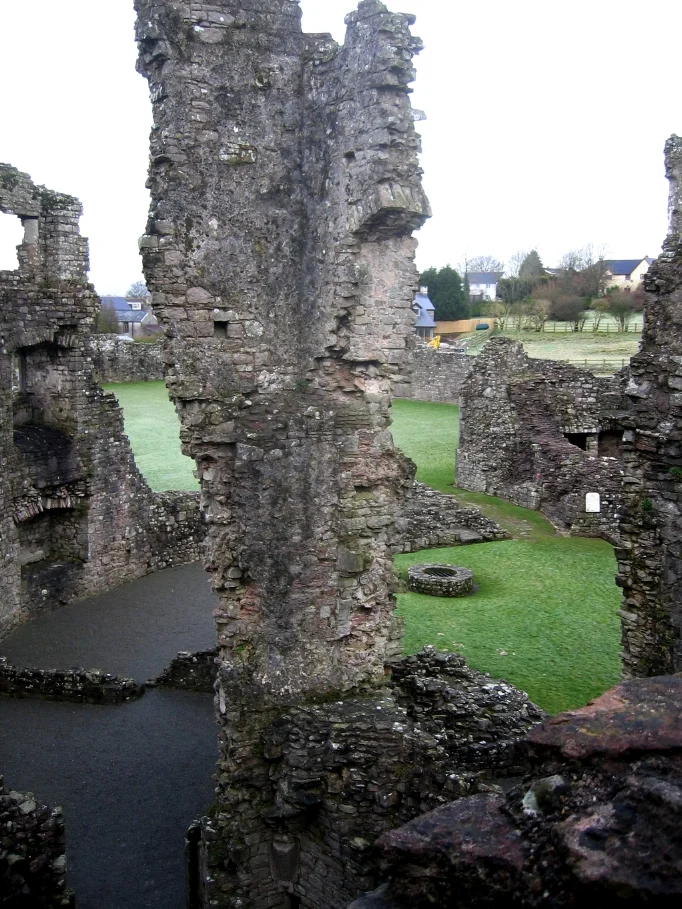

Coity Castle
Sir Payn de Turberville was called "the Demon" by the people whose land he took. He was one of the Twelve Knights of Glamorgan in the legend, the band who rode in behind Robert FitzHamon at the end of the eleventh century and carved Welsh territory into Norman lordships. Where Payn built his stronghold around 1126, the Romans had probably built a fort before him, and locals had walked the dead-straight track of Heol Spencer past it for centuries. He raised a ringwork - a circular bank topped with timber - on ground that already remembered being defended. Nine hundred years later, the walls of the castle that grew from it still stand thirty feet tall, and the road still bends, only slightly, only at the castle, around what Payn put there.
From Ringwork to Stone
The earliest castle was earth and timber: a high circular bank crowned by a wooden palisade, the kind of fortification a Norman lord could throw up in a season with the labour of the conquered. By the twelfth century, Payn or his successors had begun to build in stone. A rectangular three-storey keep went up inside the ringwork, and a curtain wall enclosed an inner ward roughly 150 feet across. The keep was strictly defensive - thick walls, narrow windows, a refuge for a fighting household and not much for comfort. Around it, in the wedge of land between the inner ward and the outer ditched enclosure, lay the unglamorous business of medieval residence: stables, smithies, kitchens, latrines emptying through a tower into the open ground beyond.
A Siege of One Month
In the early fifteenth century, two men named Thomas Gamage had a problem of inheritance and decided to solve it with a private army. The Coity lordship had passed through marriage to the Gamage family, but the legal claim was contested. So William Gamage, with the help of Sir Gilbert Denys of Siston, besieged Coity for a month - a private war fought by English knights inside a Welsh castle while the kingdom looked elsewhere. The siege worked; the claim held. But Gamage and Denys had taken the king's law into their own hands, and on 19 November 1412 they were both locked in the Tower of London. They sat there until 3 June 1413, released only after the death of Henry IV brought a new king to the throne with different priorities. Their cousins married each other; the Gamages held Coity, the descendants of the imprisoned besiegers, for another 170 years.
Comforts of the Tudor Century
By the sixteenth century, the Gamages were no longer planning sieges; they were installing chimneys. The old keep stayed, but the domestic range was remodelled almost completely. A new storey went up. New mullioned windows let in light the original builders had refused. Two big chimney stacks broke the silhouette, evidence of a household that now expected hearths in private rooms rather than a single hall fire. The principal chambers moved to the upper floors. A grand spiral stair connected a vaulted undercroft to a first-floor hall. To the west, ground-floor service rooms - including a kitchen with ovens and a malting kiln for brewing - turned the castle from a fortress into a country house with crenellations. The Gamage line ran out in 1584 with the death of John Gamage. Without an heir, Coity passed through marriage, through sale to the Edwins of Llanharry in the eighteenth century, and eventually to the Earls of Dunraven, who let it fall into the picturesque ruin it remains.
What Stands Today
Walk up the lane from Bridgend and the castle appears suddenly through trees, a tight cluster of curtain walls and a roofless keep set on slightly rising ground. The wall heads still bear faint traces of the merlons and embrasures Payn's masons cut. Inside the inner ward, the spiral stair survives, narrow enough that two armed men could not pass each other on it. Garderobe chutes drop through the masonry into what was once an open ditch. Across the road stands the parish Church of St Mary the Virgin, fourteenth-century and battlemented like a small fortress in its own right - a reminder that in Glamorgan in the late Middle Ages, even God's house wore a fighting collar.
A Castle in the Hedgerows
From the air, Coity is harder to spot than its size suggests. The trees of the Coity Higher community press up against it, and the village's modern houses sit just outside the medieval ditch. Look for the dark circular footprint of the inner ward and the bright cut of the parish church beside it. The dead-straight line of Heol Spencer, possibly Roman, runs north of the castle, deflecting just slightly around its ditches - one of those small inheritances the Welsh landscape keeps, eight centuries after the surveyors who first drew the road went home.
From the Air
Located at 51.522N, 3.553W in the community of Coity Higher, just north of Bridgend in south Wales. Nearest airports are Cardiff (EGFF, about 16 nautical miles east-southeast) and Swansea (EGFH, about 18 nautical miles west). Best viewed at 1,500-3,000 feet AGL; the castle sits in a small cluster of trees with the battlemented parish church of St Mary the Virgin immediately adjacent, making a tight identification pair from the air. The M4 corridor runs about a mile to the south.
Nearby Stories
- Brecon and Merthyr Tydfil Junction Railway 2.4 km away
- Abergwili 3.6 km away
- Whiteford Lighthouse 7.1 km away
- Llanthony Priory 13 km away
- Hinkley Point C nuclear power station 14 km away
- Porlock 15 km away
- Brecon Beacons National Park 20 km away
- Moreton House, Bideford 35 km away