
Murders of Kate Bushell and Lyn Bryant
Kate Bushell was a teenager. Lyn Bryant was a wife and mother. Both lived ordinary lives in the West Country. Both took their dogs for walks along quiet lanes the way thousands of people in Devon and Cornwall do every afternoon. Within thirteen months of each other in 1997 and 1998, both were killed by a stranger with a knife. The cases were never solved. Their families have been waiting nearly thirty years for an answer.
Two walks, two lives
These were not statistics. Kate was 14 years old when she took a neighbour's dog out near her home and never came back. Her body was found 300 yards from her front door. Lyn Bryant was 41, walking her dog along a country lane in Ruan High Lanes, Cornwall, when she was attacked and stabbed multiple times. In a detail that has haunted investigators ever since, her killer apparently returned to the scene four months later to place her missing glasses back where she had fallen. Both women were doing something completely unremarkable on the day they died. Both had families and futures that ended without warning. Devon and Cornwall Police, who handled both investigations, described Kate's case as their largest and most high-profile murder inquiry, with costs exceeding £1 million by 2018. Lyn's case had cost £2 million by the same year. Neither investment has bought an answer.
A pattern that frightened a region
The similarities between the two killings were impossible to ignore. Both victims were women. Both were walking dogs. Both attacks happened on isolated rural lanes. Both used knives. Both were committed without apparent motive, neither sexual assault nor robbery. The combination raised a possibility no one in the south-west wanted to voice: that a serial killer was operating in the region. In January 1999, that fear sharpened. A man with a knife deliberately drove his car into a 17-year-old girl walking her dog with her mother near Newton Abbot, then dragged them into a field where they fought their way free. Devon and Cornwall Police said the similarities to the Bushell and Bryant cases were 'too obvious to ignore.' Another attack on a dog-walker followed near Camborne, Cornwall. In July 2000 a woman in Salcombe was stalked for over 300 yards by a man with a six-inch knife; her Alsatian's barking drove him off. Each incident reopened the question, and each time the trail went cold.
What the DNA knows
In 2018, investigators revealed that a DNA profile had been isolated from the Bryant case. After two decades, science had pulled something useful from physical evidence that did not exist as a tool in 1998. The profile sits in the National DNA Database, waiting. A match could come tomorrow, or in another twenty years, or never. Cold-case forensics has solved older murders than this. Retired detective Chris Clark has argued publicly that the Bushell and Bryant killings might also link to the 1987 murder of Helen Fleet, a 66-year-old killed while walking her dog in Worlebury Woods near Weston-super-Mare. The Bushell case was briefly linked to the 1998 murder of Julia Webb in Cheshire before that connection was ruled out. Each linkage attempt, each press appeal, each anniversary feature is an effort to keep evidence flowing toward an answer that has not yet come.
Why we still talk about them
Some unsolved cases fade. These two have not. Crimewatch returned to Kate Bushell's killing in January and September 1998, and to Lyn Bryant's in November 1998. The twenty-year anniversaries in 2017 and 2018 brought fresh coverage. Vanessa Brown devoted a chapter of her 2009 book Britain's Ten Most Wanted to the Bushell case. The cases stay in public memory partly because the details are so frightening, but also because each retelling is an act of patience. Someone, somewhere, may know something. A child who saw a car in a lane in 1997 is now an adult who can name the driver. A relative may finally read a story online and recognize a pattern. The investigation continues precisely because Kate and Lyn deserve more than to remain unanswered questions.
The lanes are still there
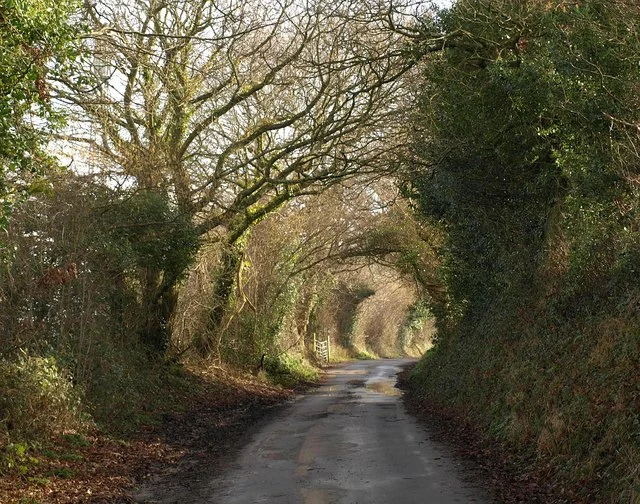
Devon's country lanes look much as they did in 1997: hedge-banked, narrow, quiet enough to hear a dog padding ahead. Most walks end uneventfully. The vast majority of dog-walkers in the West Country will live entire lives without incident. What Kate and Lyn's deaths did was contaminate something ordinary with the memory of how rarely, but really, ordinary things go wrong. Devon and Cornwall Police still take calls about the cases. The DNA profile is still on file. The killer, if alive, is now in his 60s or 70s, walking around somewhere in Britain or beyond. For the families, every passing year is both another year of grief and another year closer to the answer that forensic science keeps inching toward.
From the Air
The general area of both murders lies in the rolling country between Exeter and the South Devon coast, roughly 50.73N, 3.56W for the Exeter end. Kate Bushell was killed near Exwick on the western edge of Exeter; Lyn Bryant near Ruan High Lanes in Cornwall, around 50.20N, 4.98W. Best viewed at 1,500 to 2,500 feet AGL when the small lanes and farm hedges are visible. Exeter Airport (EGTE) is 4 nm east of Exeter. Newquay (EGHQ) and Land's End (EGHC) serve Cornwall.
Nearby Stories
- Manor of Orleigh 1.4 km away
- Berry Pomeroy Castle 3.9 km away
- 1890 Norton Fitzwarren Rail Crash 5 km away
- North Cornwall Railway 6.9 km away
- St Germans Priory 8.7 km away
- Siege of Lyme Regis 16 km away
- Exmoor 19 km away
- HMS Formidable (1898) 26 km away