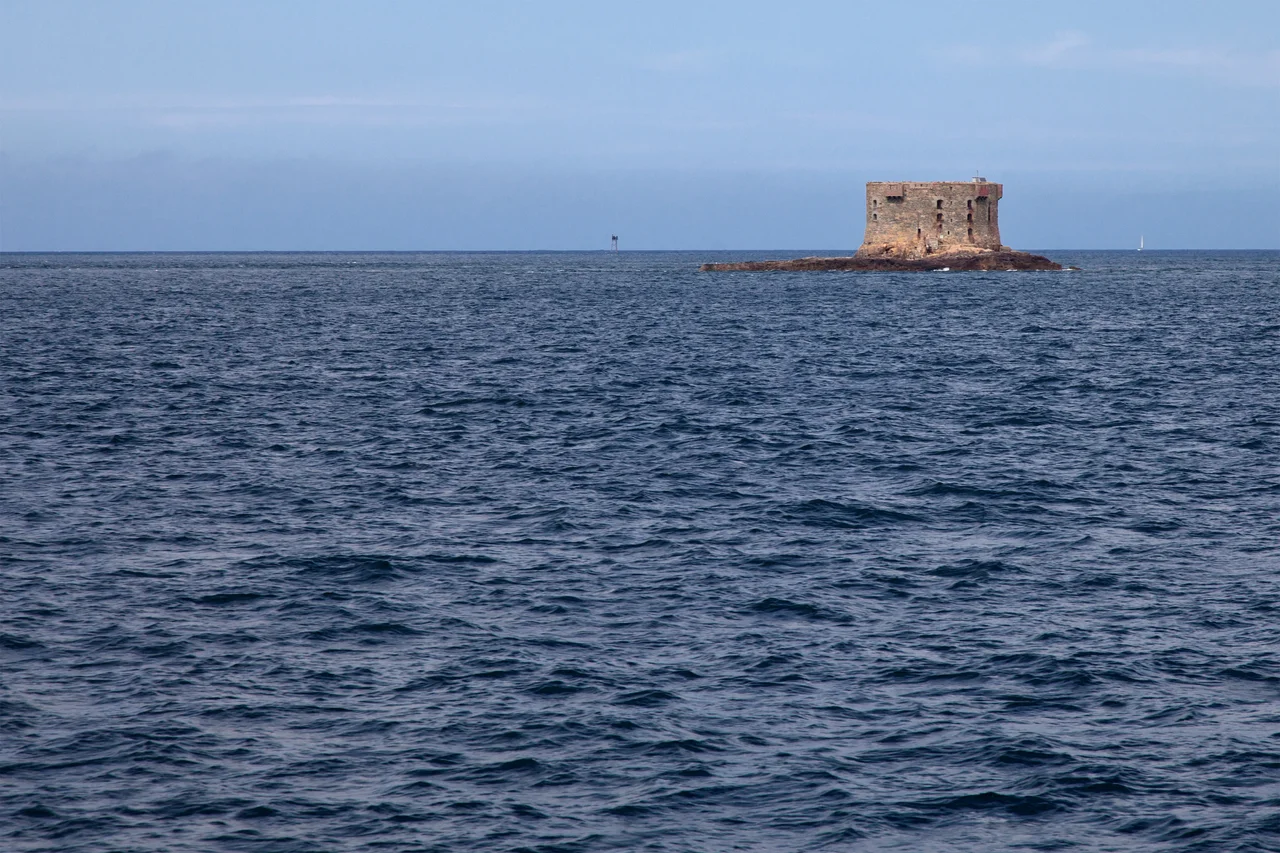

Bréhon Tower
Halfway between St Peter Port and the island of Herm, an oval lump of granite rises straight out of the sea. There is no causeway, no jetty visible from a distance, just a stubby tower planted on a rock barely larger than itself. The Bréhon Tower looks like a stone milk bottle stoppering the Little Russell channel. It has been guarding that channel since 1857, the last and strangest descendant of the Martello tower, and the story of what happened to it - and from it - is not what its sleepy silhouette suggests.
Granite Hauled From Herm
The British became nervous in 1850. France was fortifying Cherbourg, just thirty miles south, and the Channel Islands were uncomfortably exposed. The answer was a string of new towers and forts, of which Bréhon was the most exotic - oval rather than round, with three levels stacked inside its walls. Thomas Charles de Putron, born on Guernsey in 1806, oversaw the work. The granite was quarried on Herm and ferried across the Little Russell. When the construction bill was finally added up it came to £8,098, 18 shillings, and tenpence. The tower opened in 1857, eighty-five feet wide at its base, thirty-four feet tall, and equipped with something genuinely modern: indoor latrines, a Victorian luxury its garrison appreciated.
Guns That Broke Themselves
The original plan called for fourteen cannon ports and eight heavy guns. Reality intervened. By the time it was armed, Bréhon mounted three 68-pounders and two ten-inch shell guns, all crowded onto the platform at the top. Each gun weighed five tons. In 1859, while a barge was loading one of them, the boat capsized and the gun sank to the bottom of the channel, never recovered. When the garrison finally test-fired the cannon the tower had been built for, the concussion of the discharge sent a crack running from the parapet to the foundations. The guns had a range of three thousand meters. The tower could not, it turned out, comfortably fire them.
Five Years Under German Guns
Bréhon's most violent chapter came not under British command but under German. During the occupation of the Channel Islands from 1940 to 1945, Wehrmacht engineers installed coastal defense and anti-aircraft batteries on the platform. The tower that had been built to defend Guernsey now defended its occupiers. On at least two occasions, those guns did real damage. Flying Officer Jaroslav Novák of 312 Squadron, a Czech fighter pilot serving with the RAF, dove on Bréhon in his Spitfire Mk Vb to silence the flak. His aircraft, serial EP539, was shot down and he was killed. A year later, on 22 May 1944, Flight Lieutenant Hugh Percy of 610 Squadron met the same fate in a Spitfire Mk XIV. The tower's gunners also claimed one Focke-Wulf Fw 190, which crashed east of Herm - shot down, apparently, by the very batteries it was supposed to be supporting.
Birds and Boats
Today Bréhon is something gentler. The tower itself is closed, but the rock around it is open to visitors who arrive by boat - the only way to get there. A navigation light operated by the Guernsey Harbour Authority sits where the guns once stood. In summer, common terns nest on the island in noisy clouds. From the sea you can still see the gun ports staring blankly across the channel. The Alderney cutter Experiment was wrecked nearby in March 1850, before the tower existed; eight people drowned, and a Guernsey pilot boat named Mary saved twenty. The Little Russell has always been a place where things end, and where things just keep going. Bréhon, somehow, has done both.
From the Air
Bréhon Tower stands at approximately 49.47°N, 2.49°W, roughly 1.5 km northeast of St Peter Port harbor in the Little Russell channel between Guernsey and Herm. From the air the tower reads as a small oval shape on a tiny rock - easy to miss above 2,000 feet, distinctive below. The Little Russell itself is the deepwater channel ferries use to reach Guernsey, and Bréhon sits in the middle of it. Guernsey Airport (EGJB) lies on the south side of the main island, about 8 km southwest. Best viewed from the east in morning light, when the granite catches the sun.
Nearby Stories
- Pallot Steam, Motor & General Museum 29 km away
- HMS Affray 29 km away
- Operation Donnerkeil 29 km away
- German Submarine U-672 35 km away
- Action of 18 June 1793 60 km away
- Mont Saint-Michel: The Abbey That Becomes an Island Twice a Day 78 km away
- Basilica of Sainte-Therese, Lisieux 209 km away
- 1941 Santander Fire 642 km away