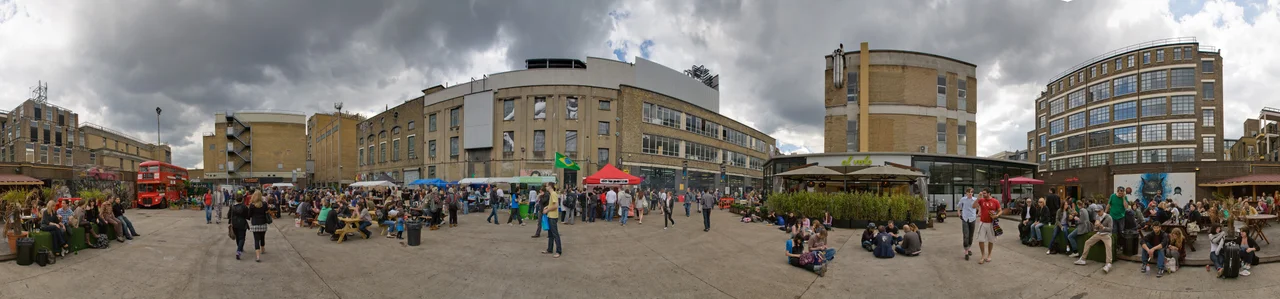

Brick Lane Market
For many years, among the hundreds of stalls that stretched the length of Brick Lane on a Sunday morning, there was one selling nothing but rusty cog wheels. No explanation was offered; buyers presumably knew what they needed. This detail captures something essential about Brick Lane Market: it has always made room for the inexplicable alongside the practical, for the singular alongside the commercial. It began in the seventeenth century as a farmers' market serving the Jewish community's Sunday trading, and has evolved into something far stranger and more interesting.
Three Centuries of Sunday Trading
The market's origins lie in a religious concession. In the seventeenth century, when Sunday trading was forbidden for Christian observances, a special dispensation allowed the Jewish community — for whom Saturday was the Sabbath — to trade on Sundays. The market that developed sold fruit, vegetables, and the kind of goods a working-class East End community needed. As the area's demographics shifted over the following centuries — waves of Irish, then Eastern European Jewish immigrants in the nineteenth and early twentieth centuries, then Bangladeshi families from the 1970s onward — the market adapted with them. Today it operates both weekdays and weekends, with Saturday and Sunday remaining the busiest days. The weekly rhythm of buyers and sellers returning to the same stretch of street connects the current market to its seventeenth-century predecessor, even if almost nothing else does.
The Old Truman Brewery
The physical heart of the modern market is the Old Truman Brewery, an 11-acre complex at the northern end of Brick Lane. The brewery's history on this site dates to 1683, when Joseph Truman first appears in records here. His descendants, particularly Benjamin Truman, built it into the sizeable Black Eagle Brewery. By the early 2000s the brewery had closed and the buildings were being repurposed. Since then, roughly 250 businesses, shops, and eateries have taken up residence within the complex. The Truman Markets — six distinct markets operating within the brewery — include the Upmarket, which opened in 2004 and houses nearly 100 stallholders in what is described as East London's biggest street food hall; the Backyard Market, added in 2006, which gives young artists and designers space to sell directly to the public; and the Brick Lane Vintage Market, which began as a monthly event in 2008 and became a permanent fixture in 2010. The Tea Rooms, founded in 2009, specializes in teas, coffees, antiques, and handmade goods.
Art Students and Bargain Hunters
Brick Lane Market has always attracted art students — the combination of unusual objects, affordable prices, and visual chaos makes it a natural hunting ground for anyone looking for reference material or raw inspiration. Fine art and fashion students from across London exhibit their work near Brick Lane each year. The walls of the surrounding streets function as a shifting outdoor gallery, with work by artists including Banksy, Stik, ROA, D*Face, and Ben Eine regularly appearing and disappearing. Ely's Yard, within the Truman Brewery complex, hosts Banksy and D*Face pieces alongside bars, restaurants, and the kind of street life that doesn't survive tidying. The market has been used in music videos by The Killers and R.E.M., among others. It photographs well, which helps — but the appeal is more sensory than visual: the smell of different cuisines competing, the sound of competing music from different stalls, the texture of objects pulled from boxes.
What You Can Actually Buy
The range of goods across Brick Lane's various markets spans antique books, eight-track cartridge players, vintage clothing from every decade of the twentieth century, handmade jewelry, street art prints, organic produce, and food from every cuisine with a London presence. The Boiler House food hall — now closed in its original form but succeeded by other food spaces in the complex — once offered Italian, Polish, Lithuanian, Mediterranean, Mexican, Peruvian, Japanese, and Caribbean-Asian fusion dishes from over thirty stalls. The market was a significant early incubator of London's vegan street food scene. The Upmarket describes itself as a platform for emerging designers and organic cuisine; the Backyard Market emphasizes work made by the sellers themselves. Nearest tube stations are Aldgate East and Liverpool Street; Shoreditch High Street on the London Overground is also within easy walking distance.
From the Air
Brick Lane Market is centered at coordinates 51.5235°N, 0.0715°W in Tower Hamlets, east London. From altitude, look for the Truman Brewery complex at the northern end of Brick Lane, identifiable by its industrial rooflines. The area lies east of the City of London, south of Bethnal Green. London City Airport (EGLC) is 8km to the east; the City of London is 2km to the west.
Nearby Stories
- Stevenage 5.7 km away
- Malling Abbey 5.7 km away
- 1952 Farnborough Airshow Crash 7.7 km away
- Ingatestone Hall 8.2 km away
- Hellfire Caves 9.1 km away
- The Carrington Event: The Solar Storm That Could Happen Again 9.8 km away
- Bletchley Park 16 km away
- Castle Hedingham 23 km away