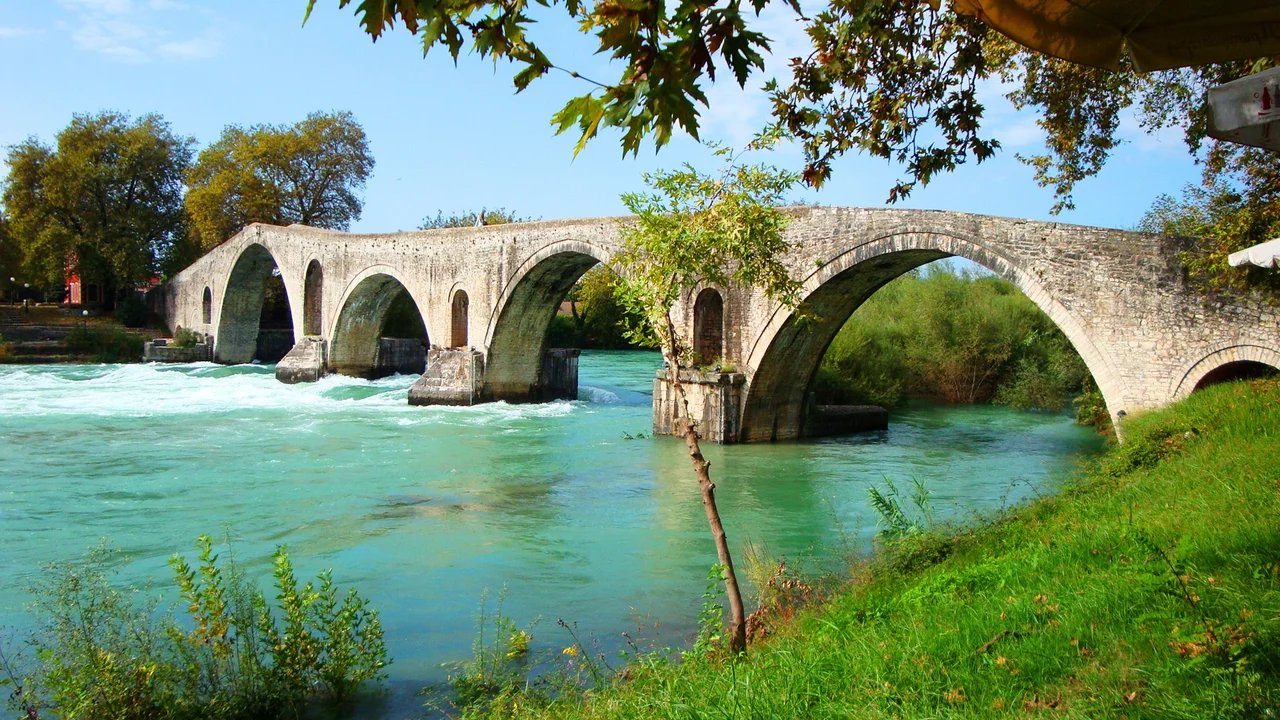

Bridge of Arta
The ballad has been sung for centuries, passed down in Greek villages long before anyone thought to write it down. Forty-five masons and sixty apprentices were building a bridge that would not stand: all day they built, and each night the arches fell. Then a bird with a human voice told the master-builder what the bridge required. He went home. He told his wife to bring him his tools at the construction site the next morning. And when she arrived, the workers were ready — not with tools, but with mortar.
Stone and Water
The Bridge of Arta crosses the Arachthos river at the western edge of the city, where the river bends before widening toward the Gulf of Ambracia. It is a genuine medieval structure — four arches of cut stone, their curves reflected in the slow current below — though the bridge's history is older than any single construction. According to the Epirote chronicler Panayiotis Aravantinos, its origins reach back to the Roman Empire. Some traditions connect a major rebuilding to the era when Arta served as capital of the Despotate of Epirus, possibly under Michael II Doukas, who ruled from 1230 to 1268. The bridge as it stands today is almost certainly Ottoman, probably constructed between 1602 and 1606, or perhaps as late as 1613. Centuries of Arachthos floods, political upheavals, and changing rulers have not moved it. The stone holds.
The Price of the Foundation
The folk ballad of the Bridge of Arta belongs to the tradition of acritic songs — Greek epic poetry with roots in Byzantine frontier life. Its story is simple and devastating. After countless nights of collapse, the bird tells the master-builder the truth: only the sacrifice of his wife, walled alive into the foundations, will make the bridge stand. He deceives her into coming. The workers seal her in. As the stone closes around her, she curses the bridge: let it tremble like a leaf, let those who cross it fall like leaves. Then someone reminds her that her own brother travels the roads and might one day use this bridge. The curse becomes a blessing — let it tremble only as mountains tremble, let travelers fall only as eagles fall. She does not curse the bridge. She cannot bring herself to endanger her brother. The ballad does not resolve this contradiction. It simply ends.
An Old Dark Theme
The practice of immurement — sealing a living person into the foundations of a structure — appears across Balkan folklore as a recurring metaphor for what permanence costs. The Serbian epic poem 'The Building of Skadar' carries the same motif, as does the Romanian 'Argeș Monastery.' Even in Arthurian legend a version appears: Vortigern's tower, which collapsed each night until Merlin revealed what the ground required. Scholars have long debated whether these stories reflect actual historical practices, collective memory of something once witnessed, or a symbolic working-out of the violence that infrastructure demands. The Bridge of Arta does not answer that question. From the ballad, Greek speech acquired a proverb about projects that never seem to finish: 'All day they were building it, and in the night it would collapse.'
A Border in Stone
The bridge's later history has its own strange chapter. From 1881, when Greece formally annexed Arta from the Ottoman Empire, until 1912 and the outbreak of the First Balkan War, the highest point of the bridge was an international border. Greek territory began on one side; the Ottoman Empire continued on the other. Travelers crossing from Arta into Ottoman lands — or back again — stepped over that invisible line in the middle of a medieval arch. The bridge itself was indifferent to the politics beneath it. It had stood through the Despotate of Epirus, the Ottoman conquest, Venetian occupation, French control under Napoleon's successors, and the warlordship of Ali Pasha of Janina. A frontier marker changed nothing fundamental.
Crossing It Today
The bridge is still crossable on foot, a graceful sweep of Ottoman stonework over green water. Standing on it, the Arachthos feels quieter than its history suggests — a river that has seen Roman engineers, Byzantine lords, and Ottoman builders measure its current and argue about its floods. The arches are lower than photographs suggest; the whole structure sits close to the water. From the bridge itself, the city of Arta is mostly hidden by trees on the eastern bank. The nearest major airport is LGPZ, Aktion National Airport, about 40 kilometers to the southwest across the Gulf of Ambracia. From the air on approach, the Arachthos appears as a silver thread through cultivated plains before it enters the city — and the bridge, four arches of pale stone, is visible just west of the urban center in good light.
From the Air
The Bridge of Arta sits at approximately 39.1517°N, 20.9747°E, on the western edge of Arta city where the Arachthos river bends. Nearest major airport is LGPZ (Aktion National Airport), approximately 40 km to the southwest. The bridge is a recognizable visual landmark at lower altitudes — four pale stone arches over the green Arachthos. Best viewed at 1,500–3,000 feet in clear conditions, approaching from the southwest. The Gulf of Ambracia is visible to the south, and the Pindus foothills rise to the east.
Nearby Stories
- Battle of Karpenisi 13 km away
- Castle of Santa Maura 17 km away
- Prousou Monastery 21 km away
- Paxos 22 km away
- Dodona 22 km away
- Meteora: The Monasteries Built on Impossible Pillars 42 km away
- Achilleion (Corfu) 47 km away
- SM UC-38 67 km away