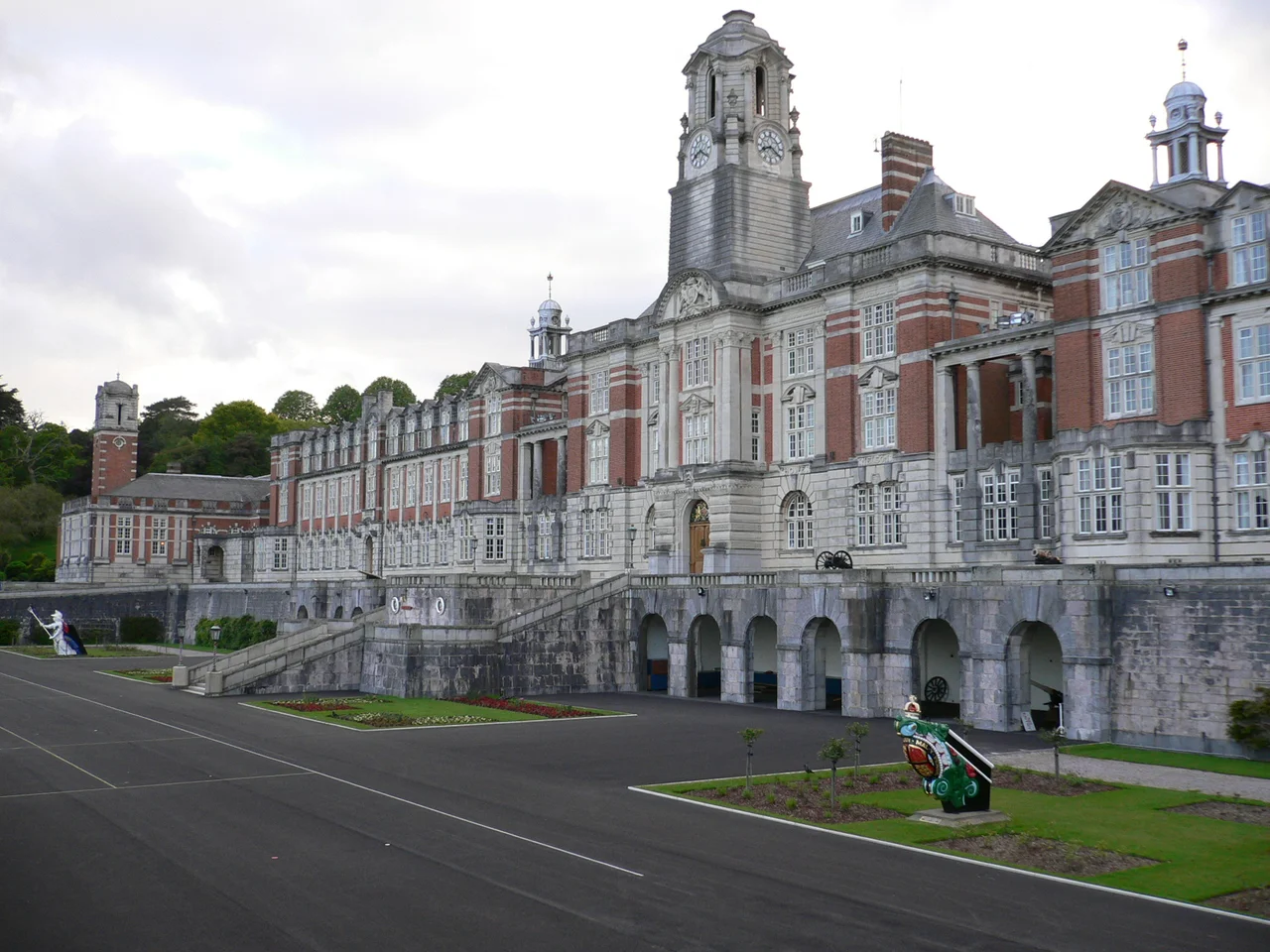

Britannia Royal Naval College
From the river, Britannia Royal Naval College looks like a ship that ran aground on a hilltop and refused to leave. Aston Webb designed it that way. The long pale facade rises in tiers above the wooded slopes overlooking the port of Dartmouth, foursquare, ceremonial, and unmistakably naval. Inside, a polished quarterdeck does duty as both parade ground and ship's deck, and every Royal Navy officer of the modern era has stood on it. King George V stood on it. So did George VI, Charles III, Andrew, William, and in July 1939, a Greek-Danish cadet named Philip who was assigned to chaperone a visiting thirteen-year-old Princess Elizabeth. They were married five years later. Dartmouth is where the British state has built officers since 1863, and even now it is the only place that does.
The Wooden Ship Years
Naval training at Dartmouth began afloat, not ashore. In 1863, the wooden hulk HMS Britannia was towed in from Portland and moored in the River Dart to serve as a floating academy. A second hulk, HMS Hindostan, was added the following year to handle the influx of cadets. Before the Dart, the Royal Naval Academy at Portsmouth had trained officers for a century, from 1733 to 1837, but the Royal Navy had developed a strong cultural preference for learning the sea on the sea itself. The Dartmouth hulks were a compromise: classrooms on water, with the estuary itself for boatwork. The original Britannia was replaced in 1869 by another vessel that was renamed Britannia, so the name went on while the timber underneath was quietly swapped out. By the late nineteenth century the limitations were obvious. Wooden hulls rot. Boys outgrew them. The Navy needed a building.
Aston Webb's Battleship
King Edward VII laid the foundation stone in March 1902. The architect was Sir Aston Webb, who would go on to design Admiralty Arch and the principal frontage of Buckingham Palace; the builders were Higgs and Hill. The shore college was practically complete by 1905, and from September of that year the first intake of cadets transferred up from the junior establishment at Osborne House on the Isle of Wight. The arrangement at first was that cadets joined the Royal Naval College, Osborne, at the age of thirteen for two years before coming on to Dartmouth, an interesting echo of the Navy's old habit of starting boys very young. Osborne closed in 1921, and Dartmouth became the sole gateway. The building Webb produced is monumental in a quiet, restrained way: a long central block flanked by wings, dominated by a clocktower above the entrance, with the parade ground inside the quarterdeck and the river at the foot of the hill below. From outside, the eye keeps reading it as a vessel.
Bombs and Backwaters
In September 1942, six Focke-Wulf aircraft made a low pass over Dartmouth and bombed the college. Two bombs penetrated the main block, damaging the quarterdeck and surrounding rooms. The college evacuated, transferring students and staff up to Eaton Hall in Cheshire for the duration of the war and not returning to the Dart until the autumn of 1946. After the war, the Navy slowly consolidated its training. The Royal Naval Engineering College at Manadon closed in 1994. The Royal Naval College at Greenwich, in Christopher Wren's great buildings beside the Thames, closed in 1998 and became a university campus. From that moment Britannia at Dartmouth has been the sole centre for Royal Naval officer training. In 2020, in an unusual moment, a troop of 34 Junior Rates and 130 officer cadets passed out together for the first time in Royal Navy history, after a recruiting surge overwhelmed the rating school at HMS Raleigh.
Cadets, Sea-class Boats, and Rot
Prospective cadets first face the Admiralty Interview Board, where mental aptitude tests, a basic fitness test, and a medical examination decide who proceeds. Cadets, who keep that title until passing out, can join between the ages of 18 and 39, most of them after university but some directly from school. The standard commissioning course runs thirty weeks; Warfare Officers and Aircrew spend a further nineteen weeks on academics at the college. International and Commonwealth students are part of the student body, including, in recent years, officers from Kuwait and Bahrain. For their boatwork, cadets now train on eight new 15-metre Sea-class workboats named Cormorant, Guillemot, Razorbill, Kittiwake, Fulmar, Skua, Gannet, and Tern. The building itself has not aged so gracefully. An Ofsted inspection in 2023 described the college as filled with "rot and mould," with boarded-up dormitory windows and unsafe structures, and rated it inadequate. Chief Inspector Amanda Spielman attributed the verdict to "a lack of investment over many decades." Aston Webb's ship on the hill is overdue for a refit.
The Royal Encounter
One story above all others is told about Dartmouth. In July 1939, King George VI brought his family to visit the college; among the cadets assigned to entertain the young princesses was an eighteen-year-old Prince Philip of Greece and Denmark. The first "significant encounter" between Philip and the future Queen Elizabeth II took place on these grounds, an introduction that grew into a wartime correspondence, an engagement, and a marriage that defined the British twentieth century. Charles III trained here. Prince Andrew trained here. Prince William spent a brief period at the college as part of his rotation through the three armed services. Dartmouth's institutional grandeur and royal connections sometimes obscure what it actually is: a school that takes adults and turns them into ship's officers responsible for crews and equipment worth billions. The polished quarterdeck looks out, every passing-out day, on the new lieutenants stepping off it. The river below is the same river the wooden hulks were moored in. The job, more or less, is the same too.
From the Air
Britannia Royal Naval College sits at 50.357 degrees north, 3.583 degrees west, on the hillside above Dartmouth on the west bank of the River Dart estuary. From the air, the long pale Edwardian facade with its central clocktower is unmistakable, set in green grounds above the town. Exeter Airport (EGTE) is roughly 28 nautical miles to the north-northeast. The estuary runs north to south here, narrow and steep-sided; a coastal track at 2,000-3,000 feet gives a clean view of the college with the harbour and Kingswear opposite. Note that the Dart estuary sees active Royal Navy training traffic, including the Sea-class workboats based at the college.
Nearby Stories
- St Germans Priory 7.6 km away
- Launceston, Cornwall 9.6 km away
- Castle Drogo 12 km away
- HMS Formidable (1898) 17 km away
- Siege of Lyme Regis 19 km away
- Battle of Plymouth (1652) 40 km away
- German Submarine U-672 48 km away
- Goonhilly Satellite Earth Station 69 km away