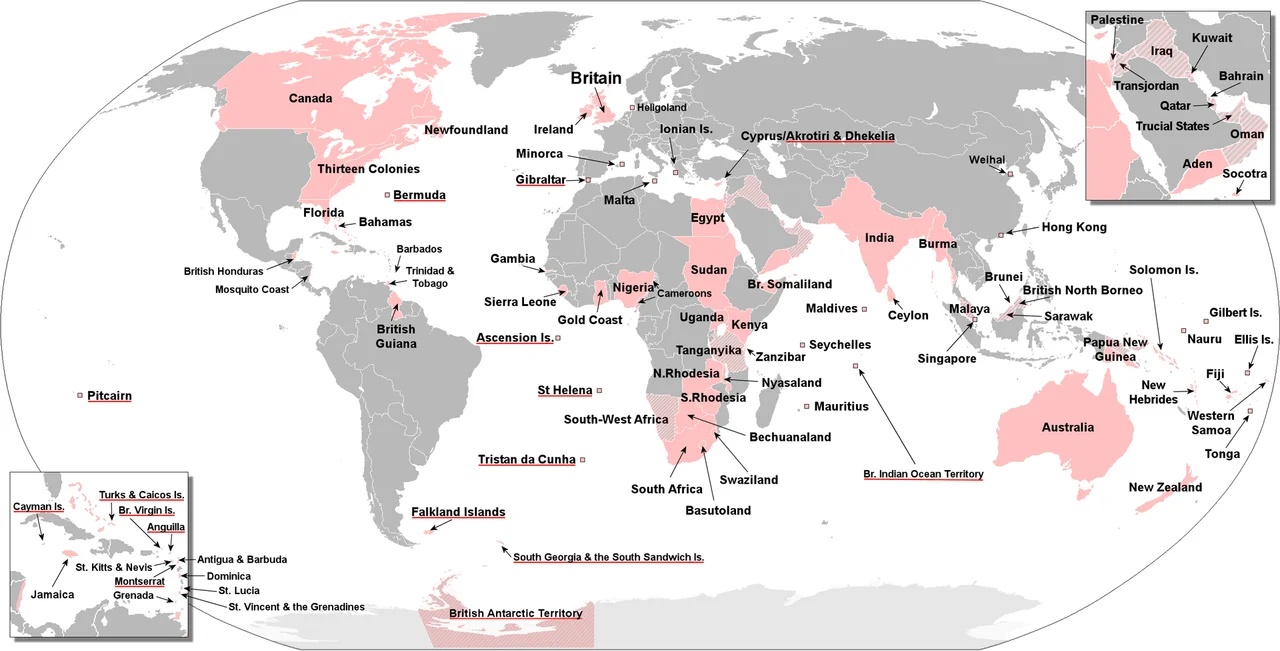

British Empire
Three days. That is roughly how long, on average, it took the sun to set somewhere on the British Empire and rise again somewhere else - because by 1920 it never did. The empire by then covered 35.5 million square kilometres, about a quarter of all the land on Earth, and ruled the lives of roughly 412 million people. It was the largest empire in history. It was also, depending on whom you ask and where they lived, a trading network, a settler project, a school system, a railway company, a slave market, a famine, a massacre, and a long, painful argument that is still going on. Any story this big has to be told with both eyes open. The empire built things. It also broke things. The people whose ancestors lived under it - in Bengal, in Kenya, in Ireland, in Jamaica, in Australia, in dozens of other places - know which of those things mattered to them.
The Beginning at Sea
It started small and badly. In 1497 King Henry VII sent John Cabot west from Bristol to find a route to Asia. Cabot reached Newfoundland, thought he had reached Asia, sailed home, sailed out again the next year, and disappeared. For nearly a century after that, England did almost nothing while Spain and Portugal carved up the world. Then in 1562 Elizabeth I licensed the privateers John Hawkins and Francis Drake to raid Spanish ships off the coast of West Africa, and one of the things they did - the founding act of a kind - was capture African people and sell them across the Atlantic. By 1583 Humphrey Gilbert was formally claiming Newfoundland for the Crown. By 1600 the East India Company had its royal charter. By the 1640s, on the sugar islands of Barbados, English planters were running plantations worked by enslaved Africans, and the empire's first really enormous source of wealth had been found. It would not be the last that depended on coerced labour.
Sugar, Slavery, and the Atlantic
For roughly two centuries the most profitable corner of the British Empire was a handful of small Caribbean islands - Barbados, Jamaica, St Kitts, Antigua - where sugar was grown on plantations worked by people brought in chains from West Africa. Ships out of Bristol, Liverpool, and London carried the bulk of the British slave trade; on the Middle Passage between Africa and the Americas, roughly one in seven captives died at sea. Those who survived were worked, often to death, in conditions designed to extract sugar at scale. The wealth this generated reshaped Britain - it built docks, country houses, banks, and political careers. In 1807 Parliament finally abolished the slave trade itself, and in 1833 it abolished slavery in most of the empire, with full emancipation following a four-to-six-year apprenticeship period that was itself abolished early in 1838. The British government did not compensate the people who had been enslaved. It compensated the people who had owned them. The loan that paid for it was finally repaid by British taxpayers in 2015.
India and the Long Wound
The British conquest of India was carried out for most of its history not by the British state but by a private company. The East India Company defeated the Nawab of Bengal at Plassey in 1757 with a force largely made up of Indian sepoys led by British officers, and from that moment its reach grew until it controlled most of the subcontinent. The Crown took over directly after the rebellion of 1857. What followed was a century and a half during which British administration in India built railways, established universities, codified law, and presided over a series of famines that killed millions. The Great Bengal Famine of 1770 may have killed ten million. The famines of the 1870s and 1890s killed millions more. In 1919, at Jallianwala Bagh in Amritsar, troops under General Reginald Dyer opened fire on an unarmed crowd in a walled garden and killed several hundred people - the figure remains contested - injuring more than a thousand. In 1943 the Bengal famine killed roughly two to three million people in the middle of the Second World War, while grain was being exported and Winston Churchill made remarks about Indians that even his admirers find difficult to defend. India became independent on 15 August 1947. Partition - the splitting of the subcontinent into India and Pakistan - displaced perhaps fourteen million people and killed something between several hundred thousand and two million in the violence that followed.
The High Imperial Century
Between 1815 and 1914 the empire added roughly ten million square miles and four hundred million people. Some of that expansion went to white settler colonies that became the dominions - Canada, Australia, New Zealand, South Africa - and were gradually granted self-government, with all the violent dispossession of indigenous peoples that settlement involved. In Australia, where colonisation began in 1788, indigenous peoples were declared too uncivilised to require treaties at all. In New Zealand the Treaty of Waitangi was signed in 1840 by William Hobson and Maori chiefs; what the Crown meant by it and what the chiefs understood themselves to have signed turned out to differ in ways that are still being litigated. In southern Africa the British fought two wars against the Boer republics, the second of which (1899-1902) saw the British army intern Boer civilians - and, separately, far larger numbers of Black Africans - in concentration camps where tens of thousands died of disease. The empire also waged what came to be called the Scramble for Africa, racing France, Germany, Belgium, and Portugal for territory at the Berlin Conference of 1884-85, the boundaries of which still scar the maps of the continent.
Resistance and the Long Unwinding
The empire was never simply done to people. It was contested, in every territory, from the moment it arrived. The American Revolution of 1776 was the first big rupture. The Irish, never reconciled to Union with Britain, fought rebellion after rebellion before the Easter Rising of 1916 and the establishment of the Irish Free State in 1922. India had its mutineers and its Congress and its Mahatma. Kenya had the Mau Mau uprising of the 1950s, during which the colonial government interned tens of thousands of suspected rebels in detention camps - many were tortured, hundreds executed - and then systematically destroyed the records. Cyprus, Malaya, Aden, Palestine: every one of them generated its own brutal counter-insurgency. The Second World War left Britain broke and the empire untenable; the Suez Crisis of 1956 confirmed for everyone, including the British themselves, that the United States had inherited what was left of their global position. India went in 1947. Burma and Ceylon in 1948. Most of Africa between 1957 and 1968. Hong Kong, the last great possession, returned to China at midnight on 1 July 1997, and the Royal Yacht Britannia sailed away in the rain.
What is Left
Fourteen overseas territories - Bermuda, the Falklands, Gibraltar, the Caymans, Pitcairn, some others - are still under British sovereignty. The Commonwealth of Nations remains a voluntary association of mostly former colonies, fifteen of which still share the British monarch. English is now spoken as a first language by hundreds of millions of people and as a second language by perhaps a billion more. Cricket is played in Mumbai and Bridgetown and Sydney. Tea is drunk everywhere. The legal systems of much of the world are still recognisable descendants of English common law. But the human cost is also still there, in the famines that did not have to happen, in the borders that were drawn carelessly and bled, in the descendants of enslaved people who built nations on top of nations, in the words that were lost when other languages were forbidden in schools. The empire is not a question with a clean answer. It is a long argument, conducted in the languages it spread and about the lives it changed. Both halves of that sentence are true.
From the Air
The administrative heart of the British Empire was Whitehall, London - the area along the river around Parliament and the Foreign Office, at roughly 51.50 degrees N, 0.13 degrees W. From an aircraft this is the bend of the Thames between the Houses of Parliament and the City. Nearest airports: EGLL (Heathrow) about 14 nautical miles west, EGLC (London City) about 7 nautical miles east, EGKB (Biggin Hill) about 13 nautical miles south-east. The Thames itself - on which the wealth of empire arrived for two centuries via the docks downstream at Wapping, Limehouse, and the Isle of Dogs - is the most visible landmark.
Nearby Stories
- Stevenage 5.7 km away
- Malling Abbey 5.7 km away
- 1952 Farnborough Airshow Crash 7.7 km away
- Ingatestone Hall 8.2 km away
- Hellfire Caves 9.1 km away
- The Carrington Event: The Solar Storm That Could Happen Again 9.8 km away
- Bletchley Park 16 km away
- Castle Hedingham 23 km away