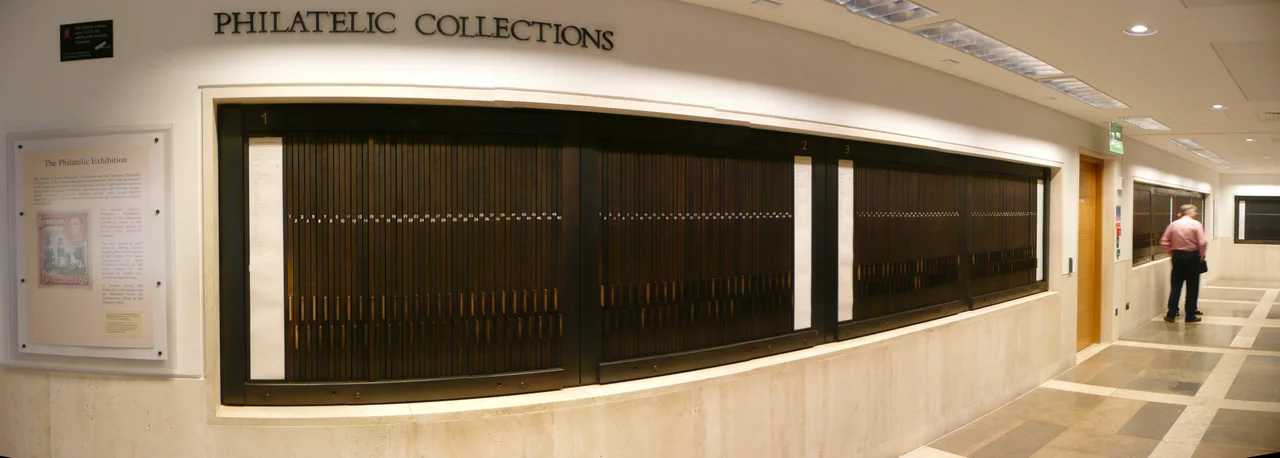

British Library Philatelic Collections
In 1971 the police walked into the British Museum and arrested the Assistant Keeper of the Philatelic Collections. James A. Mackay had been quietly removing progressive die proofs - test prints of stamp designs - that should have been returned to the Crown Agents and destroyed. He swapped them, oddly, for Winston Churchill commemoratives worth £400. The proofs themselves were valued at £7,600. He was fined £1,000, dismissed, and replaced - in a piece of institutional jiu-jitsu that the British civil service does well - with one of the investigating police officers, Bob Schoolley-West. This was just one Tuesday in the long, peculiar life of the largest stamp collection in the United Kingdom.
How a Library Acquired Eight Million Stamps
It started in 1890 with a request and two albums. Hubert Haes donated his and Walter Van Noorden's stamp collection to the British Museum Library, with the stipulation that the library would build a philatelic collection around it. The following year that condition was made real when the Tapling Collection arrived as a bequest. The probate value had been set at £12,000. When the Assistant Keeper of Printed Books, Richard Garnett, examined what had actually been shipped over, he revised the estimate to more than £50,000 and described it as the most valuable gift the library had received since the Grenville Library in 1847. The Tapling Collection still anchors the public display today: of the 6,000 sheets visible in the entrance area's 1,000 frames, 2,400 sheets come from Tapling. Then the gifts kept coming. The Crown Agents for the Colonies started sending three albums of new colonial stamps in 1900 and committed to specimens of every future issue. In 1913 came the Crawford Library, donated by the Earl of Crawford in his will - 4,500 works on philatelic literature, the foremost such library in the world at the time.
The Press That Made the Postage Stamp
The largest single object in the British Library is not a book. It is the Perkins D cylinder press, patented in 1819 by the American-born inventor Jacob Perkins. The press was one of several that printed the first British postage stamps in 1840 - the Penny Black, the Two Pence Blue, the famous designs that made the world's first adhesive postal system possible. From 1853 onwards the same machine printed colonial stamps for territory after territory: Cape of Good Hope, Ceylon, Mauritius, St Helena, Trinidad, Western Australia, the Ionian Islands, New Brunswick, New South Wales, New Zealand, Victoria. The cast-iron weight of it sits in a corner of the library's collections like a piece of industrial archaeology, except that the artefacts it produced are now microscopically valuable. The Perkins D made the small paper rectangles that made global postage possible, and then it kept making them for half the British Empire.
Rarities and Curiosities
The collection's holdings veer between sober national archives and frankly bizarre objects. There's the pilot's licence of Captain John Alcock, who in 1919 made the first non-stop transatlantic flight. There's a complete fantasy stamp collection from Terry Pratchett's Discworld novels, donated and catalogued with as much seriousness as any colonial issue. Among the genuine rarities are some of the most famous mistakes in postal history. The 1854 4-annas India stamp with the head printed upside-down survives on a unique cover. There's a single 1850 New South Wales "Sydney View" plate of nine penny stamps showing a tiny harbour view of the new colony. The Mauritius 1847 "Post Office" issue, the first British colonial postage stamp, sits in the collection on its original cover. And the United States contributes its most famous error: an Inverted Jenny, one of the 100 stamps printed in 1918 with the Curtiss JN-4 biplane flying upside-down through its frame - probably the most expensive American stamp error ever produced.
The Stamp That Almost Was
Sometimes the most interesting artefacts are the ones that were never released. In 1956, Jamaica issued a £1 stamp in chocolate and violet showing tobacco growing and cigar making - a colonial design from George VI's reign. When Elizabeth II came to the throne, the first plan was to keep the same design with the new portrait. The Jamaica £1 chocolate-and-violet stamp for Queen Elizabeth II was actually printed. Then the design was abandoned. Only seven examples are known to exist. The British Library holds one. Nearby in the Crown Agents Collection sits the 1913 King George V seahorse master die proof - the high-value stamp design used on the 2/6, 5/-, 10/- and £1 denominations, engraved by J.A.C. Harrison, whose working proofs of the process were preserved in the Harrison Collection. These aren't postage. They're snapshots of decisions: choices made and unmade about how the empire would be represented on small squares of paper.
The Quiet Work of Cataloguing
Most of the action now is digital. Richard Scott Morel, who joined as curator in 2014, has been overseeing the slow, careful work of putting the collection online. The Row Collection - 23 volumes, 1,358 pages, 24,473 items documenting the stamps and postal stationery of Siam from 1881 to 1918 - went up in 2025 as the first complete digital version. High-resolution images, descriptive metadata, archival catalogue records to ISAD(G) international standards, all browsable through the National Archives' Discovery database. The Row Collection's appearance online matters because most of the 78 major archives in the British Library Philatelic Collections are not yet digitised. Researchers still come in person, by appointment, to handle the actual sheets. The permanent display in the entrance area is free to anyone walking in off Euston Road. About 80,000 items rotate through 1,000 frames - probably, the library quietly notes, the best gallery of classic stamps and philatelic material in the world. Eight million more items wait in the stacks, indexed, catalogued, occasionally stolen, always slowly being made more accessible.
From the Air
The British Library sits at 96 Euston Road, near 51.529°N, 0.127°W, immediately west of King's Cross and St Pancras stations. From the air, the distinctive red-brick fortress-like building stands out beside the soaring Victorian Gothic of St Pancras railway station. The Philatelic Collections gallery is on the upper ground floor of the main building. Nearest airport for general aviation is London City (EGLC) about 6 nm east-southeast; London Heathrow (EGLL) is 13 nm west. This is central London Class A controlled airspace; expect altitude and routing restrictions on any approach.
Nearby Stories
- Stevenage 5.7 km away
- Malling Abbey 5.7 km away
- 1952 Farnborough Airshow Crash 7.7 km away
- Ingatestone Hall 8.2 km away
- Hellfire Caves 9.1 km away
- The Carrington Event: The Solar Storm That Could Happen Again 9.8 km away
- Bletchley Park 16 km away
- Castle Hedingham 23 km away