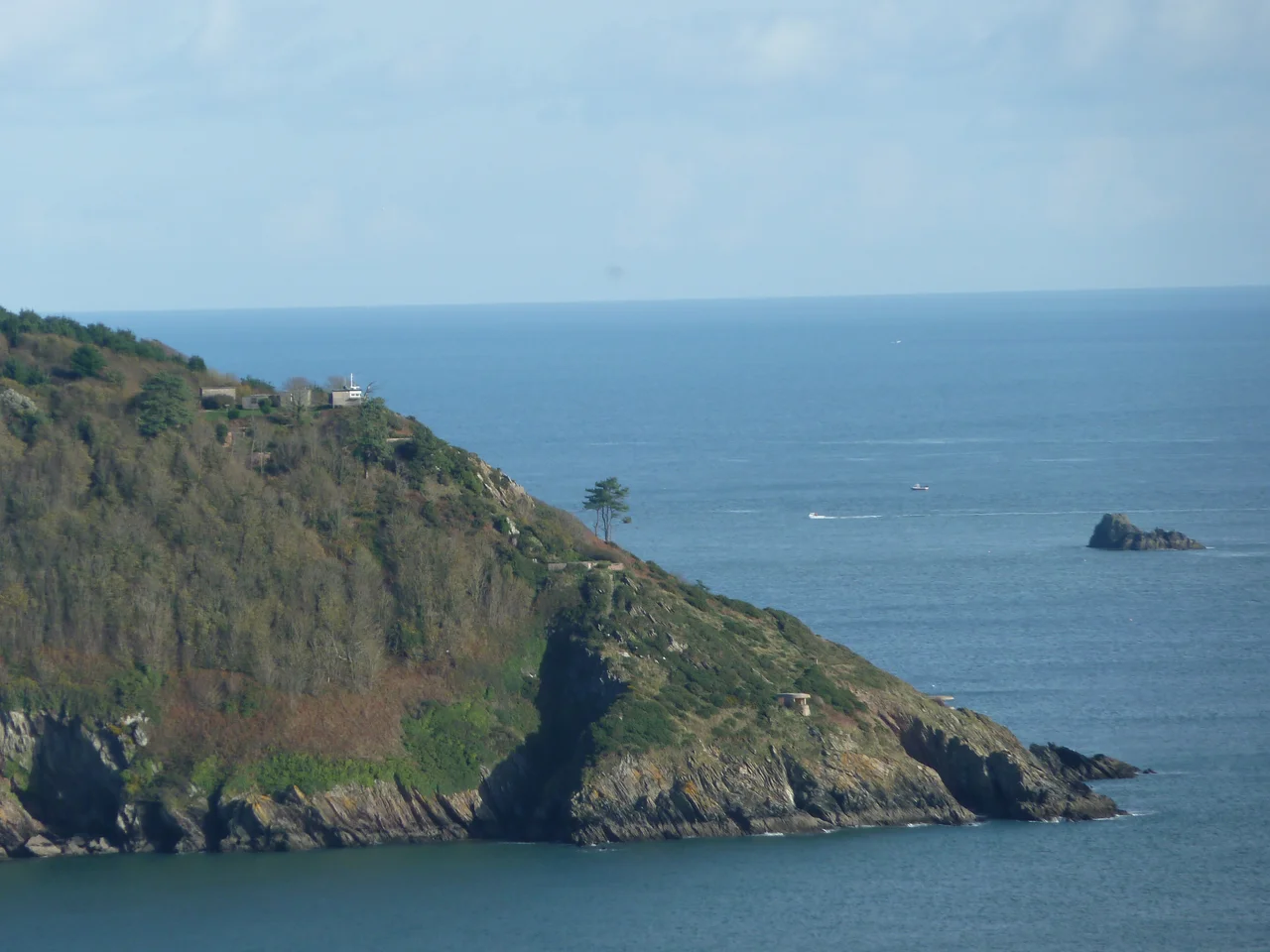

Brixham Battery
In the summer of 1940, with the British Expeditionary Force just evacuated from the beaches of Dunkirk and the southern English coast newly classified as the front line, the Royal Artillery threw up 116 emergency batteries in a frantic chain from John O'Groats to Land's End and around to South Wales. Workmen poured concrete and rolled out cable on cliff edges. The aim was to be able to shoot at a German landing craft before it reached the sand. Most of those batteries were swept away once the danger receded. Of the 116, only seven survive. Brixham Battery is the most complete of those seven, and the Devon site has the strange distinction of having been used as a defensive gun position five times across four centuries, first against Spain in 1586, last in 1945.
Spain, France, America
The fourteen-acre site of Battery Gardens, on the seashore at Brixham, was first armed in 1586, during the war between Elizabethan England and Spain. A gun platform was raised on the grounds against the threat of attack, and it was kept up until 1664. After that, the guns came and went with the politics. From 1776, when France and Spain successively entered the American War of Independence against Britain, the Board of Ordnance worked through the south coast naval stations deciding what needed defending. Brixham was at this point the western approaches station for the Royal Navy, and so was a priority. The militia prepared the positions, and the guns, twenty-four pounders, arrived in May 1780, at the same time as cannon for the Berry Head fort along the coast. The land was commandeered until 1783, when hostilities ended and compensation was paid. The guns came back during the Napoleonic Wars, with the land actually purchased this time, and went away again at the peace. The battery was still a military post in 1862, manned by the 11th Devon Artillery Volunteers, and in 1889 a 64-pounder muzzle-loading rifled cannon was mounted at Furzham, roughly where number five gun had been eighty years before.
Four Months in 1940
Almost everything you see at Battery Gardens today was built in four months. Between June and September 1940, immediately after Dunkirk, Brixham went up alongside its sister battery at Corbyn Head, Torquay, as part of the chain meant to engage German landing craft before they could reach the beaches at Torre Abbey, Livermead, Hollicombe, Preston, Paignton, Goodrington, Broadsands, and Elberry Cove. Corbyn Head covered targets close in the bay; Brixham reached further out into Lyme Bay. Both were supplemented by a more heavily armed close-defence battery at Brownstone, on Froward Point near Kingswear, sited in June 1942 with 6-inch Mark VII guns. Brownstone's job was to engage landings on Slapton Sands or Blackpool Sands and destroy any beachhead established. The basic layout at Brixham is recognisable today: gun floors, a battery observation post, magazines, accommodation, all in low concrete crouched on the headland.
The Crews
About a hundred officers and soldiers manned the battery at its peak. The initial crew came from the Royal Artillery, 362 Battery 18 CA GP Regiment in 1940, becoming 362 Battery 556 Regiment in 1941 and 378 Battery 556 Regiment in 1942. As the threat of invasion receded, the regulars were thinned out and the manning shifted toward local men of D Company, 10th Torbay Battalion, Devonshire Home Guard. The shift mattered. These were Brixham fishermen, shopkeepers, dockworkers, and railwaymen who came up after their day jobs to learn how to lay, fuse, and fire a 4.7-inch gun. They became proficient enough to crew the battery on their own if needed, and were repeatedly commended by the Brigadier of Royal Artillery Southern Command and the Commander of Coast Artillery South West District. The big guns were never used in earnest. German E-boats came into Tor Bay several times but were never engaged, because firing would have revealed the battery's location to landing forces and the position was considered too valuable to give away.
Anti-Aircraft Action
The anti-aircraft side was a different story. Brixham harbour and shipping in the bay were attacked repeatedly by what the British called "hit and run" raiders, low-level Luftwaffe sorties run for harassment and to keep the coast on edge. The early raiders were Messerschmitt Bf 109s carrying a single 500-pound bomb. Later came Focke-Wulf Fw 190s carrying a thousand-pounder. The Brixham AA defences, a 37mm gun, an Unrotated Projectile projector, and 40mm Bofors guns, engaged them. Local memory of these raids is sharp; fishing boats were sunk, houses on the front were damaged, and pilots flew so low that crews on the battery floor could see them through their cockpits. The battery's role was to keep the coast inhabitable as well as defended. The big guns waited; the small guns worked.
The Most Complete Survivor
When the war ended, the great chain of 1940 batteries was scrapped, demolished, or returned to civilian land. Most disappeared inside a decade. Brixham survived almost by accident, the 14-acre site kept as Battery Gardens, an open space on the sea front and a traditional viewpoint for Brixham's trawler races. The structures stayed where they were. English Heritage surveyed the whole site, and it is now a scheduled monument, the most complete of the seven survivors out of the 116. In 1999, a heritage group formed to maintain and interpret the site, expanding the on-site museum within the gardens. Walking the battery today you can see the gun floors, the war shelter, the observation post, and the magazines, with the bay opening out to the south and the same Lyme Bay horizon the Home Guard scanned night after night. It is, in its quiet way, the most physically intact monument to the summer Britain expected to be invaded and was not.
From the Air
Brixham Battery sits at 50.402 degrees north, 3.520 degrees west, on the seafront of Brixham at the south end of Tor Bay in Devon. From the air, look for the small fishing harbour of Brixham at the southwestern corner of the bay; Battery Gardens occupies a 14-acre stretch of coast on the headland just west of the harbour, with Berry Head and its lighthouse projecting to the southeast. Exeter Airport (EGTE) is roughly 25 nautical miles north-northeast. A coastal track at 2,000-3,000 feet gives clear views of the bay; weather can include sea fog from the southwest and gusty winds off the high cliffs at Berry Head.
Nearby Stories
- St Germans Priory 7.6 km away
- Launceston, Cornwall 9.6 km away
- Castle Drogo 12 km away
- HMS Formidable (1898) 17 km away
- Siege of Lyme Regis 19 km away
- Battle of Plymouth (1652) 40 km away
- German Submarine U-672 48 km away
- Goonhilly Satellite Earth Station 69 km away