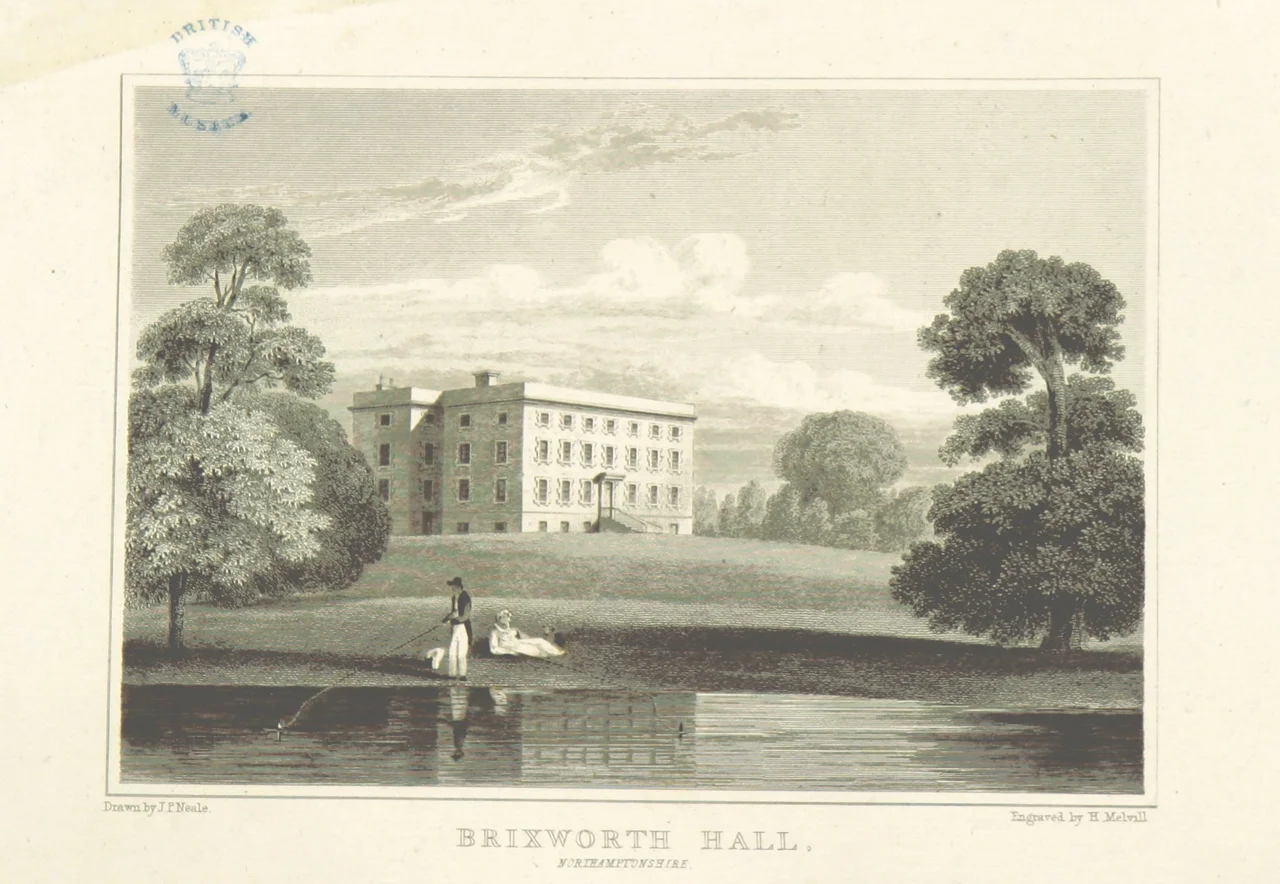
_p3.124_-_Brixworth_Hall,_Northamptonshire.jpg)
Brixworth
All Saints' Church at Brixworth was founded around 675 AD, which puts it older than most of the languages spoken in Europe and older than the idea of England itself. It is built largely of reused Roman brick. The Anglo-Saxon masons quarried it out of the ruins of the empire that had left Britain two and a half centuries earlier, stacked it into nave walls fourteen centuries old, and called the result a parish church. A mile down the road, in a shed of glass and steel, technicians wearing static-grounded coats assemble the hybrid power units that propel Mercedes-AMG Formula One cars at over three hundred kilometres an hour. Same village. Same postcode. The juxtaposition is what makes Brixworth interesting before anyone tells you anything else about it.
The church the Romans helped build
Sir Alfred Clapham, who knew his way around medieval architecture, once called All Saints' the finest Romanesque church north of the Alps. He may have been overreaching for emphasis, but he was reaching for something real. The building is mostly seventh-century, with a tenth-century tower and a Norman crypt added later, and the materials tell their own story: brick robbed from abandoned Roman villas and forts, dressed with Anglo-Saxon care into round-headed arches that march down the nave. Step inside on an overcast morning and the proportions feel different from a typical English parish church, taller, more austere, more confident about themselves than something built by villagers usually does. It is one of the few buildings in England where you can stand under a roof that was old when the Norman Conquest happened, and walk on a floor that was older still.
The Pytchley and the workhouse
By the early nineteenth century the village had taken on a quieter rhythm, the kind that ran on horses, hounds, and the dawning logic of poor relief. In 1819 Sir Charles Knightley bought land near Spratton Road and the Pytchley Hunt put up its kennels there, providing wages to villagers caught in agricultural depression. The hunt stayed until 1966. Sixteen years after the kennels went up came the Brixworth Poor Law Union, with a workhouse on the south side of Spratton Road. Only the entrance block survives. The Union acquired a name through the later nineteenth century for being unusually unwilling to grant relief unless applicants entered the workhouse itself, a stance that drew sustained criticism from reformers and a scholarly book of its own. The people sent through those doors were neighbours, often elderly, sometimes children, and the policy reduced them to a single test: would they be hungry enough to give up their homes. The buildings now house businesses; the policy left a longer mark.
Iron under the fields
Northamptonshire's gentle hills sit on ironstone, and from 1863 Brixworth's farmland was steadily opened up by quarrying. The first pit, west of the church at a place called Stonepit Close, is now allotments. Other quarries followed: a tramway running north of the church to sidings at the station, an aerial ropeway that swung ore baskets through the air from neighbouring Scaldwell, a standard-gauge branch line that replaced the ropeway in 1954. Horses worked the early tramways; by 1879 the first steam locomotive arrived; by 1935 a diesel quarrying machine was at the cutting face. When the last pit closed in 1949 the village kept its shape because the workings had been mostly tidy edge-of-fields affairs, scars that grew over. A walker on the Brampton Valley Way, which runs along the old railway trackbed half a mile to the west, can pass the village without realising any of this happened.
From Domesday to Mercedes
Brixworth first appears in writing as Briclesworde in the Domesday Book of 1086. The name means Beorhtel's enclosure, and Beorhtel was somebody nobody now remembers. He had a homestead, and a clerk wrote it down, and the place kept the name. Sixty years ago you could still ride the Northampton-to-Market Harborough railway through the parish; the line closed in stages and the trackbed became the Brampton Valley Way for walkers and cyclists in 1993. Modern Brixworth has commuters who drive to Leicester, Peterborough and London, two pubs whose buildings date from when stagecoaches passed through, a strong cricket club, and Mercedes-AMG High Performance Powertrains. The HPP plant builds the engines for Mercedes, Aston Martin, McLaren and Williams. It is, in a sense, the village's twenty-first-century equivalent of the Pytchley kennels: a fresh source of skilled employment that ties Brixworth to something much larger than itself.
What you see from above
From two thousand feet the village reads as a tight cluster of stone and brick set in a patchwork of fields, with the squared dark roof of All Saints' tower standing slightly proud of everything around it. Pitsford Reservoir glints a mile to the southeast. The A508 traces a hard line past the western edge, and the unmistakeable angular silhouette of the Mercedes HPP buildings sits on the village's southern flank. Sywell Aerodrome's grass and concrete strips lie a few miles east. The Brampton Valley Way runs north-south, a darker green ribbon through the patchwork, marking where trains once ran ore down to be smelted in the iron furnaces of the Midlands.
From the Air
Coordinates 52.329°N, 0.904°W, about 5 nm north of Northampton and 8 nm south of Market Harborough. Recommended viewing altitude 2,000-3,000 ft AGL. Visual landmarks: the dark square tower of All Saints' Church, Pitsford Reservoir 1 nm southeast, the A508 bypass running north-south to the west of the village, and the geometric Mercedes-AMG HPP factory complex on the southern edge. Nearest airfield is Sywell Aerodrome (EGBK), 7 nm east-southeast. Cranfield (EGTC) lies 18 nm south-southeast.
Nearby Stories
- Battle of Bosworth Field 3.6 km away
- Murder of Ross Parker 7.2 km away
- Royal Leamington Spa 8.8 km away
- Buckingham 9 km away
- St Neots 9.4 km away
- Letchworth 10 km away
- Uppingham School 11 km away
- Sudeley Castle 39 km away