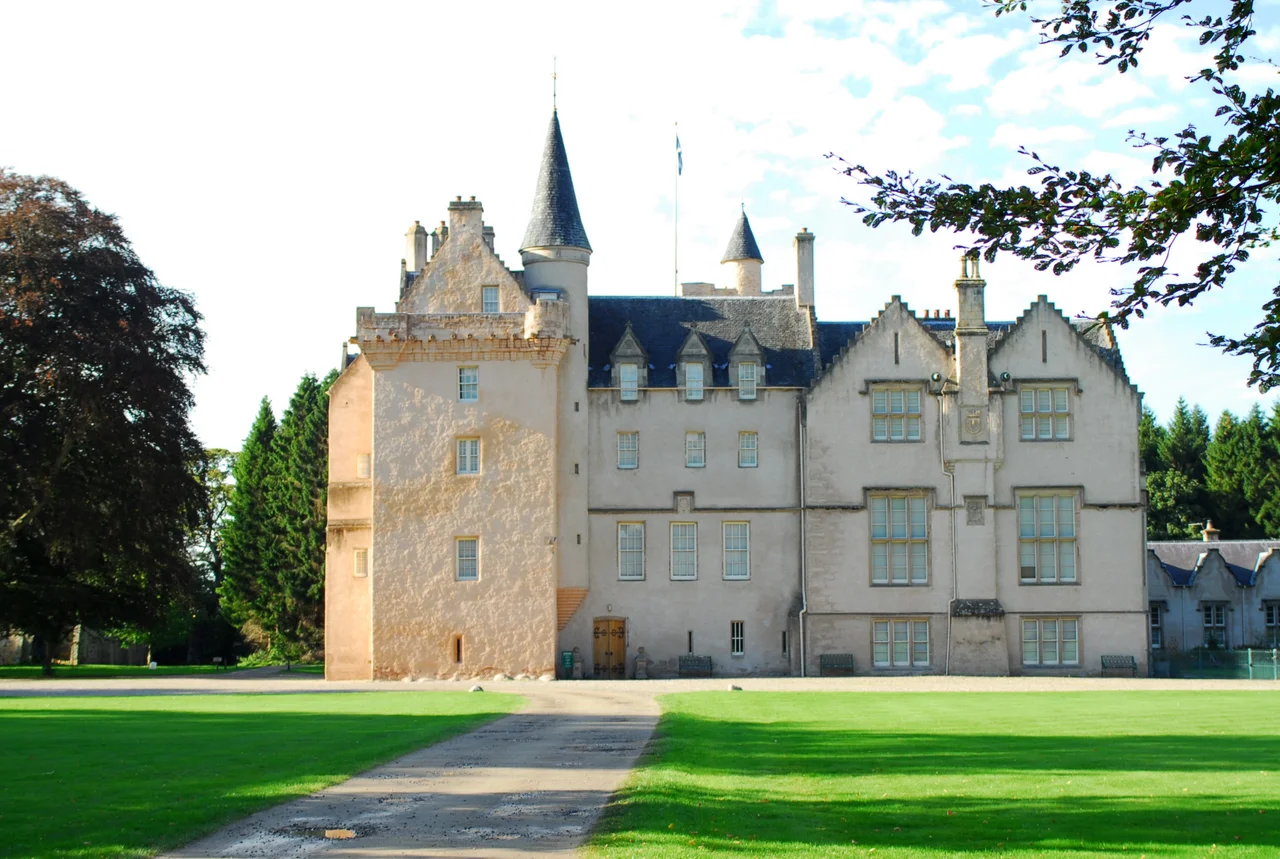

Brodie Castle
Eight and a half centuries is a long time for one family to hold a single piece of ground. Around 1160, King Malcolm IV is believed to have granted this corner of Moray to the Brodies, and the family stayed - through fires, marriages, fortunes, and a quietly catastrophic decline - until Ninian Brodie of Brodie, the last clan chief to live in the castle, died in 2003. The Z-plan tower house that anchors the estate was completed in 1567, partially burned in 1645 by Lewis Gordon of Clan Gordon, the 3rd Marquis of Huntly, and remodeled into a Scots Baronial mansion in 1824 by William Burn, then again by James Wylson. Three and a half miles west of Forres, just off the A96, it now belongs to the National Trust for Scotland.
The Z-Plan and What It Meant
The Z-plan tower house was a Scottish answer to a Scottish problem: how to build a defensible home in a country where private war was an ordinary expense of being a noble. Two towers on opposing corners of a central keep gave defenders enfilading fire along every wall - no attacker could approach without being seen and shot at from at least two angles. Brodie's 1567 version is one of the best-preserved examples surviving. The central keep is 16th-century in its bones, with two five-storey towers anchoring opposite corners. When William Burn was hired in 1824 to convert the castle into a Scots Baronial mansion, the additions were only partially completed before being remodeled by James Wylson. The result is layered: a fortified tower with a fashionable Victorian skin, neither one fully suppressing the other.
Fire and the Marquis of Huntly
In 1645 the castle burned. Lewis Gordon, the 3rd Marquis of Huntly, set it - the kind of fact that gets reported in a single sentence in modern accounts but represents weeks of fear and loss for the Brodies who lived through it. The 1640s were ruinous in Scotland: the Wars of the Three Kingdoms were dragging the country into Civil War territory, and Catholic-leaning Royalist Gordons against Protestant Covenanting Brodies was exactly the kind of fracture line on which neighbors found themselves at each other's throats. The castle survived, partially. Restoration and rebuilding came in stages over the following decades, the family clinging to the site even as much of the interior had to be redone. The fact that the Brodies stayed at all is the more remarkable thing - this is a country where a single bad season of warfare typically ended a noble line.
Rodney's Stone and Older Inhabitants
In the castle grounds stands a Pictish monument called Rodney's Stone - a carved slab from a people who lived here a thousand years before the Brodies arrived. The Picts left stones like this across northern Scotland, and what the carvings meant to the people who made them remains partly a matter of inference. Animals, abstract symbols, processional scenes: the visual vocabulary survives but the grammar has been lost. The stone was discovered in the Dyke churchyard in 1781 and later moved to Brodie. It is a reminder that the Brodie family's eight-and-a-half centuries on this land, while long by the standards of European nobility, sits as a recent layer on top of much older human presence here.
The Daffodils and the End of the Family
Ninian Brodie of Brodie - the title compresses an old usage in which the clan chief takes the family name as both first and last - was the castle's last resident family member. He died in 2003, and one wing of the castle is now rented as holiday accommodation through Sykes Cottages. The National Trust for Scotland owns the estate and its surrounding policies, which include a national daffodil collection that draws crowds each spring. Inside the castle, fine antique furniture, Oriental artefacts and ornate ceilings from the 17th through 19th centuries record what a single family accumulated over generations of marriage, inheritance, and reasonable luck. The castle hosts weddings and events now, which is one of the ways old houses survive into a century when no single family can afford to keep them up alone.
From the Air
Brodie Castle sits at 57.598N, 3.709W, about 3.5 miles west of Forres on the A96 corridor. Visible from approach as a substantial Scots Baronial structure in formal grounds, with daffodil fields in spring providing a yellow visual signature. Inverness Airport (EGPE) lies 17 nm west. The Moray Firth coastline runs 3 miles north. Best viewing altitude 2,000 to 3,500 feet AGL for grounds detail; the castle itself is identifiable from cruise altitude in clear weather.
Nearby Stories
- Black Isle 2.8 km away
- Strathspey Railway (preserved) 5.7 km away
- Tarbat Ness Lighthouse 6.2 km away
- Gordon Castle 7.4 km away
- Bonar Bridge 9.7 km away
- Loch Ness Monster 14 km away
- Kildrummy Castle 17 km away
- Battle of Tannach 65 km away