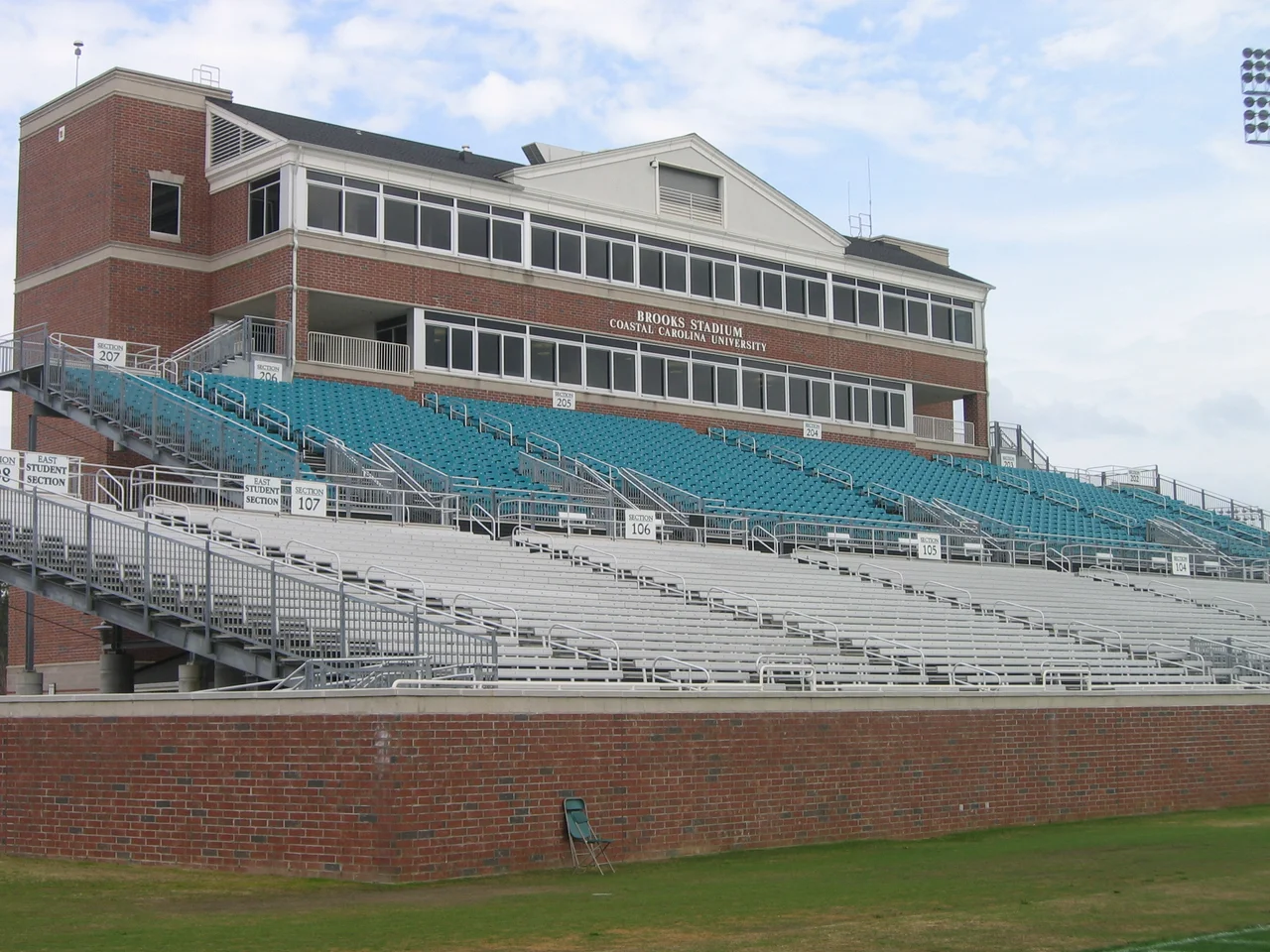

Brooks Stadium
The turf is teal. Not green. Not grass. A bright, almost cartoonish shade of teal stretched across an entire football field in the Carolina lowlands, and somehow it works. When Coastal Carolina installed the surface in 2015, sports media reacted with confusion and amusement, but the Chanticleers leaned in. By the time the team was running an undefeated regular season in 2020 and beating Liberty on a goal-line stand in front of a sellout crowd, that teal field had become one of the most recognizable in college football.
A Stadium Named for Children
Brooks Stadium opened in 2003, named for Coby Garrett Brooks and Boni Belle Brooks, the children of Robert H. Brooks. Their father grew up in Loris, South Carolina, just up the road, and went on to become chairman of Hooters of America. He wanted the building that would host Coastal Carolina's first football team to carry his children's names rather than his own. The Chanticleers opened the stadium on September 6, 2003, with an inaugural game against Newberry College. More than 8,000 fans showed up, which sounds modest only if you didn't realize Coastal had never fielded a football team before.
Building Toward FBS
Phase I held just 6,408 seats, but the foundations were poured for something much larger. When Coastal announced its move to the Sun Belt Conference in 2015, the NCAA's FBS attendance minimums forced the question: could a small coastal university actually fill 15,000 seats? The answer involved 38 million dollars, two phases of construction, and a determined fanbase. By August 2019, the expansion was complete: more than 20,000 seats wrapped around the teal field, an upper deck rising on the west side, premium seating tucked in for boosters and television cameras.
Norman Money
Beyond the north end zone sits the Marrio & Josh Norman Fieldhouse, an 8.5 million-dollar facility opened in 2010. Josh Norman, the former NFL cornerback who came up through Coastal Carolina, donated heavily to the athletic department in 2018, and the building was renamed for him and his brother. Inside are the football offices, a 13,000-square-foot strength and conditioning center used by every Coastal athlete, and the Sasser Athletic Hall of Fame. It's the kind of facility that signals a program serious about its future, and it sits in the end zone of a stadium painted the color of shallow tropical water.
The Field at James C. Benton
The playing surface inside the stadium has its own name: James C. Benton Field, dedicated in October 2006 after a substantial gift from the Benton family. It's where Coastal's program reinvented itself in the 2010s, where the now-famous teal turf turned a regional FCS program into national television fodder, and where Saturday afternoons in Conway shifted from afterthought to event. The crowd colors blend with the field — teal jerseys against teal grass — making the players visible mostly by motion. It's a viewing experience nothing else in college football quite replicates.
What the Stadium Built
Brooks Stadium reshaped Coastal Carolina's identity. Before 2003, the university was a quiet sea-grant institution with a respected biology program and a marine science fleet. After Brooks, it became a place that could fill 20,000 seats on a Saturday, draw ESPN's College GameDay to Conway, and produce NFL talent on a teal field that television announcers couldn't stop describing. The stadium is functional infrastructure for a football program, but it's also the visible marker of a university that decided, with some help from a Hooters chairman's gift and a coastal town's appetite for big-time sports, to bet on visibility.
From the Air
Brooks Stadium sits at approximately 33.79°N, 79.02°W in Conway, South Carolina, just inland from the Grand Strand. From cruising altitude in clear weather, the teal turf is one of the most distinctive landmarks in the region — a bright aqua rectangle against the surrounding pine forests and the Waccamaw River floodplain. Myrtle Beach International Airport (KMYR) is roughly 15 miles southeast; Grand Strand Airport (KCRE) sits 25 miles northeast at North Myrtle Beach. Conway-Horry County Airport (KHYW) is just 4 miles south of the stadium.
Nearby Stories
- Tabor City, North Carolina 7.2 km away
- Huntington Beach State Park 14 km away
- 1958 Mars Bluff B-47 Nuclear Weapon Loss Incident 22 km away
- Oak Island (North Carolina) 28 km away
- Florence County, South Carolina 31 km away
- Leland, North Carolina 38 km away
- Francis Marion National Forest 50 km away
- Walker's Cay 702 km away