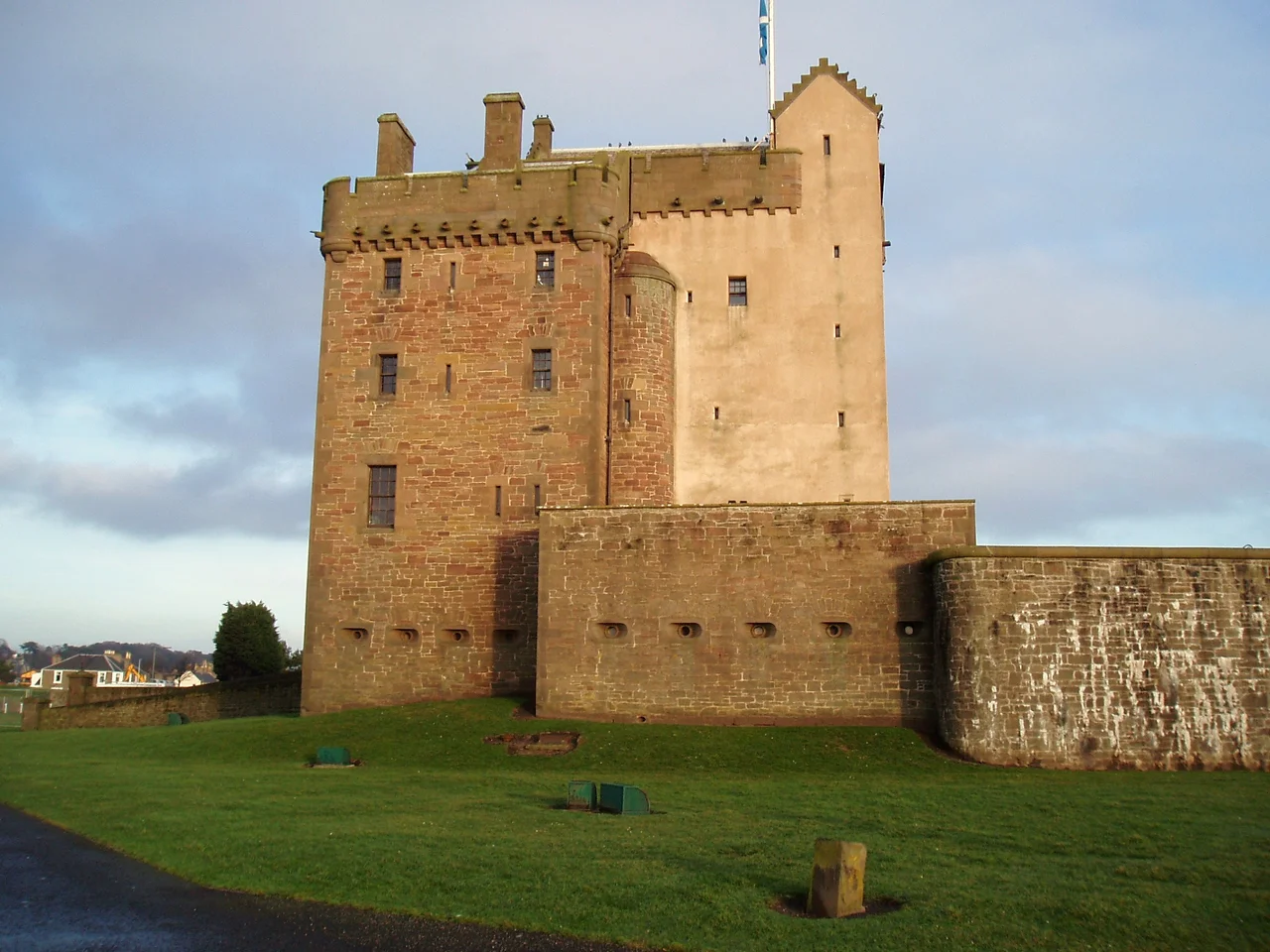

Broughty Castle
The English commander who held Broughty in 1547 wrote to his masters in London that his garrison was "never man had so weak a company, given all to eating and drinking and slothfulness" - though, he conceded, "the house stands well." The house has been standing well for over five centuries now. It has hosted Italian engineers, Spanish soldiers, French gunners, Victorian artillerymen, submarine miners, and most recently, the council debates that may decide whether it stays open. Few small Scottish castles have lived more lives than this one.
A Fortress at the Mouth of the Tay
Broughty Castle stands on a rocky promontory at the mouth of the River Tay, on what is now the Broughty Ferry edge of Dundee. George Douglas, 4th Earl of Angus, received permission to fortify the site in 1454, but the tower house that survives was built by Andrew, 2nd Lord Gray, who was granted the castle in 1490 and completed it around 1495. Its position was - and is - strategically extraordinary. The English chronicler William Patten wrote in 1547 that the castle "standeth in such sort at the mouth of the river Tay, that being gotten, both Dundee and St. John's Town (Perth), and many other towns else shall become subject to this hold." Hold Broughty and you held everything upriver. The Scots knew this. The English knew it. The Rough Wooing made it brutally explicit.
The Rough Wooing
After the Scottish defeat at the Battle of Pinkie in September 1547, Lord Gray of Foulis simply sold Broughty to the English. The garrison that occupied it included Italian and Spanish soldiers under Sir Andrew Dudley, brother of the Duke of Northumberland. They were besieged repeatedly. The Earl of Argyll attacked in November 1547 and again in January 1548 with 150 men, without success. The Italian engineer Giovanni di Rossetti was made master of ordnance and laid plans to strengthen the fortifications. In November 1549, Mary of Guise held a conference at Stirling Castle to agree on bringing French guns north. She personally watched the successful assault on 6 February 1550 from a vantage point across the Tay. Paul de Thermes led the French troops: 240 wounded and 50 killed in the attack itself. The garrison surrendered six days later, at midnight.
Monck Walks In
A century later, in 1651, Broughty's military life took a stranger turn. General George Monck and his Parliamentary army arrived as part of the campaign that would end with the sack of Dundee. The castle's Royalist defenders, by then, had no will for another long siege. They fled without firing a shot. After the Gray family sold the castle in 1666, it slowly fell into ruin. For nearly two centuries, what had been one of Scotland's most strategically vital coastal defences sat empty and decaying, a picturesque shell at the river's mouth that visitors sketched but no army cared to occupy.
Victorian Guns and Submarine Miners
The Edinburgh and Northern Railway bought the castle in 1846 to build an adjacent ferry harbour. The War Office took it over in 1855, initially against the threat of a Russian attack. Renewed fears of a French invasion in 1860 prompted a major rebuilding by the architect Robert Rowand Anderson, with emplacements for nine large guns, new wings around the tower, and a caponier along the south-east courtyard. From 1886 a range was built to house submarine miners - the unit responsible for laying mines across the Tay Estuary in wartime to damage enemy shipping. During the First World War the battery mounted two 4.7-inch Quick Firing guns. The castle remained in military use until 1932, returned to service from 1939 to 1949, and was finally decommissioned. In 1969 it was reopened as a public museum under Dundee City Council, and is now operated by Leisure & Culture Dundee.
Save the Castle
The most recent chapter has been a battle of a different kind. In February 2024, Broughty Castle was named on a list of Dundee venues facing closure due to council budget cuts. Public outcry forced a reprieve, but proposals returned in May 2024, and in December the council voted to close the castle. Local response was immediate. In July 2025 a community-led "Save the Castle" campaign launched, and a £50,000 funding package allowed it to stay open through late 2025 with reduced hours. In September 2025 the actor Brian Cox - born in Dundee and a Dundee Rep alumnus - publicly backed the campaign, urging the council not to allow the castle to become a "mausoleum." Five centuries of garrison, siege, ruin, restoration, and reinvention have made Broughty Castle a survivor. Whether it survives the 21st century intact will be decided by the people of Dundee, not by any besieging army.
From the Air
Broughty Castle stands at 56.4628 degrees north, 2.8703 degrees west, on the north bank at the mouth of the River Tay, roughly 3.5 nautical miles east of central Dundee. EGPN (Dundee) lies 5 nautical miles to the west; EGPN's runway 27 approach passes north of the castle. The structure is highly identifiable from the air - a small square tower house on a promontory directly above Broughty Ferry beach, with the open water of the Tay estuary to the south and the ferry harbour to the north. Best viewed at 1000-2000 feet AGL. The Tay Road Bridge sits 3 nautical miles upstream and provides reliable navigation alignment.
Nearby Stories
- Battle of Dunkeld 7.2 km away
- Balgonie Castle 9.8 km away
- Bell Rock Lighthouse 10 km away
- Inverbervie 13 km away
- Battle of Dollar 14 km away
- Battle of Mons Graupius 16 km away
- HMS Pathfinder (1904) 23 km away