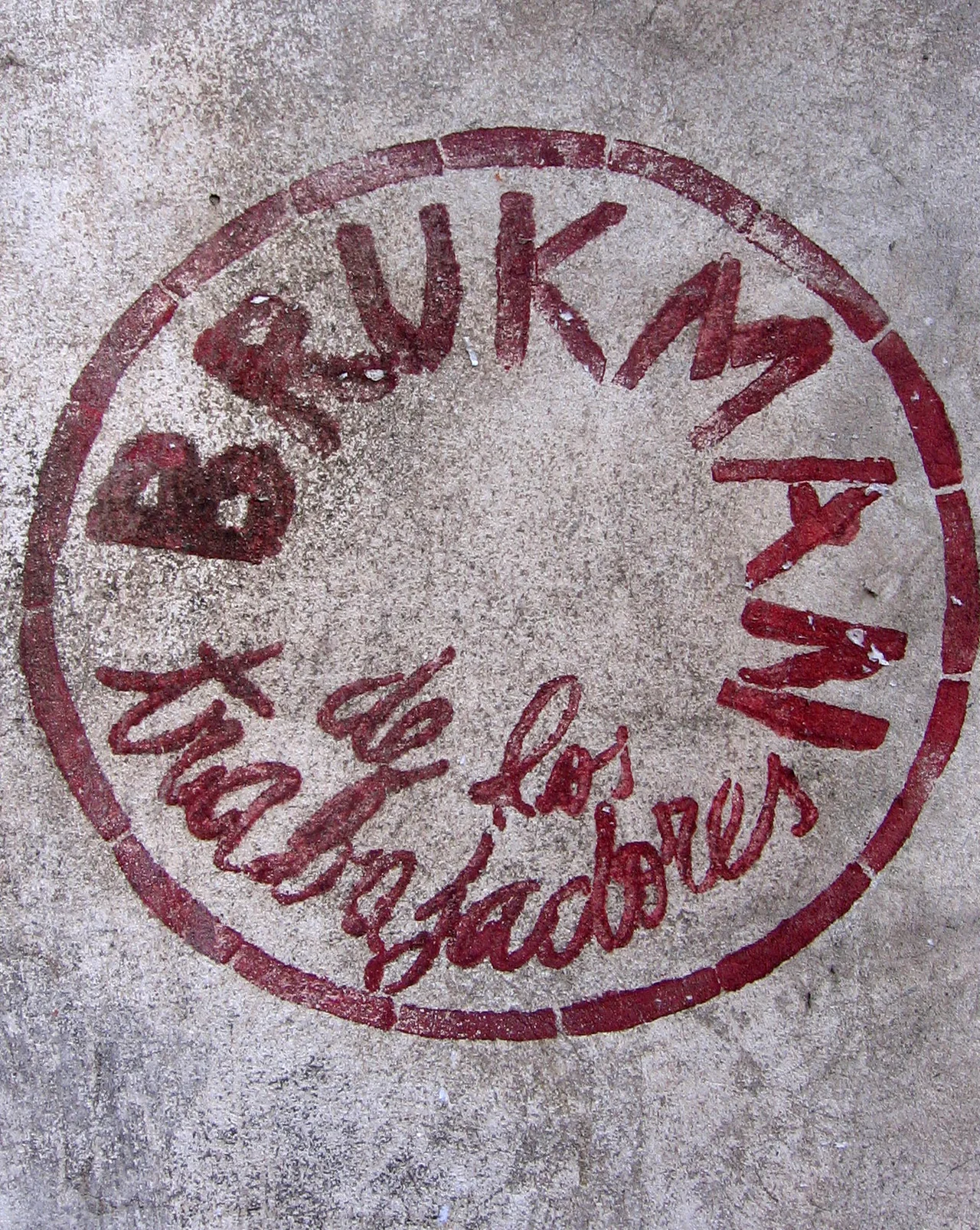

Brukman factory
On the night of 18 December 2001, about fifty workers — most of them women, most of them seamstresses — decided not to go home. They had come to the Brukman factory on Jujuy Street that day to ask for a small travel allowance, just enough to cover the bus fare to work. Their wages had been cut so deeply they could no longer afford to show up. The owners promised to return with money and left. They never came back. So the workers asked the doorman for the keys, spent the night inside, and in the morning did the only thing they knew how to do: they turned on the machines and went back to work.
A Factory Coming Apart
Brukman had sewn men's suits in the Balvanera barrio for half a century. By the late 1990s it was failing along with the country. Argentina's long economic crisis, deepening from recession in 1998 toward outright collapse, had hollowed the business out. Sales fell, debts mounted, and the workforce shrank from some 300 employees to a fraction of that. Wages were slashed until they would not cover a worker's daily commute, and rumors spread that the owners were preparing to shut the doors for good. The fifty who gathered that December day were not making a political statement. They were trying to hold on to the jobs that kept their families fed.
Running It Themselves
What began as a desperate sit-in became something none of them had planned. With the owners gone, the workers simply kept producing. They organized themselves into an assembly, found new clients, and slowly paid down the company's debts. They voted on a fair wage and set it themselves. Within months they had not only stabilized the operation but raised their own pay and hired ten more people. The factory had a new name behind the old one — the cooperative called itself 18 de Diciembre, after the night it all began. The work was the same as it had always been: cloth, thread, and dress trousers stitched to order. Only now the people doing it answered to no one but each other.
The Fence on Jujuy Street
The owners sought to reclaim the building, and the courts obliged. The final eviction order came from Judge Jorge Rimondi, and at midnight on 18 April 2003 more than 300 federal police forced the workers out. They did not go quietly into defeat. By dawn, 3,000 supporters had gathered around the factory — neighbors, members of local assemblies, and piqueteros — and the workers set up camp on the sidewalk outside. In one image that came to define the struggle, the Brukman seamstresses, unarmed and arm in arm, walked toward the police fence to reclaim what they had built; when it gave way, they walked through. They simply wanted to return to work.
A Movement Made of Many Hands
Brukman was never alone. When the eviction came, the workers of the Zanon ceramics factory in distant Neuquén — another recovered plant run by its employees — blocked a national highway in solidarity. On 21 April, provincial police attacked demonstrators outside Brukman, leaving twenty wounded and around a hundred arrested. But the pressure held, and in the end the workers regained control of their factory, which still runs as a cooperative today. Their fight became one of the defining stories of Argentina's recovered-factory movement, captured in the 2004 documentary The Take by Avi Lewis and Naomi Klein. The graffiti near the building said it plainly: Brukman belongs to the workers.
From the Air
The Brukman factory stands at Jujuy 554 in the Balvanera barrio of central Buenos Aires, at roughly 34.62°S, 58.40°W — a working-class stretch of the dense city grid, not a monument visible from altitude but part of the fabric of the southern-central neighborhoods. For orientation from the air, it lies a short distance south of the green dome of the Argentine Congress and west of the historic downtown, with Avenida Jujuy running north-south nearby. Aeroparque Jorge Newbery (ICAO: SABE) is about 6 km northeast along the Río de la Plata and offers the closest approach; Ministro Pistarini International (Ezeiza, ICAO: SAEZ) is roughly 23 km southwest. The flat, low-rise grid is best read on a clear day; river haze is common on humid mornings.
Nearby Stories
- Ezeiza Massacre 1.9 km away
- Luján, Buenos Aires 5.1 km away
- Curutchet House 13 km away
- Colonia del Sacramento 17 km away
- Martín García Island 28 km away
- Atucha Nuclear Power Plant 37 km away
- Lobos 43 km away
- Cry of Asencio 87 km away