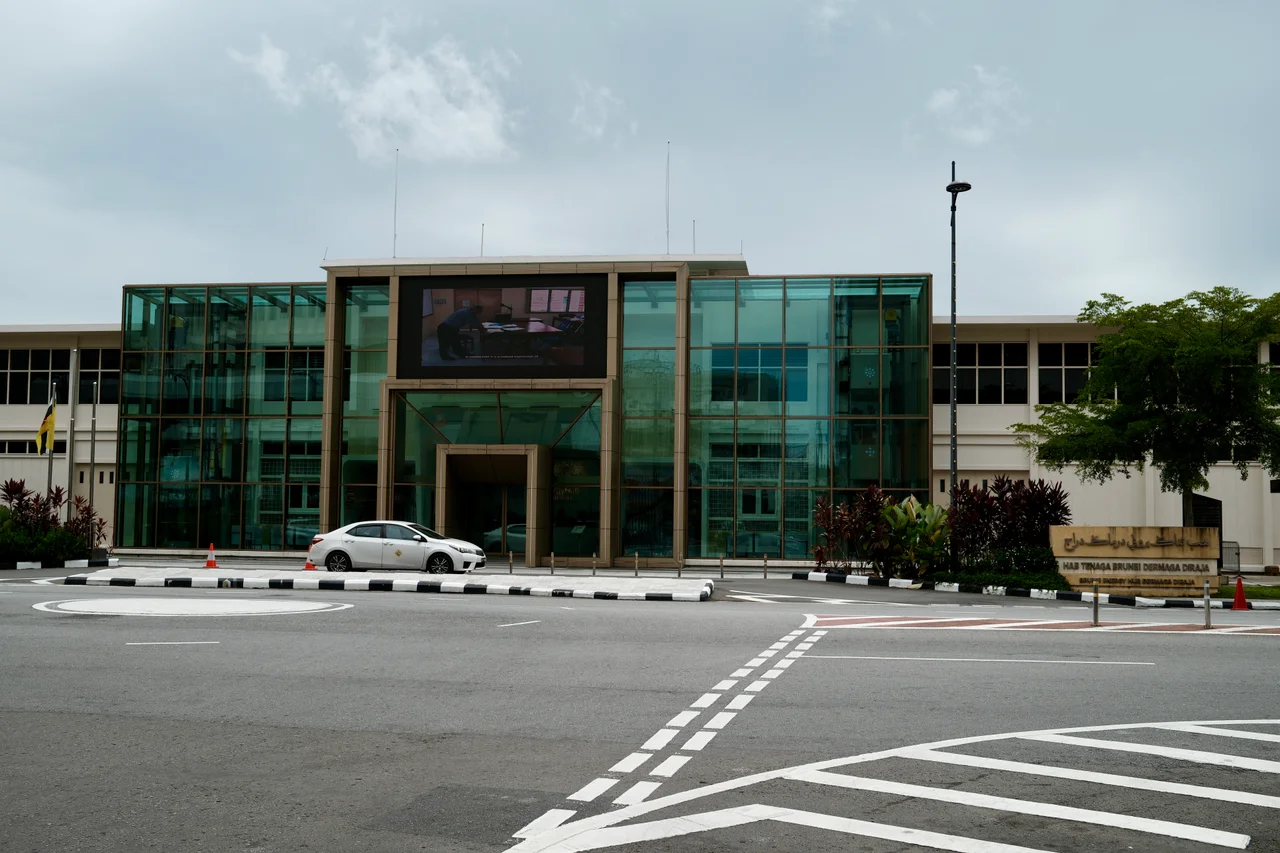

From Customs House to Energy Story
The tunnel through the middle of the building is easy to miss. Marked with the faded words "H.H. Customs House," it once allowed cars to pass through what was, for decades, the most important structure on the Brunei River: the Royal Customs and Excise Building, a 400-foot-long concrete wharf where everything entering or leaving the sultanate was weighed, taxed, and recorded. Completed in 1956, the building served as Brunei's administrative backbone until the creation of Muara Port in 1972 rendered it obsolete. For years it sat largely dormant on the waterfront. Then, in 2022, Sultan Hassanal Bolkiah reopened it as something entirely different: the Brunei Energy Hub, an interactive museum telling the story of the resource that made modern Brunei possible.
The Wharf That Built a Nation
Brunei's Customs Department is one of the country's oldest government agencies, established in the early 1900s under the authority of British Residents to oversee the flow of goods through the sultanate. The original wharf, built at the end of Jalan Sultan between the 1920s and 1930s, was a modest affair of wood and lanting -- floating pontoons lashed together on the river. By the mid-1950s, the growing economy demanded something more substantial. The new building, finished in 1956, was a two-story concrete structure stretching 400 feet along the riverbank and only 30 feet wide, designed by the Sino-Malayan Engineer who also built the Omar Ali Saifuddien Mosque. Iron grilles in the Victorian style adorned the doors and windows, blending colonial practicality with tropical architecture. The customs house was not glamorous, but it was essential -- the chokepoint through which Brunei's trade with the world passed.
Black Gold Under Borneo
The story the museum tells begins not at the wharf but in the ground beneath Seria, a coastal town 100 kilometers to the southwest. On 5 April 1929, oil began flowing from the S-1 well, drilled to a depth of 978 feet using the cable-tool method. That first well, operated by the British Malayan Petroleum Company -- a predecessor of today's Brunei Shell Petroleum -- produced 5,320 barrels before it was shut in on 30 June of that year. But the discovery was transformational. By 1935, oil royalties accounted for 47 percent of state revenue. The first gallery, titled "Our Past: Footsteps in Time," walks visitors through these early years using a 180-degree projection room that recreates the moment of discovery and the waves of change it sent through Bruneian society. What had been a fishing and trading economy became, within a generation, a petrostate.
Four Galleries, One Timeline
The museum is organized as a journey through time. The second gallery, "Our Present: The Nation's Aspiration," maps the modern oil and gas value chain through interactive walls and touch stations, showing how Brunei satisfies global energy demands from a territory smaller than Delaware. The third gallery, "Our Future: Our Eyes on Tomorrow," hands visitors augmented reality tablets to explore emerging technologies -- carbon capture, renewable energy integration, and more sustainable extraction methods. Brunei Shell Petroleum designed and organized these first three galleries, investing in the renovation that transformed the old customs house. The fourth gallery takes a different turn entirely. Organized by the Museums Department of the Ministry of Culture, Youth, and Sports, it functions as a rotating art gallery showcasing paintings, sculptures, and photographs by Bruneian artists. The juxtaposition is deliberate: oil wealth and artistic expression sharing a single building, as if to argue that a nation's energy and its culture are not separate conversations.
A Riverside Second Life
The Brunei Energy Hub sits on the Dermaga Diraja waterfront in Pusat Bandar, the heart of Bandar Seri Begawan, with the Raja Isteri Pengiran Anak Hajah Saleha Bridge arching behind it. An observation deck on the upper level offers views across the Brunei River to Kampong Ayer, the vast stilt village that predates the customs house by centuries. Within two weeks of its October 2022 opening, the hub had drawn more than 2,800 visitors -- a sign of curiosity in a country where oil revenues have been a daily reality but their origin story has rarely been told in one place. The building's flat roof and rectangular profile still read as mid-century colonial architecture, but the Victorian grilles and the car tunnel now frame something the original engineers never imagined: a museum that asks Brunei to look at what oil has meant, what it means now, and what it might mean when the wells eventually run dry.
From the Air
Located at 4.887°N, 114.943°E on the Dermaga Diraja waterfront in central Bandar Seri Begawan. The building sits along the Brunei River with the Raja Isteri Pengiran Anak Hajah Saleha Bridge visible behind it. Brunei International Airport (WBSB) is approximately 11 km to the northeast. The nearby Omar Ali Saifuddien Mosque's golden dome is a useful orientation landmark. Best viewed at low altitude when following the Brunei River through the city center.
Nearby Stories
- From Residency to Memory 28 km away
- Twenty Years on the Seattle Run 30 km away
- The Abode of Peace on Borrowed Coastline 31 km away
- USS Salute: The Minesweeper That Found the Last Mine 33 km away
- The Ants of Borneo 50 km away
- Sabah State Railway 55 km away
- Starcevich Monument 74 km away
- Luconia Shoals 209 km away